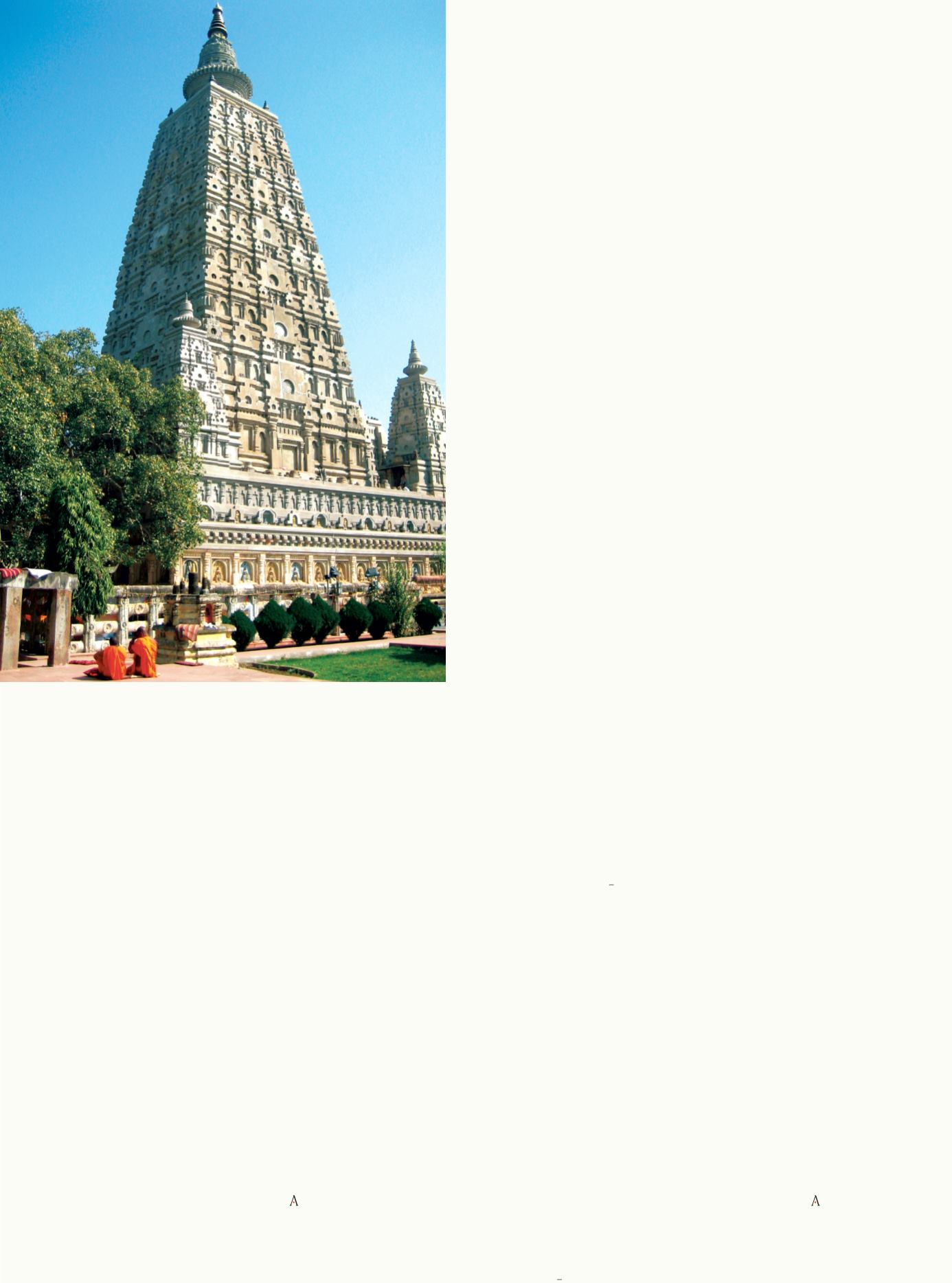
T
he Mahabodhi Temple ("Great Awakening Temple") is a
Buddhist temple in Bodh Gaya, the location where Siddhartha
Gautama, the Buddha, attained enlightenment. Bodh Gaya is
located about 96 km away from Patna, Bihar, India.
According to tradition next to the temple (on the west side) is the
holy Bodhi tree, the place of the enlightenment.
Near this temple, an old monastery is located with the name
of Bodhimanda Vihara. Delcared as Patrimony of Humanity by
the UNESCO in 2002.
In approximately 250 B.C, about 250 years after the Buddha
attained Enlightenment, Buddhist Emperor Asoka visited Bodh Gaya
with the intention of establishing a monastery and shrine.
As part of the temple he built the diamond throne called
the Vajrasana, attempting to mark the exact spot of the
Buddha's enlightenment.
Emperor Asoka is considered the founder of the Mahabodhi Tem-
ple, which dates from the 5th–6th century. It is one of the earliest
Buddhist temples built entirely in brick that is still standing in India,
from the late Gupta period.
Mahabodhi Temple is constructed of brick and is one of the oldest
brick structures to have survived in eastern India. It is considered to
be a fine example of Indian brickwork, and was highly influential in
the development of later architectural traditions.
Mahabodhi Temple's central tower rises to 55 meters, and was
heavily renovated in the 19th century. This tower is surrounded by
four smaller towers, constructed in the same style.
Mahabodhi Temple is claimed as property of the state government
of Bihar, where the state’s government is responsible for the protec-
tion, management, and monitoring of temple and its properties.
E
l Templo Mahabodhi (Templo del Gran Despertar), es un santuario
budista situado en Bodhgaya, a 96 kilómetros de Patna, estado de
Bihar, en la India. Es en este lugar donde Sidarta Gautama alcanzó
la iluminación, convirtiéndose en Buda.
Según la tradición, junto al templo (del lado oeste) crece la higuera
sagrada de Bodhi, bajo la cual ocurrió la iluminación de Buda.
Próximo a este templo, se encuentra un viejo monasterio llamado
Bodhimanda Vihara, declarado como Patrimonio de la Humanidad por la
UnESco en el año 2002.
cuenta la historia, que entorno al 250 a.c., unos 250 años después
de que Buda obtuviera la iluminación, el emperador budista Asoka visitó
Bodhgaya con la intención de establecer un monasterio y un santuario.
como parte del templo, construyó el trono de diamantes llama-
do el Vajrasana, como un intento de marcar el lugar exacto de la ilu-
minación de Buda.
El emperador Asoka es considerado el fundador del templo de Ma-
habodhi, el cual data de los siglos V y VI, uno de los primeros santuarios
budistas construidos en su totalidad de ladrillo y que siguen en pie, del
periodo llamado Gupta.
El Templo de Mahabodhi está considerado como un fino ejemplo del
trabajo a ladrillo, siendo una de las más antiguas estructuras que aún se
conservan de este tipo en la India, y que influyó en el desarrollo posterior
de la arquitectura religiosa en la región.
La torre central del conjunto de Mahabodhi se eleva hasta los 55 me-
tros de altura, renovado en el siglo XIX. Ésta se encuentra rodeada de cua-
tro torres similares y construidas en el mismo estilo.
Actualmente, el santuario es propiedad del estado de Bihar, donde
el gobierno del estado se hace responsable por la protección, manejo y
monitoreo del templo y sus propiedades.
Templo de
Mahabodhi
El gran despertar de Buda
The Great Awakening of Buddha
Mahabodhi Temple
·amura·
compás int •
compass int
54
Texto /
Text : Roberto Salido
• Foto /
Photo
: creativecommons.org


