·amura·
111
herencia cultural •
culture and heritage
To the Buddhist monastery of Ayanta, with
the splendid mural paintings exhibition. It was
the time when Hinduism, became the foremost
source of inspiration in art and architecture; the
styles Nagara in the north and Dravida in the
south. The Khajuraho temples were built during
the Chandella dynasty that reached its zenith be-
tween 950 and 1050 AD, some constructions still
exist. Islam, dominated in north India in the XII
century. Three Mongol emperors Akbar (1556-
1605), Jahanangir (1605-27) and Shah Jahan
(1627-58) were fosterers of the fine arts. To the
monumental miniatures.
To the Taj Mahal, the mausoleummade of white
marble, that Shah Jahan I built for his wife Mum-
taz Mahal. To Landscape, Mansur. Rajasthan, the
Punjab Hills to the production of the Pahari school
developed in the mountainous states of Punjab,
near the Himalaya, from the XVI to the XIX century.
Until the moment in which, in the XVIII century,
the European influence in India was articulated in
a dominant way.
The sculpture or painting works from far away
Hindu times, comprise this fascination for the
human body related to the cosmos, the sensorial-
sensual atmospheres, the cells are micro-univers-
es and, the universes, cosmic islands. Every part,
is connected by an energy to which corresponds
a movement in its wholeness and without being
equal they comprehend the wholeness, the har-
mony in the middle of its unity and the contradic-
tions between the chaos and the circumstantial
order in time and space.
To encourage our readers in these aesthetic
walkings, I invite you to meet two creators and one
female contemporary writer.
Al monasterio budista de Ayanta, con la es-
pléndida exposición pictórica mural. Fue cuando
el hinduismo, se transformó en la fuente princi-
pal de inspiración en el arte y la arquitectura, los
estilos Nagara en el norte y Dravida en el sur. Los
templos de Khajuraho fueron construidos durante
la dinastía Chandella que alcanzó su apogeo en-
tre el 950 y el 1050 d.C.; existen todavía algunas
edificaciones. El Islam, dominó el norte de la India
en el siglo XII .Tres emperadores mongoles, Akbar
(1556-1605), Jahanangir (1605-27) y Shah Jahan
(1627-58) fueron promotores de las bellas artes. A
las miniaturas monumentales.
Al Taj Mahal, el mausoleo de mármol blanco,
que Saha Jahan construyó a su esposa Mumtaz
Mahal. A Landscape, Mansur. El Rajasthán, las co-
linas del Punjab a la producción de escuela paha-
ri que se desarrolló en los estados montañosos
del Punjab, cerca del Himalaya, desde el siglo XVI
y hasta el siglo XIX. Hasta que en el siglo XVIII, la
influencia de Europa en la India artículo un forma
dominante.
La obra escultórica o pictórica desde tiempo
remotos hindúes, comprende esta fascinación so-
bre el cuerpo humano relacionado con el cosmos,
las atmosferas sensoriales-sensuales, las células
son microuniversos y, los universos, islas cósmi-
cas. Cada parte, está conectada por una energía
a la que corresponde un movimiento que en su
conjunto y sin ser iguales abarcan la totalidad, la
armonía en medio de su unidad y contradicciones
entre el caos y el orden circunstancial en el tiempo
y espacio.
Animar a nuestros lectores en estos andares
estéticos, los invito a conocer dos creadores y una
escritora contemporáneos.
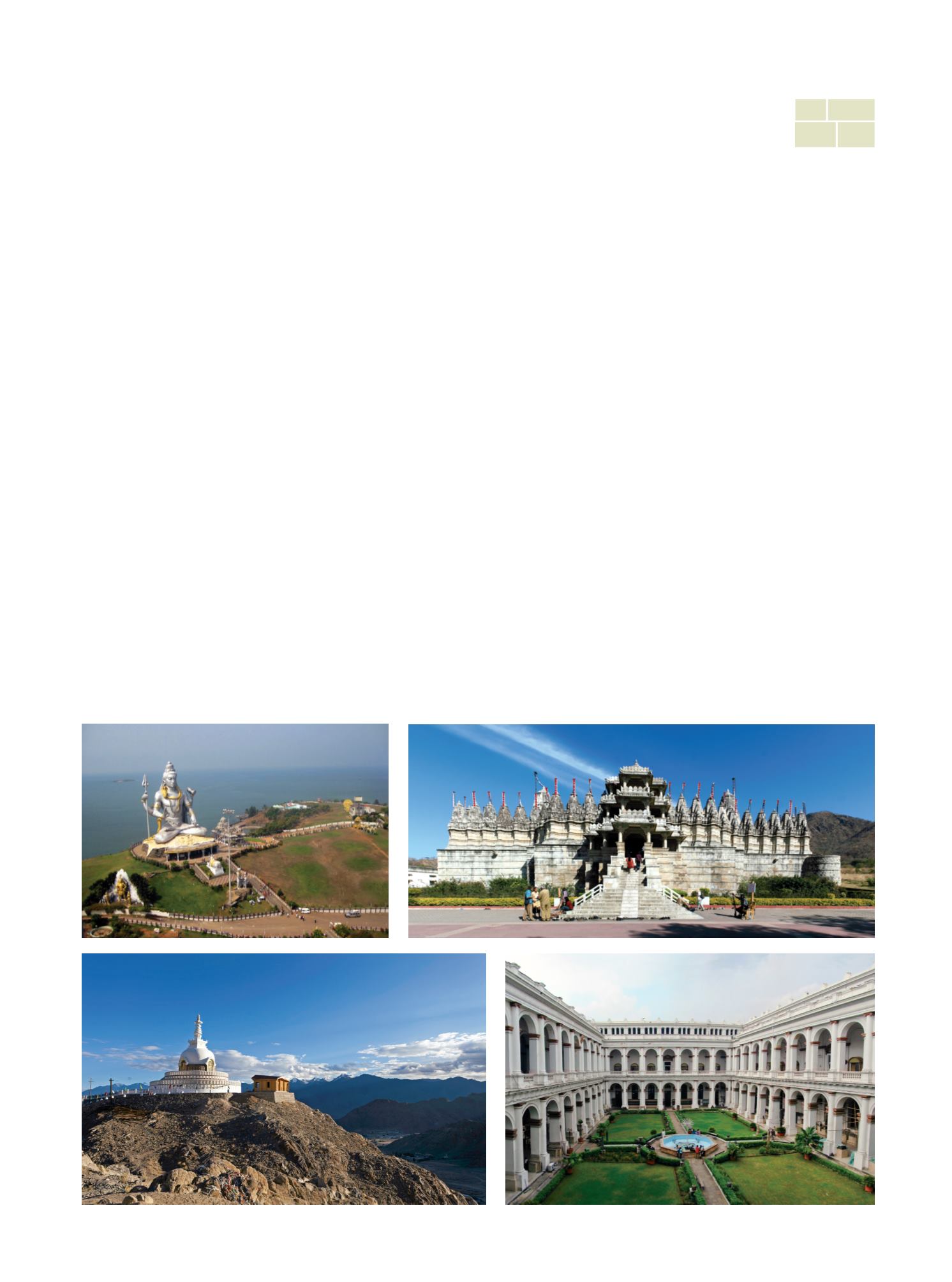
5.EsculturadeShiva,el
diosmas importantedel
hinduismo.Construidaen
el2006enMurudeshwara.
/
SculptureofShiva,the
mostimportantHindu
god.Builtin2006in
Murudeshwara.
6.TemplodeAdinatha
consideradounode los
masbellosde la India
delsigloXV.Dedicado
aAdinathyconstruido
demármolblanco.
/
AdinathaTemple
consideredoneofthe
mostbeautifulinthe
fifteenthcenturyIndia.
DedicatedtoAdinathand
builtofwhitemarble.
7.LaEstupa Indiaes la
representaciónde lomas
antiguodelartebudista.
Estosantiguos lugares
deretiroespiritual,
hoyson importantes
enclavesdeperegrinajey
monumentosfunerarios.
/
IndiaStupaisthe
representationofthe
oldestBuddhistart.
Theseancientplaces
ofretreat,aretoday
importantplacesof
pilgrimageandfuneral
monuments.
8.Museodel Indio,creado
porWilliamJonesen
1784.Enélseencuentran
extrañascoleccionesde
antigüedades,fósiles,
momias,ornamentos
yhermosaspinturas
deMughal./
Indian
Museum,createdby
WilliamJonesin1784.
Ithousescollectionsof
strangeantiques,fossils,
mummies,ornaments
andbeautifulpaintings
ofMughal.
5
6
7
8


