Between 1717 and 1723, he worked as Kapell-
meister and director of chamber music at Coethen, at
the Court of Prince Leopold of Anhalt. During these
years, he cultivated instrumental music, producing
a rich library of Sonatas and Concertos. Meanwhile,
in 1720 ,his wife Maria Barbara died. In 1721, Bach
married a second time. She was Anna Magdalena
Wuelken, who bore him thirteen children.
In 17 23, Bach assumed the post he was to hold
for his remaining years, that of Cantor at the St.
Thomas Church (or Thomasschule) in Leipzig. His
duties included the writing of music for Leipzig’s
leading churches and directing it, playing the organ
teaching a class of boys in Latin and music. Though
his regimen was severe and exacting, though he
was continually at odds with his employers, and
though he was compelled to live in dark and unsan-
itary quarters, his creative output was prodigious.
It was for these church services at Leipzig that
Bach wrote many of his most important Cantatas
together with the Pasion According to St. Matthew
and the B minor Mass. Not even partial paralysis
or blindness could arrest his creativity. In his last
year, Bach completed The Art of the Fugue and the
choral prelude, Vor deinen Thron Just before his
death, sight returned briefly, enabling him to revise
and copy out the parts of The Art of the Fugue. He
died in Leipzig on luly 28 1750 and was buried in an
unidentified grave in the churchyard of St. John’s
Church. His coffin was finally recovered in 1894 and
reburied within the church.
Entre 1717 y 1723, fue Kapellmeister y director de
música de cámara en Coethen, en la Corte del Príncipe
Leopoldo de Anhalt. Durante estos años compone mú-
sica instrumental, produciendo legado importante de
Sonatas y Conciertos. Mientras tanto, en 1720, muere
su esposa Maria Barbara. En 1721, se casó por segun-
da ocasión. Ella fue Anna Magdalena Wuelken, con la
que tuvo 13 hijos.
En 1723, Bach tomó el puesto que ocuparía por
el resto de su vida, el de Cantor de la Iglesia de Santo
Tomás (o Thomasschule) en Leipzig. Entre sus obli-
gaciones estaban la composición de música para las
iglesias principales de Leipzig, dirigirlas, tocar del
órgano, impartir clases a niños en latín y afirmar-
los en la música. Aunque este régimen era severo
y exigente, ya que estaba siempre en conflicto con
sus jefes y aunque estaba obligado a vivir en un lu-
gar obscuro y poco sanitario, su vena creativa fue
prodigiosa. Fue en estos servicios religiosos en Lei-
pzig que Bach compuso la mayoría de sus Cantatas,
además de La Pasión Según San Mateo y la Misa en
si Menor. Ni una parálisis parcial, ni la ceguera pu-
dieron frenar su creatividad. En su último año, Bach
terminó El Arte de la Fuga y el preludio coral, Vor
deinen Thron. Justamente antes de su muerte, re-
cuperó la vista brevemente, permitiéndole revisar
y copiar las partes del Arte de la Fuga. Murió en Lei-
pzig el 28 de julio de 1750 y fue enterrado en la fosa
común del panteón de la Iglesia de San Juan. Sus
restos fueron exhumados en 1894 y depositados
dentro de la iglesia.
Meet the music • Música
·amura·
105
3
4
5
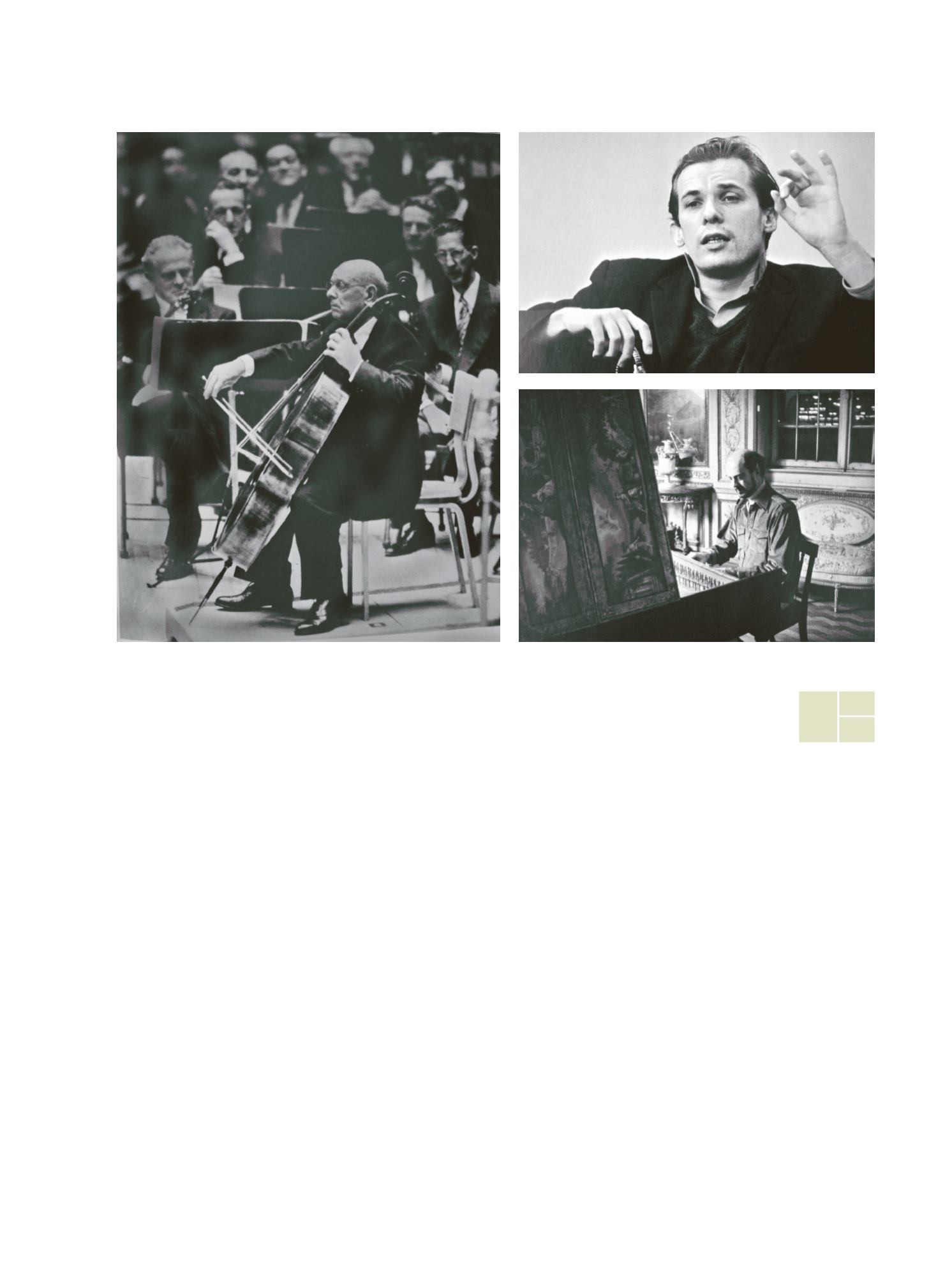
3. Pablo Casals
(1876-1973). Chelista
español. Uno de
losmúsicosmás
admirados del S. XIX,
su nombre: sinónimo
del chelo /
Pablo
Casals(1876-1973)
-Spanishchelist.One
ofthemostidolized
musiciansofthe
twentiethcentury,
hisnamewas
synonymouswith
thecello.
4. Glenn Gould.
/
GlennGould.
5. Alan Curtis /
AlanCurtis.


