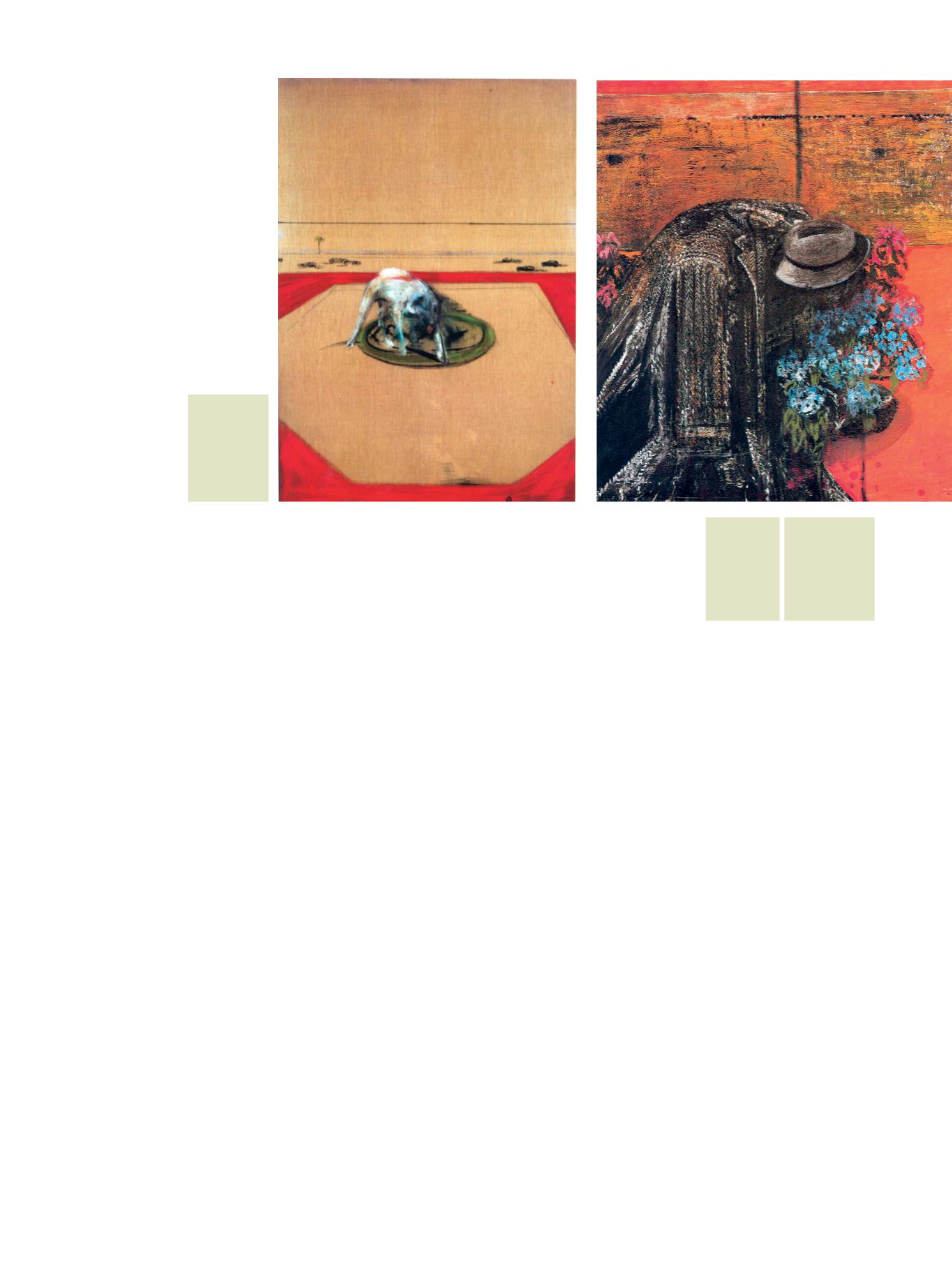
T
he exhibition “Francis Bacon”, that now is
showing in the Tate Britain of London, is
the first retrospective exhibition of the art-
ist that is presented in the United Kingdom since
1985. In the framework of the centenary of Fran-
cis Bacon (1909-1992), the show gathers around 60
works that include a representative work of each
period of its pictorial production. But more than a
chronological approach, the guardianship of the
exhibition set out thematic nucleus and concerns
that ruled the work of Bacon along his life.
After its closure in January of 2009, the exhibi-
tion will be presented afterwards in the National
Museumdel Prado inMadrid (February–April, 2009)
and then in the MetropolitanMuseumof Art of New
York (May–August, 2009).
Thework of Francis Bacon stirs, revives, incites.
His paintings are endured with entire submission
as the tragic is suffered. Bacon wear us out, it ig-
nite us, exceed us but first and foremost makes us
realize that we are alive. In his work, he inhabits
a basic violence, the violence of what is real that
overflows the representation itself. Bacon, with a
scalpel, exerts an incision to the reality. Exhaust-
ed, to this, there is one thing left but its entrails,
which to we always resist watching over and dis-
guise as we constantly do.
What is for real is that which had to undo to
build the reality, that whichhad to be covered, ardu-
ously covered to be able to live. Bacon is one of the
few painters that is able to grab –just as it is with
a claw- the instant in which the representation es-
capes the reality to show us its phase of the real.
That is the moment in which the life dissolves; it is
L
a exposición “Francis Bacon”, que actual-
mente se presenta en la Tate Britain de Lon-
dres, es la primera exposición retrospectiva
del artista que se presenta en el Reino Unido desde
1985. En el marco del centenario de Francis Bacon
(1909-1992), la muestra reúne cerca de 60 trabajos
que incluyen obra representativa de cada periodo de
su producción pictórica. Pero más que un enfoque
cronológico, la curaduría de la exposición plantea
núcleos temáticos e inquietudes que rigieron la obra
de Bacon a lo largo de su vida.
Tras su clausura en enero del 2009, la exposición
se presentará posteriormente en el Museo Nacio-
nal del Prado en Madrid (febrero–abril, 2009) y a
continuación en el Metropolitan Museum of Art de
Nueva York (mayo–agosto, 2009).
La pintura de Francis Bacon inflama, aviva, impele.
Sus cuadros se padecen con entera sumisión como se
padece lo trágico. Bacon nos agota, nos inflama, nos
rebasa pero ante todo nos hace dar cuenta de que
estamos vivos. En su trabajo habita una violencia
fundamental, la violencia de lo real que desborda la
representación misma. Bacon, con escalpelo, ejerce
una cisura a la realidad. Desguanzada, a ésta, no le
quedan más que sus entrañas, aquello a lo que siem-
pre invariablemente nos hemos de resistir velando y
revistiendo como hacemos.
Lo real es aquello de lo que hubo que deshacerse
para construir la realidad, aquello que hubo que cu-
brir, tapar penosamente para poder vivir. Bacon es de
los pocos pintores que logra agarrar -tal cual como
con una garra-, el instante en que la representación
escapa a la realidad para mostrarnos su fase de lo
real. Es ese el momento en el que la vida se disuelve,
1
2
1)
Figure Study I
1945-1946
Oil on canvas
123 x 105.5 cm
Scottish National Gallery of Modern Art,
Edinburgh. Accept by Her Majesty’s Gov-
ernment in lieu of Inheritance tax on the
Estate of Gabrielle Keiller and allocated to
the Scottish National Gallery of Modern
Art in 1998
© Estate of Francis Bacon. All Rights
Reserved, DACS 2008
ID_003
X18640
2)
Study of a Dog
1952
© Tate
Oil on canvas
218 x 158 x 11 cm
(Portadilla)
Lying Figure
1969
Fondation Beyeler,
Riehen/Basel
© Estate of Francis
Bacon. All Rights Re-
served, DACS 2007
Los conquistadores • the conquerors


