·amura·
123
Meet the music • Música
The composer patriotically interrupted his career
to drive an ambulance during the First World War.
He went in, a high spirited, adventurous young
man. He came back, after a few months, his hair
streaked with grey, his outlook sobered and his
nerves in such a state that he was obliged to take
a rest-cure.
The Concerto for the Left Hand
was ample proof
of the artistic capacity of Ravel. He desired to pay
tribute to the famnous austrian pianist Paul Witt-
genstein, that had lost his right arm in combat. All
pointed towards tragedy because apparently the
career of this pianist was finished. Nevertheless,
Wittgenstein proved to be brave and would not
accept defeat. He addressed several composers
requesting works for the left hand only. We must
add that Wittgenstein was a fine pianist, well
known in concert circles.
These facts impressed Ravel who decided to
accept the challenge. He had a singular person-
ality liking unusual situations and experimenta-
tion. At that moment, he was under the influence
of jazz and the
Concerto
has touches that come
from his visits to Harlem and Greenwich Village in
New York.
Although the
Concerto
has only one movement,
three sections are clearly etched out and easy to
identify. The orchestra prepares the ground within a
certain mystery and a true musical wave of sound,
then the piano enters with enormous force and
starts its dialogue with the orchestra. After an
An-
dante
, where the piano flirts with the english horn, a
moment of catching our breath arrives followed by a
tarantela
that opens the final
cadenza
, which shows
no mercy for the soloist. The work ends brilliantly.
El compositor interrumpió su carrera al ser llamado a
lasfilasen laPrimeraGuerraMundial. Fue chofer deambu-
lancia, no aviador, como habría deseado, pero su entrega
fue total. Aun en los momentos más difíciles realizaba su
tarea conentusiasmo.Mesesdespués regresóaParís. Vol-
vía con el pelo cano, una total actitud de rechazo y con los
nervios en tal estado de alteración, que debió ser interna-
do en un hospital.
El Concierto para la mano izquierda
fue
una auténtica prueba de la capacidad artística de Ravel.
Deseaba ofrecer un homenaje al famoso pianista austria-
co Paul Wittgenstein, que había perdido el brazo derecho
combatiendo. El caso apuntaba hacia la tragedia, pues la
carrera del pianista aparentemente había finalizado. Witt-
genstein mostró sin embargo un valor increíble. No po-
día aceptar la derrota. Se dirigió a varios compositores y
les pidió que escribieran música exclusivamente para su
mano izquierda. Cabe decir que Wittgenstein era un ver-
dadero virtuoso del piano, ampliamente reconocido.
El hecho conmovió a Ravel, cedió además a la atrac-
ción de aceptar un difícil juego cerebral. Ravel tenía una
personalidad singular, gustaba de lo poco usual y de la
experimentación. Se hallaba en aquel momento bajo la
influenciadel jazz, así que -aunquenodemaneraexpresa-
hay toques en el concierto que provienen de sus visitas a
Harlemy el Greenwich Village, en Nueva York.
Aunque el concierto tiene un solo movimiento, se
perciben las tres secciones claras y fáciles de identifi-
car. La orquesta prepara el terreno con cierto miste-
rio y una auténtica oleada musical, entra entonces el
piano, con fuerza enorme, y empieza su diálogo con la
orquesta. Tras un Andante, en el cual el piano coque-
tea con el corno inglés, sobreviene un momento de
respiro y se entra de lleno en una tarantela que abre la
cadenza final, francamente inmisericorde para el so-
lista. La obra termina con gran brillantez.
2. Dafnis y Chloe
(escena), Conjunto
del Ballet Clásico.
Conductor Yuri
Zhdanov, Moscú. /
Daphnis et Chloe
(scene), Classic
Ballet Ensemble. Yuri
Zhdanov, Director,
Moscow.
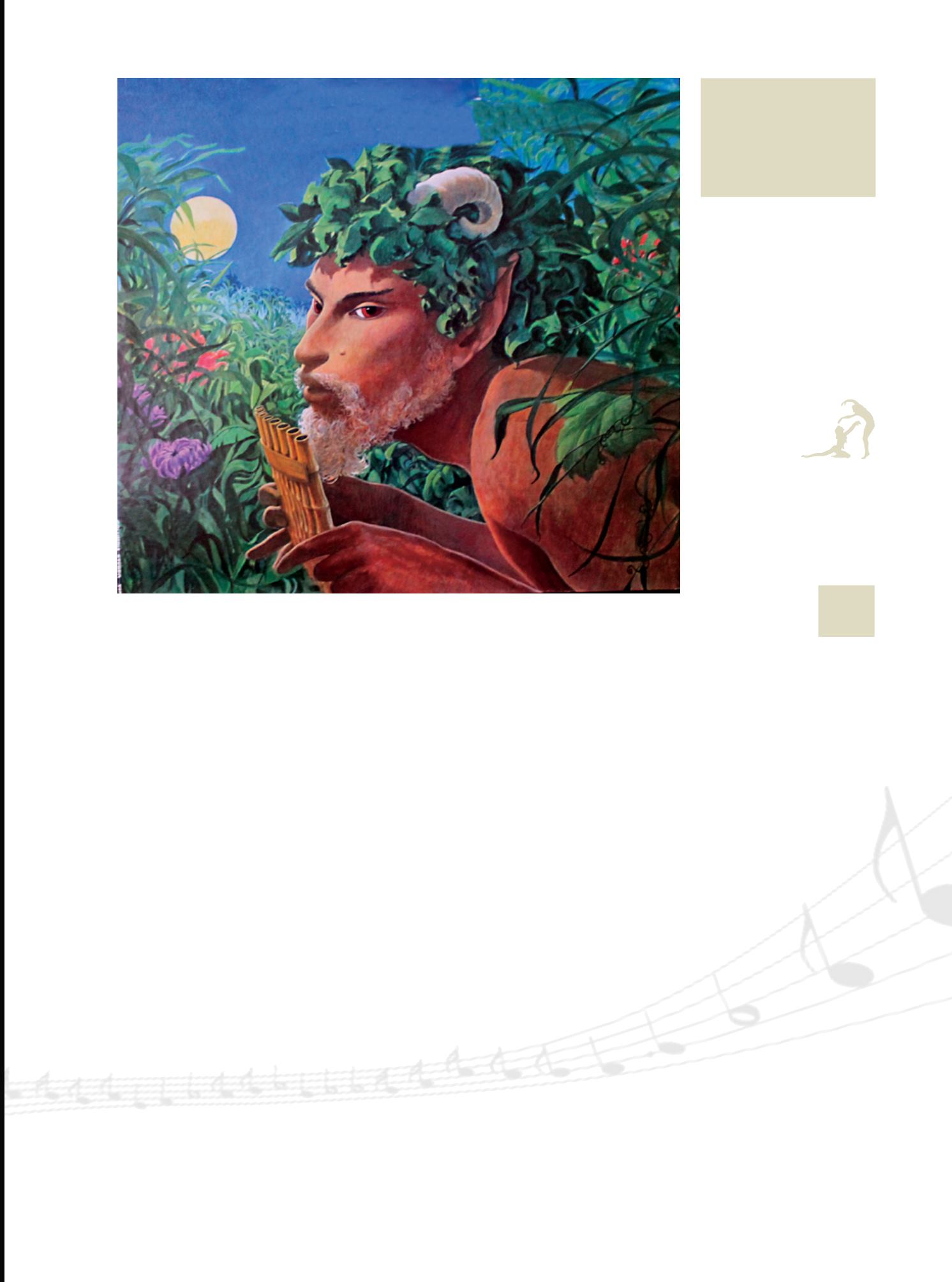
3.Dafnis y Chloe
(dios Pan).1975
orquesta
filarmónica de
Nueva York Pierre
Boulez. /
Daphnis et Chloe
Ballet (Pan).
1975 New York
philarmonic
orchestra
Pierre Boulez,
Conductor.
3
1. Maurice Ravel
(1875-1937)
Compositor francés.
Autor de dos óperas
notables, ballets y
canciones. Su Bolero
es una de las obras
más populares del
género. /
French composer.
Composed two
notable operas,
ballets and songs.
His Bolero is one of
the most famous
Works of the
repertoire.
1
2


