·amura·
131
especies •
species
Cuando el imperio se desintegró, algunos de los
pueblos establecidos en la Península Ibérica, tenían
caballos oriundos de lo que ahora es Alemania. Para
los siglos de la invasión árabe en España (VIII-XV dC),
el caballo ibérico, en ciertos casos, ya mostraba cruza-
miento con otros de origen árabe. En el caso particular
de lo que hoy es Portugal, para el siglo XII, el caballo
fue utilizado también para acompañar al guerrero en
la batalla.
Gastón Santos Pue, criador e introductor en
México de este tipo de equino, cuenta que duran-
te la época Colonial llegaron a la Nueva España
sólo caballos españoles, sobre todo extremeños
y andaluces.
En el siglo XVI, por algunas décadas, España y Por-
tugal formaron un solo reino bajo Felipe II, dado que
no hubo descendencia del rey de Portugal Sebastián I,
muerto en la batalla de Alcazarquivir en Marruecos. Es
durante esos años, comenta Gastón Santos, cuando
llegaron a México caballos portugueses.
When the empire disintegrated, some of the
settled villages in the Iberian Peninsula had native-
born horses, to what is now Germany. For the cen-
turies of the Arab invasion in Spain (8 th -15th c.
AD) the Iberian horse in some cases it had already
showed cross-breeding with others of Arab origin.
In the particular case of what today is Portugal, to
the 12th century the horse was also used to accom-
pany the warrior in battle.
Gaston Santos Pue, breeder, and introducer in
Mexico of this type of equine, tells that during the
Colonial era came to New Spain only Spanish hors-
es, especially from the province of Extremadura
and andalusian horses.
In the 16th century, for decades Spain and Por-
tugal formed a single kingdom under Philip II since
there were no descendants of the king of Portugal
Sebastian I, who died in the battle of Alcazarquivir, in
Morocco. It was during those years, mentions Gaston
Santos, when Portuguese horses came toMexico.
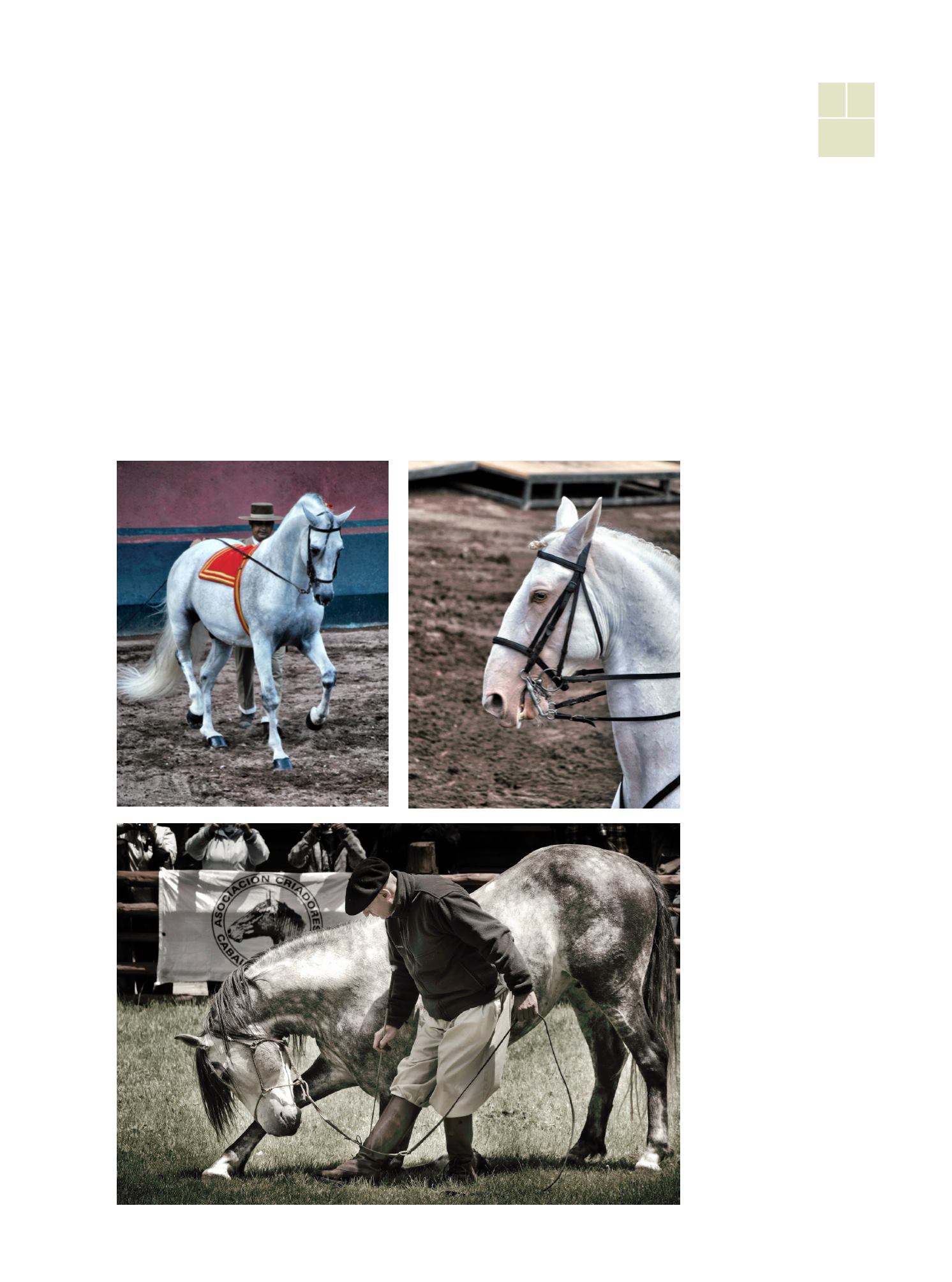
3. El Lusitano tiene
una tendencia
natural a la
concentración. /
The
Lusitanian has a
natural tendency to
concentrate.
4. La altura
promedio del
Lusitano es de 160
cm. /
The average
height is 160
Lusitanian
5. El Lusitano se
distingue por su
inteligencia. /
The
Lusitanian is
distinguished by
his intelligence.
3
5
4


