·amura·
92
planeta azul •
blue planet
Unionbuilds strength.
Penguins get together in big noisy groups to pair and
they always return to exactly the same spot their an-
cestors went to. They nest in burrows or rock cavities,
or open spaces. There’s one scene that will always
amaze us: After laying an egg the mother holds it in
her short legs so it won’t touch the ice, and covers it
with a fold of her plumage.
When the mother has to travel to the sea and get
something to eat, in a highly careful maneuver, de-
mandinggreat coordination she passes the egg to the
malewho also takes it withhis legs and keeps it there
week after week for as long as the dark and frozen
Antarctic night lasts. Always protecting it from cold
andwarming his precious product.
When sunrise and for reason mama has not re-
turned, the frail father abandons eggor chick -if it has
already broken the shell- so he can go to get some-
thing to eat and not die fromstarvation.
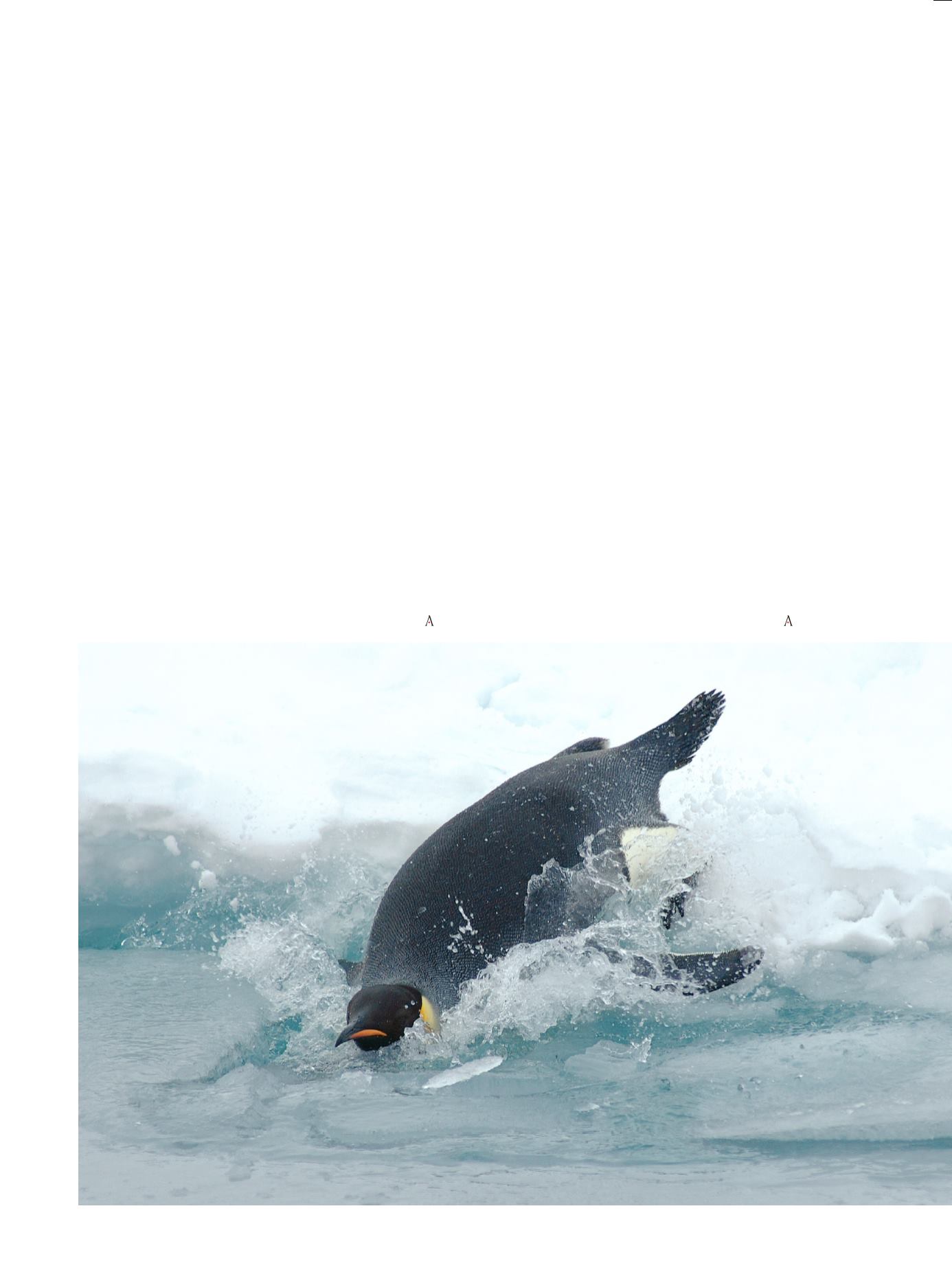
Penguins Emperor and King are those who take
care of the egg and chick. They pair and they brood
only one at a time. During the Antarctic night pen-
guins colonies form a great motionless and compact
mass that blocks theflowof the intense freezingwind
andheatingone another. This avoids their death from
deep freezing.
When the couple is back togetherwith their chick,
there are timeswhenbaby is left alonewhile its elders
go away in search of food. In those cases pigeons get
together in “childcare” bunches toprotect themselves
fromtheir predators. Once they grow their first plum-
age, the young, follow the adults and take a dive into
the ocean to find their own nourishment.
La unión hace la fuerza
Los pingüinos, en grandes y ruidosos grupos, se re-
únen para aparearse y siempre vuelven a los mismos
sitios que sus antecesores. Anidan en madrigueras o
huecos en las rocas, aunque también lo hacen a cielo
abierto. Una escena no deja de maravillarnos: luego
de poner un huevo la madre lo sostiene con sus cor-
tas patas para que no toque el hielo, y lo cubre con un
pliegue de su plumaje.
Y cuando esta hembra ha de viajar al mar para co-
mer, en una maniobra de sumo cuidado que exige gran
coordinación, le pasa el huevo al macho y éste lo toma
también con sus patas y lo mantiene ahí semana tras
semana, durante la oscura, larga y helada noche an-
tártica, cuidando del frío y dando calor a su preciado
producto.
Si cuando vuelve el sol la madre no ha vuelto por
alguna razón, el debilitado padre abandona el huevo o
a la cría -si ya rompió el cascarón- para ir también en
busca de alimento y no morir de inanición.
Los pingüinos Emperador y Rey son los que así
cuidan el huevo y al polluelo. Empollan sólo un hue-
vo por vez. Durante la noche antártica las colonias de
pingüinos forman una gran masa inmóvil, apretada,
cerrándole el paso al intenso viento y dándose calor
unos a otros. Esto les evita la muerte por congelación.
Cuando la pareja vuelve a estar junta con la cría,
hay ocasiones en las que ésta se queda sola mientras
sus mayores van en busca de alimento. En estos ca-
sos, los pichones se juntan en “guarderías” para cui-
darse de sus depredadores. Una vez que tienen su pri-
mer plumaje, ya jóvenes, siguen a los adultos al mar
para procurarse su alimento.


