



 114 / 156

·amura·
112
planeta azul •
blue planet
El océano Atlántico se comunica con el Caribe a través del
Paso de Anegada entre las Antillas Menores y las Islas Vír-
genes, yel Pasode losVientos localizadoentreCubayHai-
tí, primordial ruta entre los Estados Unidos y el Canal de
Panamá. El canal de Yucatán lo une con el Golfo deMéxico
entre la Península de Yucatán y la isla de Cuba. La tem-
peratura del agua se mantiene entre 21 y 32,2 °C al año.
El Caribe vive anualmente una temporada de huracanes
entre los meses de junio a diciembre. Sin embargo, es po-
sible prever la trayectoria de estos colosos atmosféricos,
que tienen un lado benéfico al contribuir a mitigar el duro
clima del norte de Europa.
Se estima que en el Caribe coexisten 13.000 especies
de plantas, muchas de ellas endémicas; 450 de peces, 600
de aves, 500 de reptiles, 170 de anfibios, 90 de mamífe-
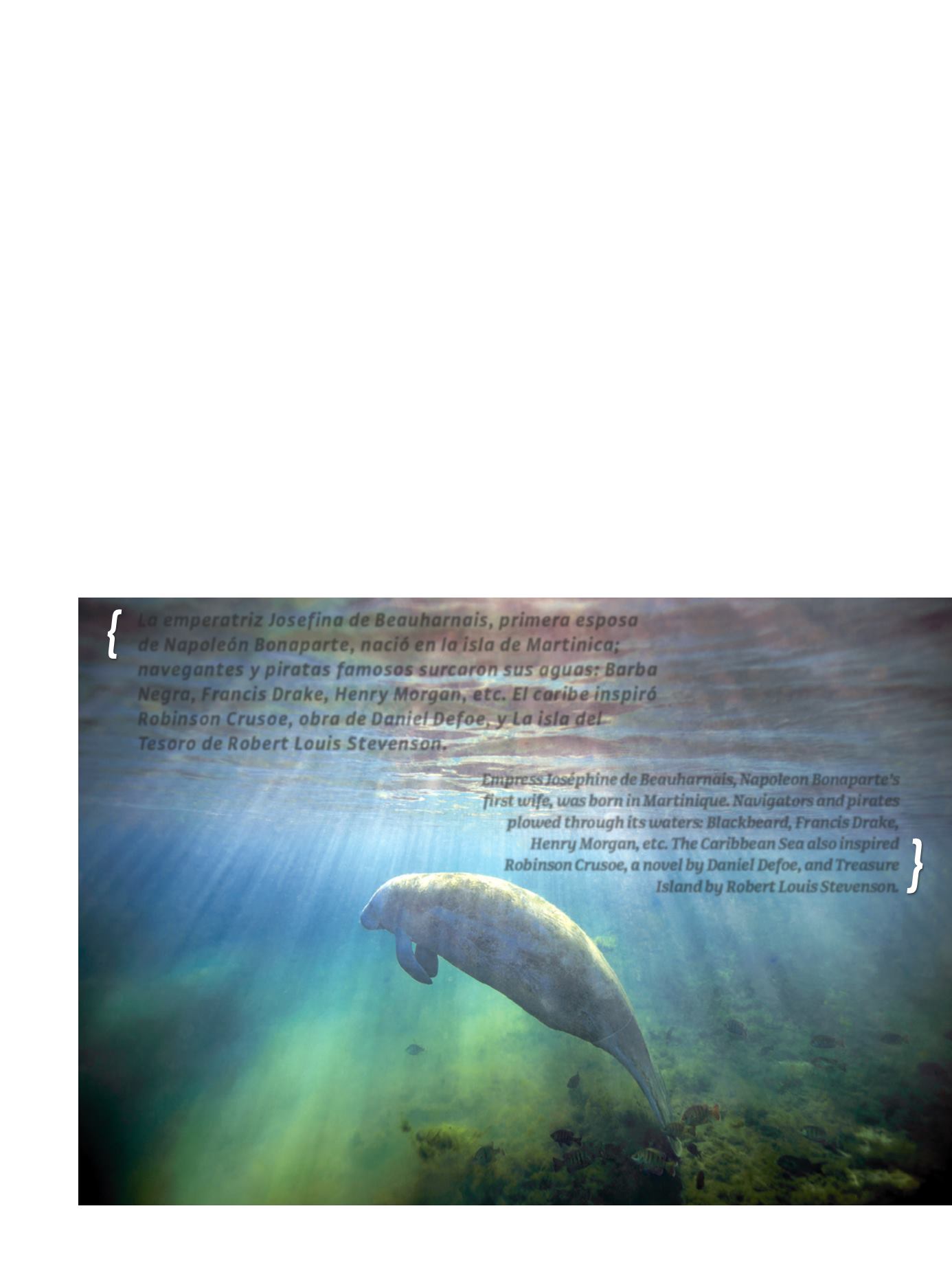
ros, como el Manatí (en peligro de extinción), el Almiquí
(endémico de las Antillas) y la ballena jorobada entre otras
especiesmigratorias. Es el hogar de animales asombrosos
como pez vela, mantarraya gigante, raya águila, tiburones
ballena y toro. Los arrecifes de coral caribeños represen-
tan el 7% del área total a nivel mundial, y constituyen un
complejo hábitat que proporciona un refugio ideal donde
viven muchas criaturas: esponjas, peces, medusas, crus-
táceos, tortugas y moluscos; las Corrientes están carga-
das de plancton, que es la base de la cadena alimenticia
enelmar, yquealimentadesdediminutos animales, entre
ellos a los pólipos de coral, hasta gigantes como el tiburón
ballena. Bajo el agua se encuentra una espectacular suce-
The Atlantic Ocean is connected to the Caribbean
through the Anegada Passage, between the Lesser An-
tilles and the Virgin Islands, as well as the Windward
Passage, located between Cuba and Haiti—a crucial
routebetweentheUnitedStatesand thePanamaCanal.
The Yucatán Channel links the Caribbean to the Gulf
of Mexico between the Yucatan peninsula and Cuba.
Water temperature averages between 21 and 32.2 C°
yearly, and hurricane season in the Caribbean takes
place fromJune to December. Fortunately, it is possible
to predict the trajectory of these atmospheric giants,
which canbe beneficial since they contribute to dimin-
ish theharshclimates of northernEurope.
It is estimated that 13,000 plant species coexist in
the Caribbean, many of them endemic to this region;
450 fish, 600 birds, 500 reptiles, 170 amphibians, 90
mammals like the manatee (endangered), solenodons
(endemic to the Antilles) and the humpback whale
among other migratory species. It is home to amazing
creatures like the sailfish, the giant oceanic manta ray,
theeagle ray, thewhale shark, and the sand tiger shark.
The Caribbean coral reefsmake up around 7%of the to-
tal reefs intheplanet, andcreatea complexhabitat that
servesasahome fornumerous creatures: sponges, fish,
jellyfish, crustacean, turtles, andmollusks. Currents in
these areas are teeming with plankton—the basis of
themarinefoodweb;itfeedsfromtinyanimals,suchas
coralpolyps,togiantslikethewhaleshark.Underwater,
La emperatriz Josefina de Beauharnais, primera esposa
de Napoleón Bonaparte, nació en la isla de Martinica;
navegantes y piratas famosos surcaron sus aguas: Barba
Negra, Francis Drake, Henry Morgan, etc. El caribe inspiró
Robinson Crusoe, obra de Daniel Defoe, y La isla del
Tesoro de Robert Louis Stevenson.
Empress JoséphinedeBeauharnais, NapoleonBonaparte’s
firstwife,was born inMartinique. Navigators andpirates
plowed through itswaters: Blackbeard, FrancisDrake,
HenryMorgan, etc. The CaribbeanSeaalso inspired
RobinsonCrusoe, anovel byDaniel Defoe, andTreasure
IslandbyRobert Louis Stevenson.
CARIBBEAN
DIVERSITY
DIVERSIDAD
CARIBE