·amura·
94
especies •
species
E
l jaguar o yaguar (Phantera onca) toma su nom-
bre de un vocablo guaraní que tiene dos posibles
significados: “El que mata de un salto” o “Cuerpo
de perro”. Es un mamífero carnívoro que pertenece a la
familia Felidae, siendo el felino de mayor tamaño que
encontramos en el Continente Americano. Llega a me-
dir más de dos metros y medio de longitud, aunque el
tamaño promedio de su cuerpo oscila entre 1.80 me-
tros de largomás la cola, que puedemedir otros 70 cen-
tímetros. Pesa entre 130 y 150 kilogramos y por lo ge-
neral losmachos sonmás corpulentos que las hembras.
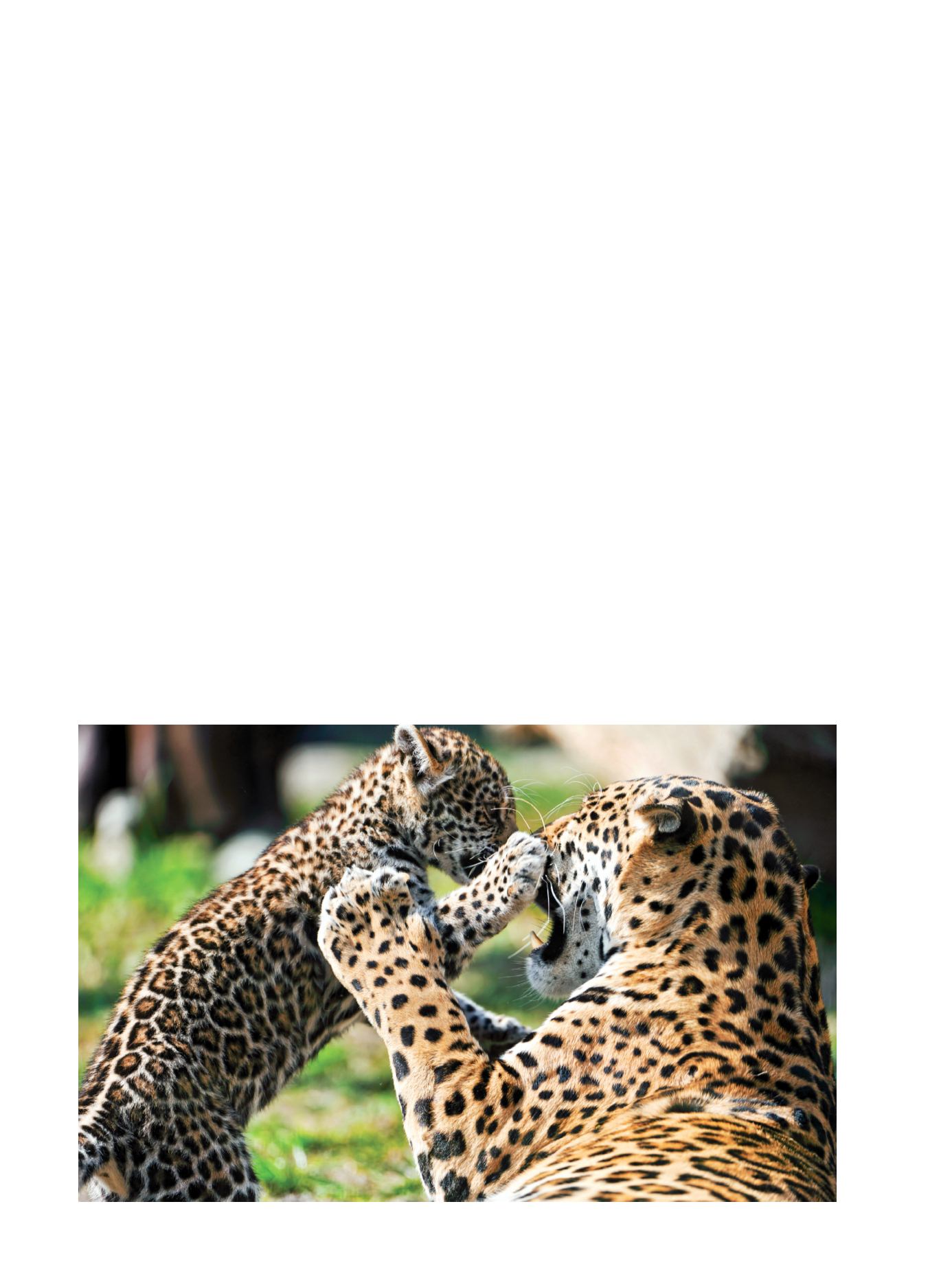
Tiene manchas negras por todo el cuerpo en for-
ma de anillos o rosetas y, a diferencia del leopardo, las
rosetas en el jaguar encierran otra pequeña mancha
y tienden a concentrarse a lo largo de la boca y otra
en la parte posterior de sus orejas. La hembra siempre
es más clara y presenta menos manchas anulares en
cuello y espalda. Es frecuente encontrar melanismo
(jaguares negros) y algunos casos de albinismo.
Alguna vez pobló densamente desde el sur del
estado de Arizona hasta el extremo polar de Argen-
tina; esta área se ha reducido considerablemente. En
la actualidad el Jaguar Joya vive en una rara mezcla
de hábitats: al sur de Arizona y noroeste de México,
donde quedan muy pocos ejemplares; en una delga-
da franja de la costa mexicana del Pacífico, en la sel-
va lacandona y la península yucateca, y en una zona
mucho mayor que ocupa la costa del Caribe hasta
Sud América, su territorio abarca toda la amazonia
y más: de la costa atlántica hasta los andes, y de Co-
lombia hasta el norte de Argentina. Su población ya
es muy escasa, por lo cual se le clasifica como especie
en riesgo de extinción. La mayor densidad de ejem-
plares se halla en la selva del Amazonas, igual que
algunos de sus parientes cercanos , como el puma.
Es un animal territorial y solitario que vive en
pareja sólo durante la época de celo, la que dura de
T
he Jaguar or Yaguar (Phantera Onca) takes
its name from a Guarani voice with two
possible meanings: “He who kills i one
leap” or “Dog body.” A carnivorous mammal be-
longing to the Felidae family, it is the largest fe-
line found in the Americas. It can surpass 8 feet
in length, although the average size of the body
ranges from 6 feet long plus tail, which can mea-
sure another 2 feet. It weighs between 130 and
150 pounds and males generally are more robust
than females.
It has black spots all over its body in the form of
rings or rosettes, andunlike the leopard, jaguar rings
enclose a small spot and tend to concentrate around
the mouth and in the back of its ears. The female
is always clearer and has fewer ring spots on neck
and back. The leather is spotted with black rings all
over. Unlike leopards, jaguars’ ring stains surround
a small spot present in higher density around the
mouth and back of the ears. Female is lighter in color
and lhas fewer spots on neck and back. Melanism –
black jaguars- is frequent as well as albinism.
The only habitat unconquered by jaguars is the
highmountain.
Their favorite place is the rainforest, especially
near water, although they can be found in almost
every kind of places such as North and South forests,
riparian areas, grassy plains, dry, thorny scrub, des-
erts and savannahs. The only environment that re-
mains unconquered by the jaguar is the highmoun-
tain, where the cougar reigns for it is better adapted.
At some point in the past it densely populated
a vast area that goes from southern Arizona to the
polar extreme of Argentina. This territory has di-
minished considerably. The Jewel Jaguar currently
lives in a strange mixture of habitats: south Arizona
and north eastern Mexico, where few specimens re-


