·amura·
132
Meet the music • Música
When Vaughan-Willims discoivered christmas
carols, madrigals, folksongs and dances from the
Tudor period he absorbed them into his multiple
musical expresions. He applied forcé and inspira-
tion. This is all reflected in the great legacy he left
us. In 1897nhe married Adelibne Fisher and lived
in germany studying compositionwith Max Bruch.
Upon returning to England he applied his alents
to composition under the influence of Johannes
Brahms. His three Niorfolk Rhapsodies , of which
only the fist survived exhibits his special idiom. Lat-
er he studied in Paris with Ravel and improved his
technical equipment. . Little by Little he creates for-
midable muscalo expresions like On Wenlock Edge,
his First Symphony,called the sea Sympopnhy, the
fantasy on a Theme of homas Tallis and becomes the
most important British composer of his time.
DuringWorldWarI,Vaughan-Williamsservedforst
in the Territorial Army Military Corps as a hospital or-
derly inFrance andMacedonia, and thenat the front as
an Arillery lieutenant. When the war ended he joined
the Faculkty of the Royal College of Music, where he
taught compositionup to the timeofhisdeath in1958.
He died at his home in London with his second wife at
his side, for he had been awidowand on septiembre 19
his asheswere taken toWestmenister Abbey.
Cuando Vaughan-Williams descubrió cantos navi-
deños, madrigales, canciones folklóricas y danzas del
periodo Tudor, las absorbió y las incorporó a sus múl-
tiples pensamientos musicales. Aplicó fuerza e inspi-
ración. Todo se refleja en el gran legado que nos dejó.
En 1897 se casó con Adeline Fisher y vivió en Alemania
estudiando composición con Max Bruch. Al regresar a
Inglaterra se aplicó a la tarea de la composición bajo
la influencia de Johannes Brahms. Sus tres
Norfolk
Rhapsodies
(Rapsodias de Norfolk), de las cuales sólo
sobrevivió la primera, manifiestan este idioma que
en él es único. Estudió después en París con Ravel y
enriqueció su técnica. Nacen poco a poco expresiones
formidables como
On Wenlock Edge
, su primera sinfo-
nía; la
Sinfonía del mar,
la
Fantasía sobre un tema de
Thomas Tallis
y se coloca como el compositor británico
más importante de su tiempo.
Durante la Primera Guerra Mundial estuvo en el
servicio activo del Ejército Territorial Militar como
asistente en un hospital en el frente. Esto fue en
Francia y Macedonia. Después impartió la cátedra
de composición en el Royal College of Music y con-
tinuó hasta su muerte en 1958. Murió en su casa de
Londres al lado de su segunda esposa, ya era viudo
en agosto de 1958, y el 19 de septiembre fueron en-
terradas sus cenizas en la Abadía de Westminster.
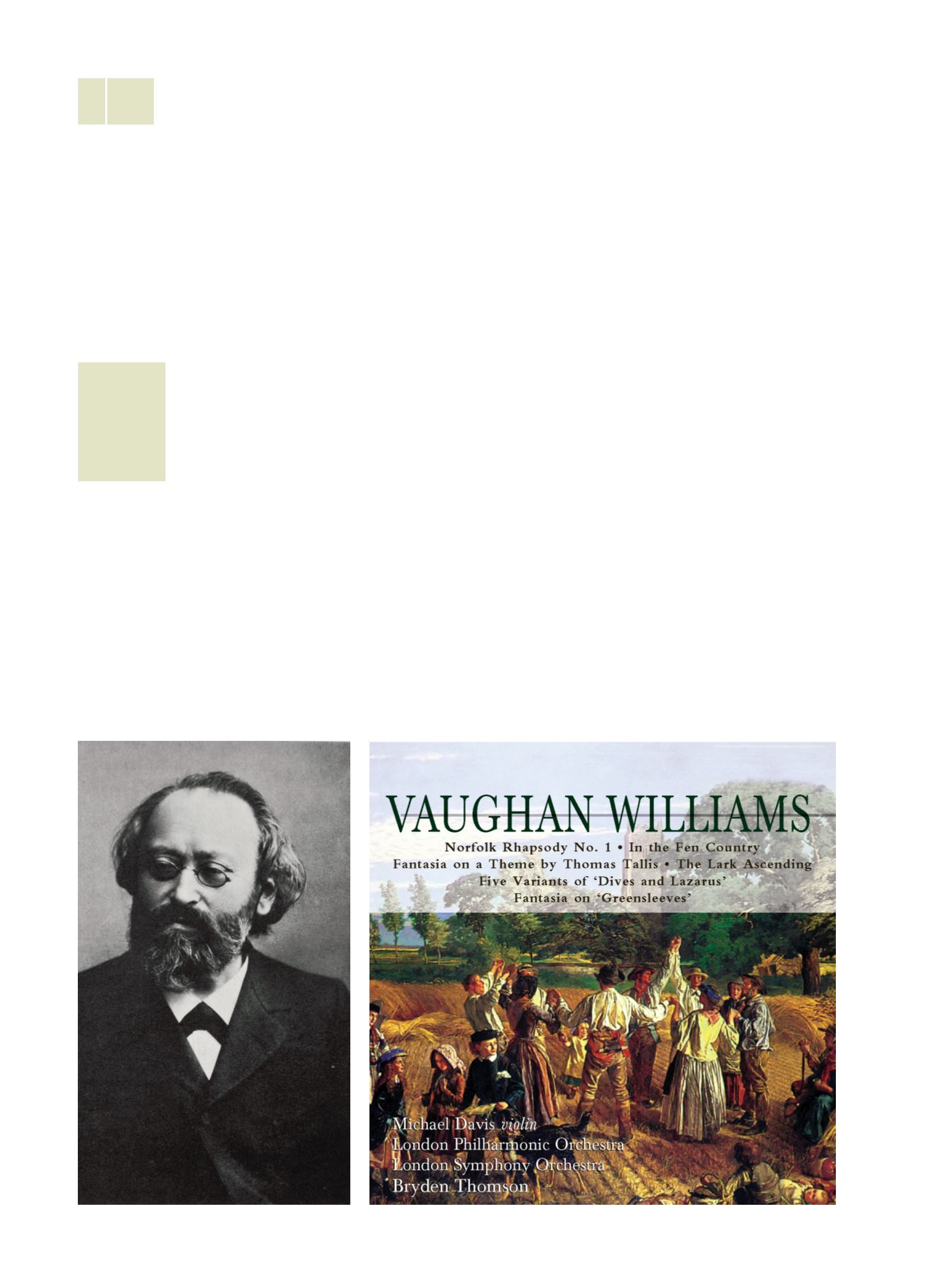
3.MaxBruch(1838-
1920)Compositor
alemán.Famosoporsu
KolNidreiparacelloy
orquestacompuestopara
lacomunidad judíade
Liverpoolen1880,escribió
óperas,unconciertopara
violínmuyfamosoypiezas
corales.
/MaxBruch(1838-
1920)Germancomposer.
Speciallyfamousforhis
KolNidreiforcelloand
orchestracomposedfor
theLiverpoolJewish
communityin1880.He
alsowroteoperas,agreat
violinconcertoandchoral
pieces.
4.NorfolkRhapsodies
/
NorfolkRhapsodies
5.SinfoníaAntartica
-EdwardA.Wilson(1872-
1912)ElTrineoen laGran
Barrera1903(Inspirado
en laexpedicióndeScott
aAntártica1901-1904).
Cortesía Institutode
InvestigacionesPolares
deScott,Cambridge.
Foto:Bibliotecadearte
Bridgeman
/Sinfonia
Antartica-EdwardA.
Wilson(1872-1912)Sledge
haulingontheGreat
Barrier1903(OnScott´
s
expeditiontoAntartica
1901-1904).CourtesyScott
PolarResearchInstitute,
Cambridge.Foto:The
BridgemanArtLibrary.
3 4
5


