31
·amura·
compás int •
compass int
Cutting straight across from the entrance to
Chingoudy Bay with its long beach, we reached the
Chateau d’Antoine D’Abbadie. Built by Eugène Viollet-
le-Duc in 1860, it is of neogothic architecture with a
touch of Oriental passion. Antoine D’Abbadiem, a great
traveler and Ethiopia’s first cartographer, set up an
observatory in this castle of spiked towers that guards
the sea. Surrounded by the Abadía Ecological Reserve, it
is like a ghost emerging from the past.
We followed this coast outlined by surprising cliffs,
where the uneven, inclined layers have formed a strange
scene drawn by the sea. In the meadows the sheep looked
like white spots on the dazzling green and, further along,
the waves raised a humid, clear fog. We passed the Sainte
Barbe point to enter the great Saint Jean-de-Luz Bay,
guarded to the south by the small town of Socoa, dominat-
ed by its fort, and, to the north, by a cliff. A beautiful beach
borders the city, a magnet that attracts people in the sum-
mer, and the Nivelle River flows in to the bay. In this river,
that separates Ciboure and Saint Jean-de-Luz, we found the
marina and fishing port, where boats are reflected in the
water lying at the foot of the church’s tower.
Romantic Ciboure, with its beautiful Saint Vincent
church (16 th century), famed Bourdagain Tower (14 th
century) and ancient fountain (17 th century), is the city
where Maurice Ravel was born. Its rival and companion,
Saint Jean-de-Luz, with its typical narrow streets that
surround the Saint John the Baptist church, with its mar-
velous altar and wood banisters, is livelier. The church is
Atravesando en línea recta la entrada de la Bahía de
Chingoudy, con su larga playa, llegamos al Château
d’Antoine D’Abbadie, construido por Eugène Viollet-le-
Duc en 1860, con una arquitectura neogótica teñida de
pasión orientalista. Antoine D’Abbadie, gran viajero y
primer cartógrafo de Etiopía, instaló un observatorio
astronómico en ese castillo que domina el mar con sus
torres picudas, como un fantasma surgido del pasado y
rodeado por la Reserva Ecológica de Abadía.
Seguimos esa costa formada por sorprendentes
acantilados, donde las capas accidentadas han dibujado
un extraño paisaje, inclinadas, cortadas por el mar. En
los pastizales los borregos aparecían como manchas
blancas sobre el verde brilloso, y más allá las olas levan-
taban una húmeda neblina clara. Pasamos la punta de
Sainte Barbe para entrar en la gran Bahía de Saint Jean-
de-Luz, guardada al sur por el pequeño puerto de Socoa,
dominado por su fuerte, y al norte por el acantilado. Una
hermosa playa bordea la ciudad, gran polo de atracción
para la gente en el verano, y el río Nivelle desemboca en
el fondo de la bahía. En ese río que separa Ciboure de
Saint Jean-de-Luz encontramos la marina y el puerto de
pescadores, donde los barcos se reflejan en el agua al
pie de la torre de la iglesia.
Ciboure, ciudad natal del compositor Maurice Ravel, es
un paseo lleno de romanticismo, con su bella Iglesia de
Saint Vincent (siglo XVI), la famosa Torre de Bourdagain
(siglo XIV) y su vieja fuente del siglo XVII. Su rival y compa-
ñera Saint Jean-de-Luz es más ruidosa, con sus callejones
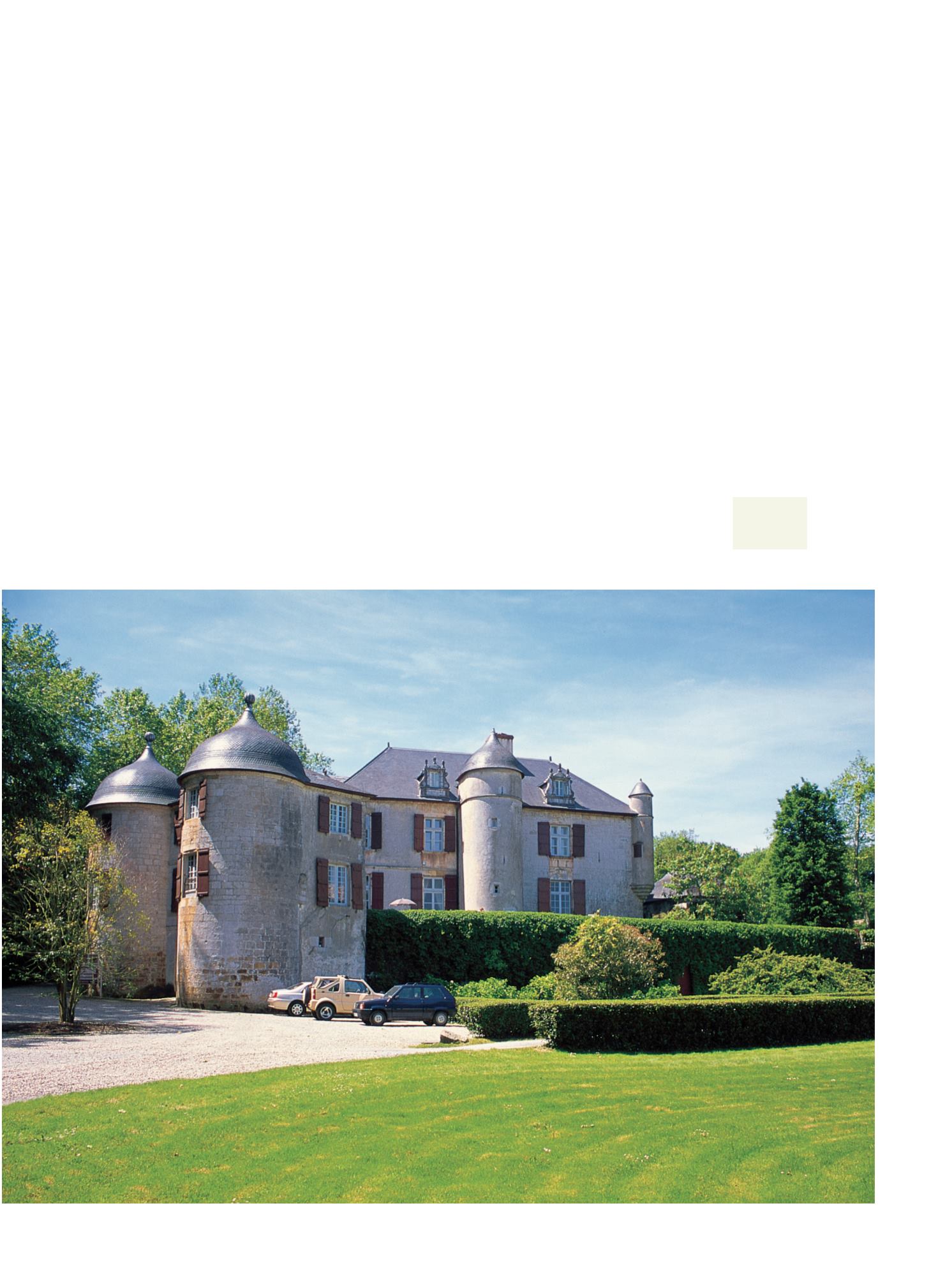
El castillo d’Urtubie, al lado de
Saint-Jean-de-Luz, un pequeño
viaje en el tiempo
The d’Urtubie castle, next to
Saint-Jean-de Luz, a small
trip back in time


