·amura·
118
catadores •
tasters
los conquistador s •
the conquerors
This multidisciplinary exhibition brought
together more than 300 works: modern and con-
temporary art, architecture, films and documents
drawn from numerous public and private collec-
tions. Designed as an experience both playful and
educational, it will offer the first comprehensive
exploration of its theme, inviting visitors to think
about how the city is imagined and how this imagi-
nation finds expression in concrete projects.
World’s Fairs, contemporary theme parks, the
Las Vegas of the 1950s and ‘60s, twenty-first-century
Dubai : all these have helped bring about a profound
transformation in our relation to theworld, our con-
ceptions of geography, time and history, our ideas
about the original and the reproduction, about art
and non-art.
The dreamlands of the leisure society have
shaped the imagination, nourishing both utopian
fantasies and artistic productions. But they have
also become realities: the pastiche, the copy, the
artificial and the fictive have become facts of the
environment in which real life is led, and they serve
as models for understanding and planning the
social life, blurring the boundaries between imagi-
nation and reality.
From Salvador Dali’s Dream of Venus pavilion for
the New York World’s Fair of 1939 to such manifes-
toes as Venturi and Brown’s Learning fromLas Vegas
and Rem Koolhaas’s Delirious New York, the sixteen
sections of the exhibition trace the history of a com-
plex and problematic relationship.
La exhibición multidisciplinaria reunió más de 300
obras de arte moderno y contemporáneo; arquitec-
tura, cine y documentos recolectados de numerosas
colecciones públicas y privadas. Diseñado como una
experiencia al mismo tiempo divertida y educacional.
También ofreció la primera exploración comprensiva
sobre el tema, invitando al público a pensar en cómo
la ciudad es imaginada, y cómo esta imaginación
encuentra expresión en proyectos concretos.
Las Ferias Mundiales, los parques de diversiones
contemporáneos, Las Vegas durante los años de la
década de los 50 y 60, Dubai del siglo XXI: todos éstos
han ayudado a atraer un profundo cambio a nuestra
relación con el mundo, nuestra concepción de la geo-
grafía, del tiempo y de la historia, de nuestra idea de lo
original y lo reproducido y del arte y no arte.
Los mundos de ensueño de las sociedades ociosas
han moldeado la imaginación, nutriendo fantasías
utópicas y las producciones artísticas. Pero también
se han vuelto realidades: el pastiche, la copia, lo ar-
tificial y lo ficticio se han convertido en hechos del
entorno en donde la vida real se desenvuelve, y sirven
como modelos para entender y planear la vida social,
borrando la línea entre la imaginación y la realidad.
Desde el pabellón del Sueño de Venus de Salvador
Dalí para la Feria Mundial de Nueva York en 1939, hasta
los manifiestos de Venturi y Brown “Aprendiendo de
Las Vegas” y la obra de Rem Koolhaas “Delirando en
Nueva York las dieciséis secciones de la exhibición
sirvieron para mostrar la historia de una relación
compleja y problemática.
1
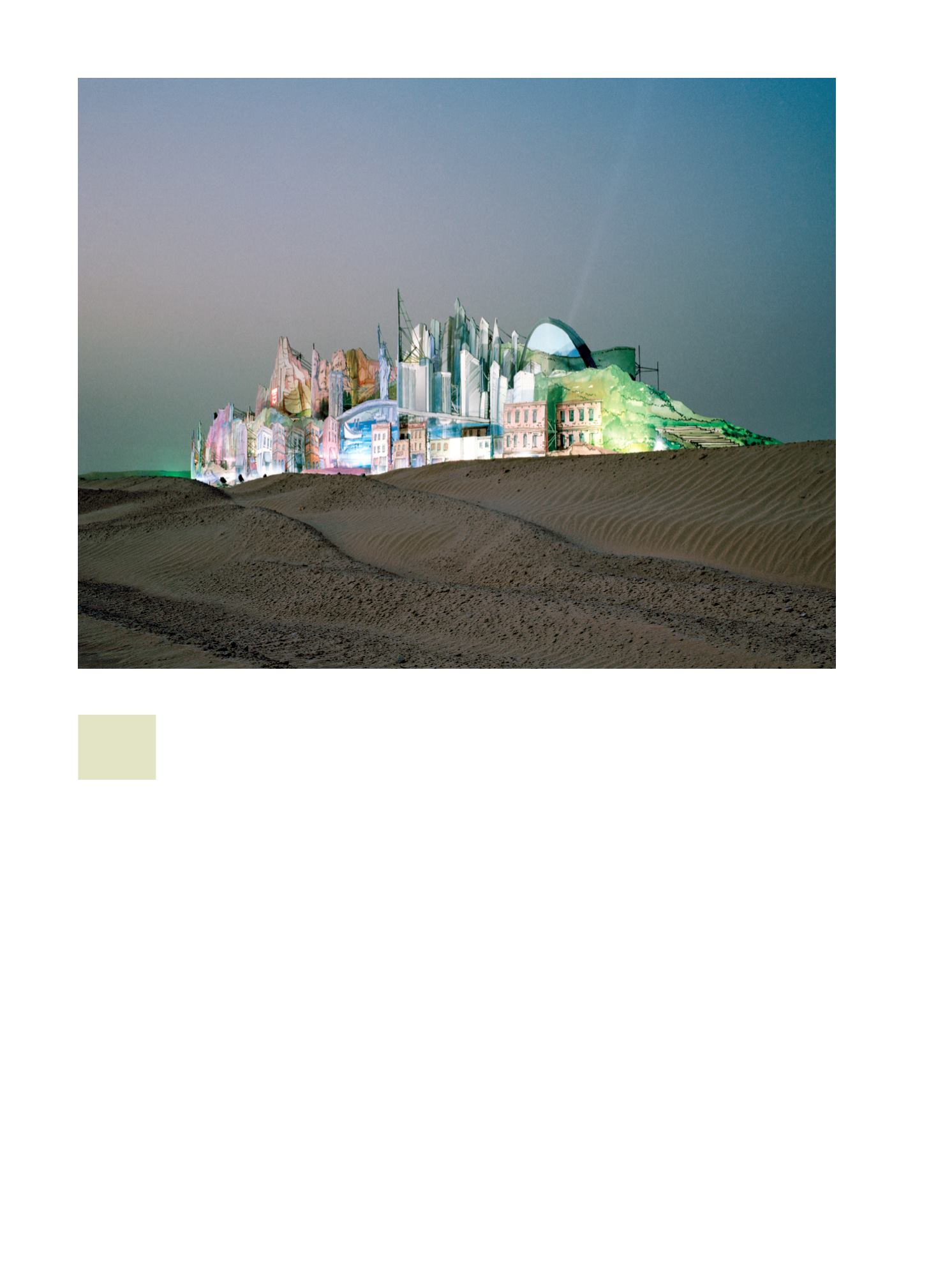
1. Florian Joye
Bawadi, Desert gate
2006
Photographie
81cm x 62 cm
Collection de l’artiste,
Paris
© Florian Joye, ecal


