31
·amura·
compás int •
compass int
end in hills and embellish a docile coast. We passed the
small, narrow Foz Estuary, with its stunning golden
sand beaches and a plain that ends in the low cliffs, and
we anchored in Foz to explore the ancient fortified
Celtic settlement of Fazouro, which safeguards its
stone ruins at the edge of the sea. In Sargadelos we
found the factory of Galician blue and white ceramics,
created by the Marquis of Sargadelos in the 18th centu-
ry, together with the steel foundry.
The coast makes its way to the northwest. The wind
was against us until we passed Cabo Burela and entered
the Viveiro Estuary, the largest of the Galician
Cantabric and into which the Landro River flows. Safely
anchored in the Viveiro marina, we visited this town
that preserves three doors in its medieval wall (the
most notable is the Porta do Castelo with its white
coats of arms), a number of noble mansions that sur-
round the main plaza and the San Francisco convent.
We passed the O Barqueiro Estuary, created by the
Sor River and where we discovered the enchanting
towns of O Viñedo, O Barqueiro and the quaint white
port of Bares. When we passed Estaca de Bares —the
northernmost watchtower in Spain, the first wind farm
and observatory of migrant birds— we encountered a
violent wind that calmed down slightly once we
entered the open estuary of Ortigueira, surrounded by
imposing cliffs. Cariño is a charming fishing village
lying at the end of a cliff that leads to Cabo Ortegal,
where we found percebes (barnacle) harvesters sailing
by. They were part of a superb scene that is appreciated
el escenario es dramático, inquietante y bellísimo. En
esa zona los pequeños acantilados terminan en las
colinas, decorando un litoral dócil. Pasamos la
pequeña y estrecha ría de Foz con sus hermosas pla-
yas de arena dorada, sitio en el que el llano termina
en bajos acantilados, y nos anclamos en Foz para
visitar el castro de Fazouro, un antiguo asentamien-
to celta que conserva sus vestigios de piedra a la ori-
lla del mar. En Sargadelos encontramos la fábrica de
cerámica gallega azul y blanca, creada por el mar-
qués de Sargadelos en el siglo XVIII junto con la
industria siderúrgica.
La costa se dirige hacia el noroeste. El viento
estaba en nuestra contra hasta pasar el Cabo Burela
y penetrar en la ría de Viveiro, la más grande del
Cantábrico gallego, en la cual desemboca el río
Landro. Asegurados en la marina de Viveiro, visita-
mos la población que conserva tres puertas de su
muralla medieval, la más notable es la Porta do
Castelo con sus blasones, unas casas señoriales que
rodean la plaza mayor y el convento de San
Francisco.
Pasamos la ría de O Barqueiro creada por el río
Sor, donde se alojan los encantadores pueblos de O
Viñedo, O Barqueiro y el pintoresco puerto blanco
de Bares. Al pasar la Estaca de Bares, la atalaya más
septentrional de España, primer parque eólico y
observatorio de aves migratorias, nos encontramos
con un viento violento que se calmó ligeramente
una vez adentro de la abierta ría de Ortigueira,
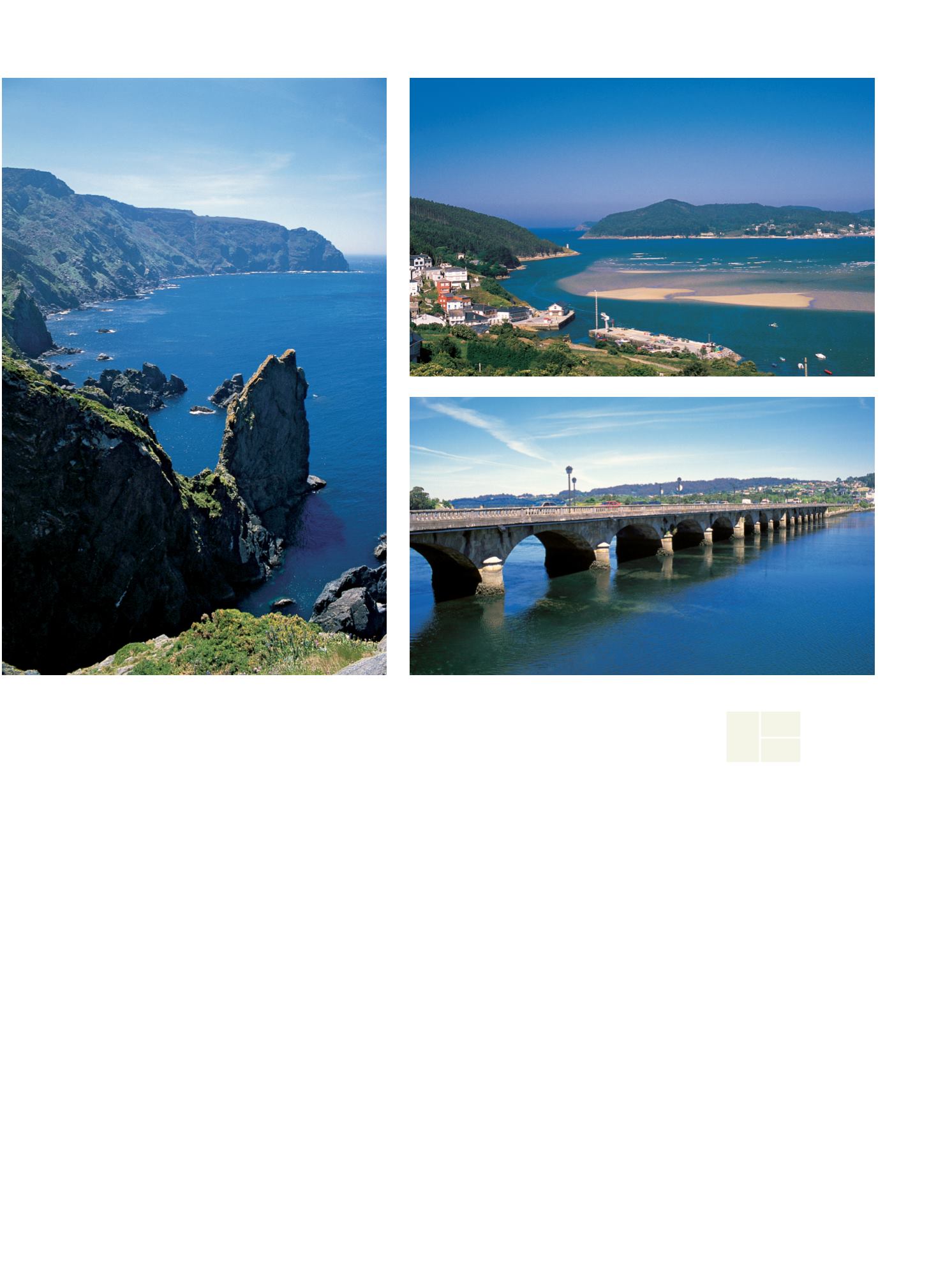
1. El cabo Ortegal, uno de los
más peligroso y donde se
pescan unos excelentes
percebes.
Ortegal Cape, one of the
most dangerous and where
excellent goose barnacles
can be caught.
2. La ría Ortigueira, una de las
más profundas de las rías
altas.
The Ortigueira Reach, one of
the deepest of the high
reaches.
2 1


