compás int •
compass int
44
·amura·
E
ntre las verdes colinas, Santiago es uno de los
mayores centros de peregrinación del mundo,
donde se veneran los restos del Apóstol, conser-
vados en una suntuosa urna de plata. Para llegar se
han diseñado caminos, que se recorren caminando
para merecer un trozo de paraíso, el más largo y mere-
cedor es el francés.
En la catedral, cuya estructura data del siglo XI,
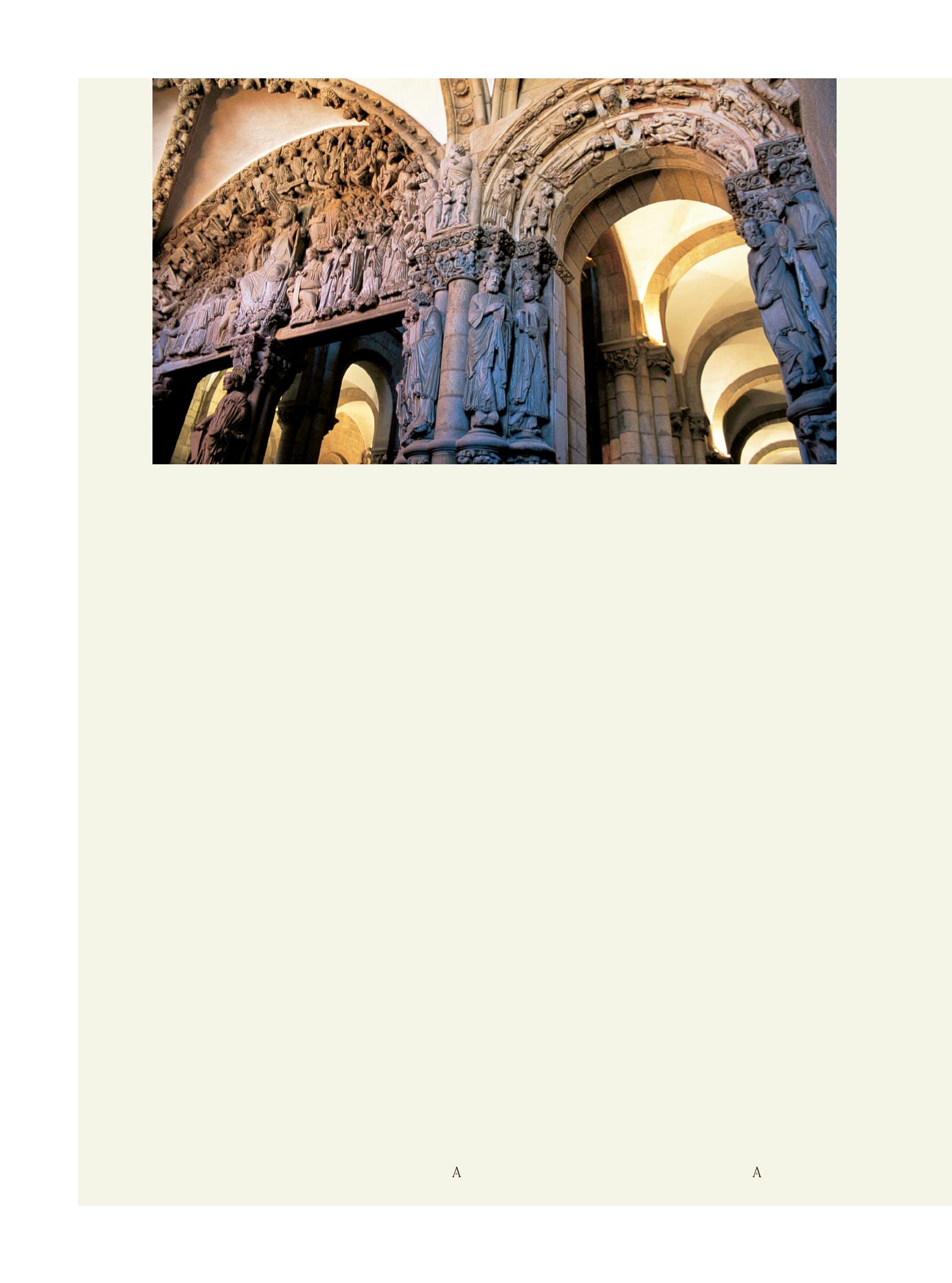
destacan el Pórtico de la Gloria, un fabuloso monu-
mento iconográfico de la estructura medieval, donde
la tradición pide que se abrace el pilar, y su coro de
piedra. Su impresionante fachada domina la bella
plaza do Obradoiro, enmarcada por el plateresco hos-
pital de Peregrinos del siglo XV, actual parador turís-
tico con su rica capilla y patios interiores, el
neoclásico Pazo de Raxoi, el Colegio de san Jerónimo,
actual Rectorado de la Universidad, con portada del
siglo XV, y el Pazo de Gelminez.
Paseando por la ciudad descubrimos impresionan-
tes monumentos, como el Colegio Fonseca, de estilo
renacentista y con bello claustro, la Puerta Santa de la
catedral que se abre sólo en años santos, la imponente
Torre del Reloj creando un frente barroco con la Casa de
la Parra y la de los Canónigos, el infinito y macizo muro
del Convento de San Paio de Antealtares. Las plazas se
abren entre los callejones desnudos o bordeados por
arcos, por donde nos perdimos para alcanzar la Casa de
la Troya, la Azabachería o el monasterio benedictino de
Martín Binario, que destacan entre lasmaravillas arqui-
tectónicas que adornan la ciudad santa.
Santiago es un auténtico museo viviente que
vibra con una ambiente de fiesta perpetua, donde
pasean estudiantes, visitantes y peregrinos. Es la
perla de Occidente, la joya de Galicia.
S
ituated in the midst of the green hills, Santiago,
where the remains of the apostle are preserved in
a sumptuous silver urn, is one of the world’s
most important pilgrimage destinations. Roads have
been built to reach it and traversing them on foot
makes one worthy of earning a portion of paradise. The
longest and most commendable is the French one.
The cathedral, built in the 11th century, is notable for
its stone chorus and its Pórtico de Gloria, the fabulous
iconographic monument of its medieval structure and
where tradition enjoins one to embrace the pillar. Its
impressive façade dominates the beautiful Plaza do
Obradoiro, framed by the 15th century Plateresque
Hospital de Peregrinos, which is now an innwith an opu-
lent chapel and interior patios; the neoclassical Pazo de
Raxoi, the Colegio de San Jerónimo, with its 15th century
façade and now the rectory of the University; and the
Pazo de Gelminez.
Exploring the city, we discovered impressive monu-
ments, like the Renaissance style Colegio Fonseca and its
beautiful cloister, the cathedral’s Puerta Santa, which is
only opened during holy years; the impressive Torre del
Reloj, which creates a baroque front with the Casa de la
Parra and Casa de los Canónigos; and the infinite, massive
wall of the Convento de San Paio de Antealtares. Plazas,
either bare or framed by arches, appear in the streets and
we wandered among themuntil we reached the Casa de la
Troya, the Azabachería and Martín Binario Benedictine
monastery, which are truly outstanding among the archi-
tectural wonders that embellish this holy city. .
Santiago, where students, visitors and pilgrims
amble by, is an authentic, living museum that beats to
the rhythm of a never-ending celebration. It is the
pearl of the west, the jewel of Galicia.
Santiago de Compostela
Ciudad mítica monumental
Monumental, Mythical City


