


 111 / 132

109
·amura·
Mitos •
Myths
Para realizar la décima proeza de capturar los rebaños de
Gerión (un gigantesco monstruo con seis manos, confor-
mado por tres cuerpos, que era considerado invulnerable
hasta que Hércules le dominó) tuvo que superar múltiples
obstáculos. Uno de ellos fue el paso cerrado hacia el océa-
no Atlántico por una gran montaña que él partió a la mitad;
esto creó dos promontorios que separaron definitivamente
a África de Europa. Es de esta forma que surge el monte Cal-
pe (Gibraltar) en Europa, y el monte Abyla o Abila (unas teo-
rías afirman que se trata de Yebel Musa situado en el norte
de Marruecos, y otros alegan que es el Hacho, donde se ubi-
ca la ciudad española autónoma de Ceuta). Posteriormente
logró llegar a la isla de Erítia, atravesando el recién liberado
Océano. En otra versión de este mito, las
Columnae Herculae
fueron erigidas allí por el héroe para avisar que estos dos
puntos montañosos a cada lado del Estrecho de Gibraltar
marcaban el límite del mundo conocido, el fin del mar, el
principio del caos, de lo desconocido. Esta fue una
creencia firme durante la antigüedad y la Edad
Media, hasta que los viajes de Colón compro-
baron en la práctica que nuestro hermoso
planeta es redondo. Por lo tanto, es im-
posible encontrar el punto geográfico de
su fin. A partir de entonces, “ir más allá”
significa abrir el rumbo a los mares que
bañan las tierras del nuevo hemisferio, y
el principio de grandes gestas históricas
de la humanidad.
To accomplish the tenth labor of capturing the Cattle of
Geryon (a giant monster with six hands and three bodies
that was considered invulnerable until Hercules defeat-
ed him) had to overcome many obstacles. One of them
was the closed path toward the Atlantic Ocean, blocked
by a big mountain that he split in half; this created two
peaks that separated Africa and Europe for good. This
is how
Mons Calpe
(Gibraltar) in Europe and
Mons Abila
surged (some theories claim that it could be
Jebel Musa
,
located north of Morocco, and others say it is
Monte Ha-
cho
, which overlooks the autonomous city of Ceuta.)
Thus, he managed to reach Erytheia through the new
liberated ocean. In another version of this myth, the
Co-
lumnae Herculae
were built by the hero himself to warn
that these mountainous peaks at each end of the Strait
of Gibraltar marked the limit of the knownworld, the end
of the sea, the beginning of chaos, the unknown; this
was a firm belief in ancient times through
the Middle Ages, until Columbus’s voy-
ages proved in practice that our beautiful
planet is round.
Therefore, it is impossible to find a
geographic location which marks its
limits. From then on, “going beyond”
means opening up the path to the seas
that surround the lands from the new
hemisphere, as well as the beginning of
great, historic deeds frommankind.
Finisterre - Non Terrae Plus Ultra
No hay tierra más allá
No Land Beyond
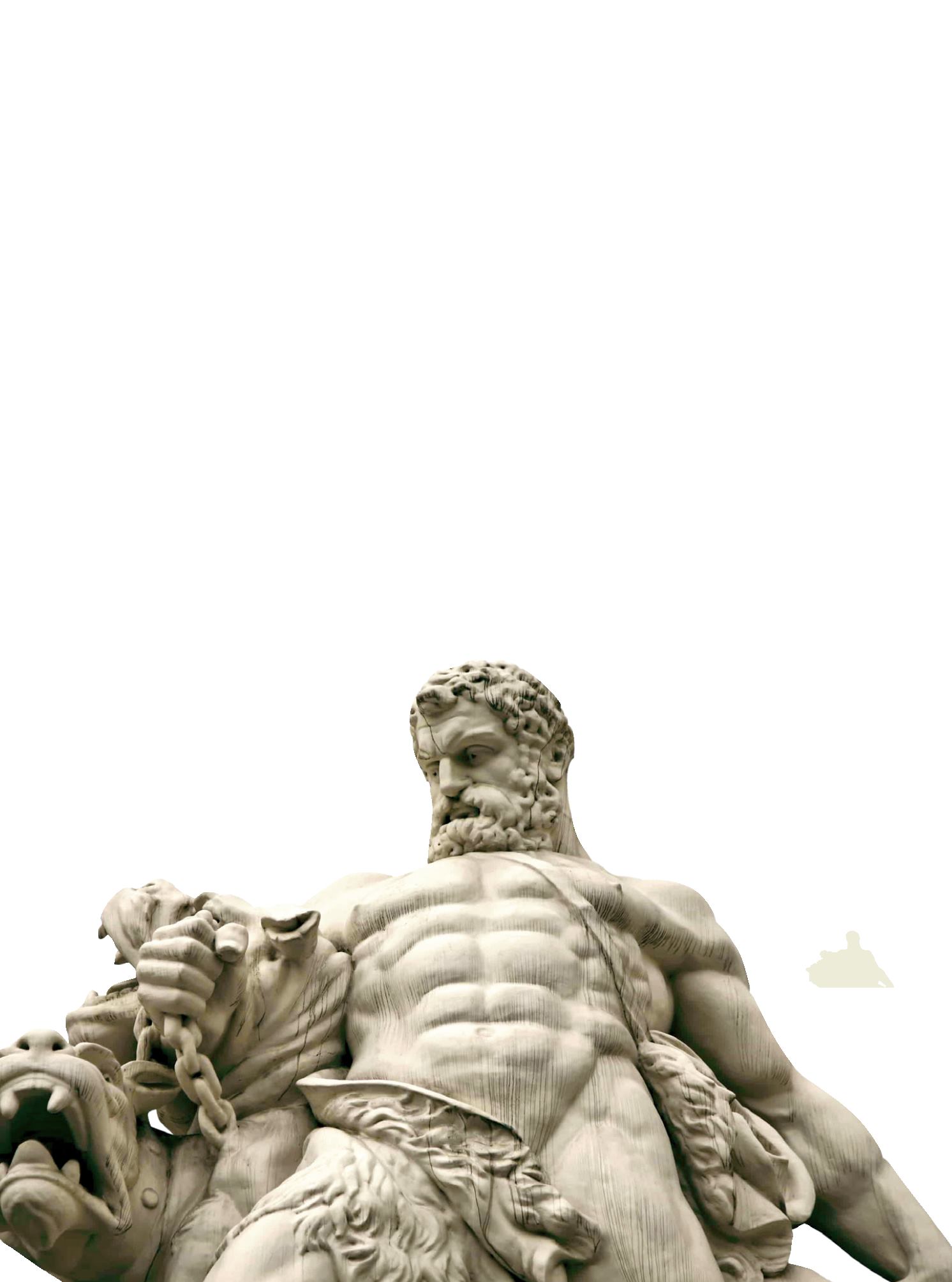
8. Hércules y Cerbero -
Hofburg, Viena, Austria
/HerculesandCerberus
-HofburginVienna,
AustriaAustria
8