



 120 / 132

·amura·
118
herencia cultural •
culture and heritage
In the 7th century BC, Greeks occupied Abyla
(Ceuta); it was then that they appointed the Strait as
the scenery for the Pillars of Hercules, which were
previously known as the Pillars of Melqart by
the Phoenician. From then on, many battles be-
tween Phoenicians, Carthaginians, Greeks, and
Romans took place; subsequently, there were
confrontations between Byzantine, Berbers,
Dutch, French, Spanish and British in a series of
events of great significance: moments of rivalry
and the interconnectionbetweenworlds.
It’s necessary to awaken the imagination,
since specialists argue that, in terms of the
Strait of Gibraltar, it’s better to follow its trail
through mythology, because history lives in it:
kings, philosophers, and heroes from ancient
lost civilizations, narrated by the Greek, Phoeni-
cian, Egyptian and others—many of them turned
into gods thanks to the fantasy in the stories.
It is said, for example, that Eritrea—where the
tenth labor of Hercules took place—would be
Perejil Island (an islet near the Rock of Gibral-
tar that is currently uninhabited). Other tales
identify this site as
Ogygia
, where—according
to the
Odyssey
—the nymph Calypso kept Ulyss-
es for seven years. A legend says that Hercules
founded Tangier, a Moroccan city, in the name of
a woman called Tingis, whom he loved. Along the
Strait, temples were built to honor Hercules, the
favored hero in these lands and seas.
For a long time, the constant incursion of
several civilizations in the Strait begot a multi-
cultural legacy and patrimony, palpable in the
architecture, gastronomy, literature and music.
This is a journey that would never cease to be
narrated, to be dreamed about with the sound of
the wind, in the splashing of the waves created
from the eternal embrace between the Atlantic
Ocean and the Mediterranean Sea.
O
En el siglo VII a.C., los griegos ocuparon Abyla
(Ceuta) al tiempo que fijaron el Estrecho como el
escenario de las Columnas de Hércules, que antes
los fenicios llamaban las columnas de Merkart.
Desde este punto se suceden confrontaciones a lo
largo del tiempo entre fenicios, cartagineses, grie-
gos, y romanos; más tarde se enfrentan bizanti-
nos, bereberes, holandeses, franceses, españoles
e ingleses en una continuidad de acontecimien-
tos cardinales: momentos de rivalidad y enlace
entre mundos.
Es necesario despertar la imaginación, porque
los propios especialistas exponen que en el caso del
Estrecho de Gibraltar es preferible seguir su huella a
partir de la mitología, pues la historia pervive en ella:
los reyes, sabios, héroes de las antiguas civilizaciones
perdidas, fueron narrados por los griegos, fenicios,
egipcios, etc., convertidos en dioses, gracias a la fan-
tasía de las historias. Se describe por ejemplo, que Eri-
tia –escenario de la décima proeza de Hércules– sería
la isla de Perejil (islote deshabitado en la actualidad,
situado muy cerca del Peñón de Gibraltar). Otros rela-
tos ubican este mismo lugar como
Ogigia
, donde –de
acuerdo a la
Odisea
– la ninfa Calipso retuvo a Ulises
durante siete años. Una leyenda narra que Hércules
fundó Tánger, ciudad de Marruecos, en honor a una
mujer llamada Tingeria, de la cual estaba irremedia-
blemente enamorado. En todo el Estrecho se fundaron
templos en honor a Hércules, que es el héroe preferido
de sus tierras y de sus mares.
Durante largo tiempo, la incursión sucesiva de
varias civilizaciones en el Estrecho, fueron fun-
dando el extraordinario legado multicultural de su
patrimonio; palpable en la arquitectura, gastrono-
mía, literatura, o en la música. Este sería un viaje
que no terminaría nunca de contarse, de ensoñar-
se en el sonido del viento, en el salpicar de las olas
creadas por el abrazo entre el Océano Atlántico, y
el mar Mediterráneo.
O
18. Los
componentes
del Estrecho de
Gibraltar /
The
componentsofthe
StraitofGibraltar
18
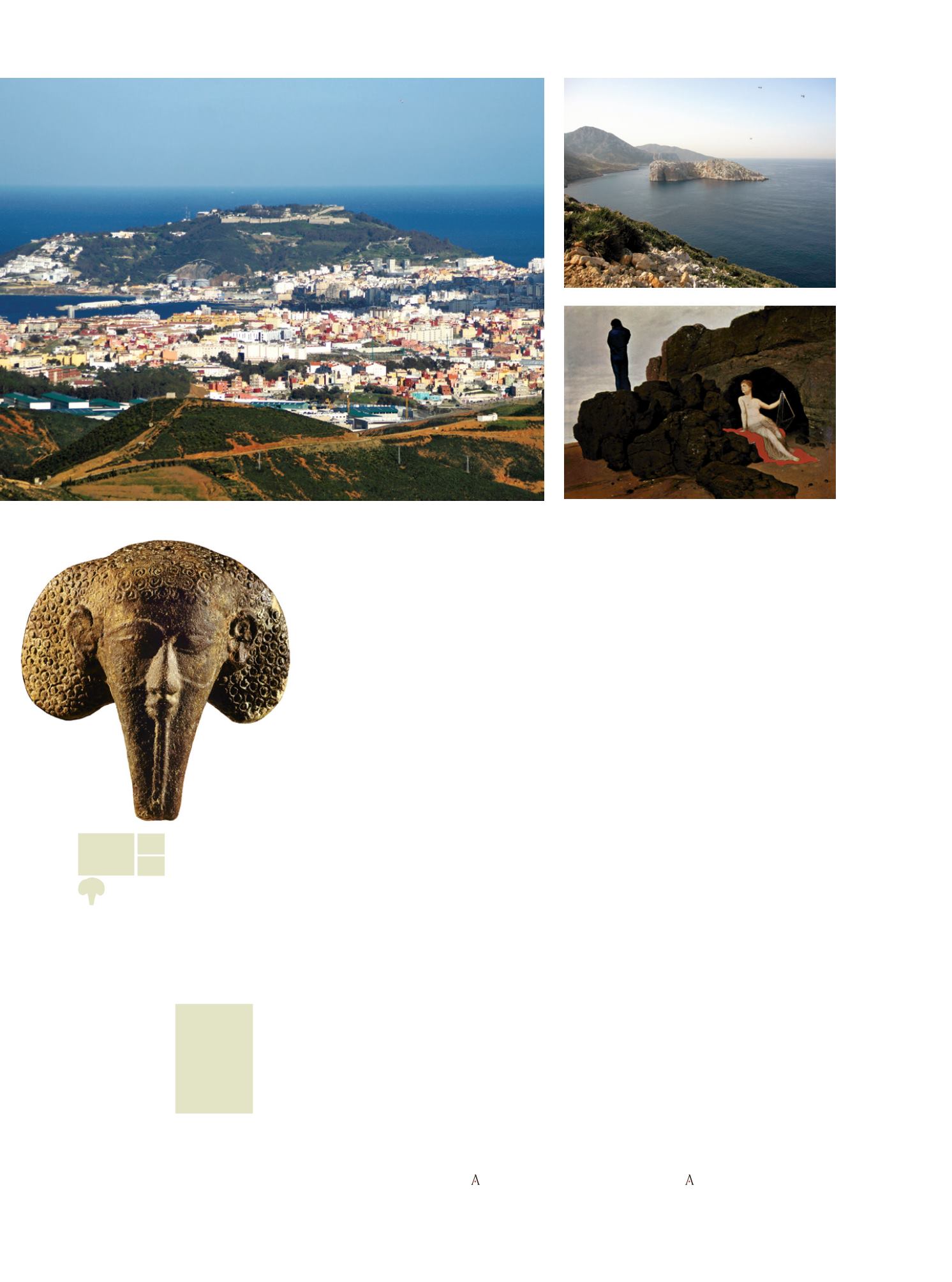
14. La costa
africana de Ceuta,
territorio español
en Marruecos /
TheAfricancoast
ofCeuta,Spanish
territoryinMorocco
15. La isla Perejil
podría ser Eritia:
escenario de la
décima hazaña de
Hércules /
Perejil
Islandcouldbe
Eritrea:sceneryof
Hercules’tenthlabor.
16. La isla Perefil
también podría ser
la isla Ogigia de la
Odisea
de Homero
/
PerejilIslandcould
beOgygia,fromthe
Odyssey
byHomer
14
15
16
17
17
.
La cultura
fenicia jugó
un papel
preponderante
en el Estrecho de
Gibraltar /
The
Phoeniciansplayeda
preponderantrolein
theStraitofGibraltar