·amura·
118
los conquistadores •
the conquerors
ras, amazonas y valquirias, las magas Circe y Medea,
Santa Catalina de Alejandría, quien convirtió a cin-
cuenta filósofos paganos, y Santa Eulalia, crucificada
como Jesús, Safo de Lesbos, María Magdalena leyen-
do y Santa Teresa levitando, Artemisia Gentileschi,
Frida Kahlo y otras grandes pintoras. Sin seguir un
orden cronológico sino temático, la muestra es tam-
bién una especie de “ciudad de las mujeres” enfoca-
da de manera especial en el ciclo de la modernidad, a
partir del siglo XIX, aunque se incluyen algunas obras
desde el Renacimiento.
En cada capítulo de la muestra se yuxtaponen
obras de distintas épocas, lenguajes y medios artís-
ticos para provocar una reflexión sobre lo que cam-
bia y lo que permanece a través de esas diferencias.
Y en cada capítulo, una o varias voces de grandes
mujeres artistas responden a las imágenes creadas
por sus ilustres colegas varones: Caravaggio, Ru-
bens, Rembrandt, Goya, Delacroix, Pissarro, Degas,
Munch, Nolde, Malevich, Hopper; artistas vivas como
Marina Abramovic, Kiki Smith, Mona Hatoum, Julia
Fullerton-Batten, Rineke Dijkstra y artistas de todos
los tiempos que incluyen a Mary Cassat, Lee Kassner,
Nancy Spero, Angelica Kauffmann y Berthe Morisot.
warriors, Amazons andValkyries, the sorceresses Circe
andMedea, Saint CatherineofAlexandriawhoconvert-
ed fifty pagan philosophers, Saint Eulalia, crucified in
the manner of Christ, Sappho of Lesbos, Mary Magda-
lene reading, Saint Theresa levitating, Artemisia Gen-
tileschi, Frida Kahlo and other great women painters.
Following a thematic rather than chronological order,
the exhibition also presents a type of “city of women”
that focuses in particular on the period of modern art
from the 19th century to the present, although works
are included fromthe Renaissance onwards.
Each chapter of the exhibition juxtaposes works
fromdifferent periods and in different artistic idioms
and media with the aim of encouraging the visitor
to reflect on change and permanence through these
differences. In each section the voices of one or more
great women artists respond to the images created by
their illustrious male colleagues: Caravaggio, Rubens,
Rembrandt, Goya, Delacroix, Pissarro, Degas, Munch,
Nolde, Malevich, Hopper; living female artists like
Marina Abramovic, Kiki Smith, Mona Hatoum, Julia
Fullerton-Batten, Rineke Dijkstra, and women artists
of other periods including Mary Cassat, Lee Krasner,
NancySpero, AngelicaKauffmannandBertheMorisot.
1
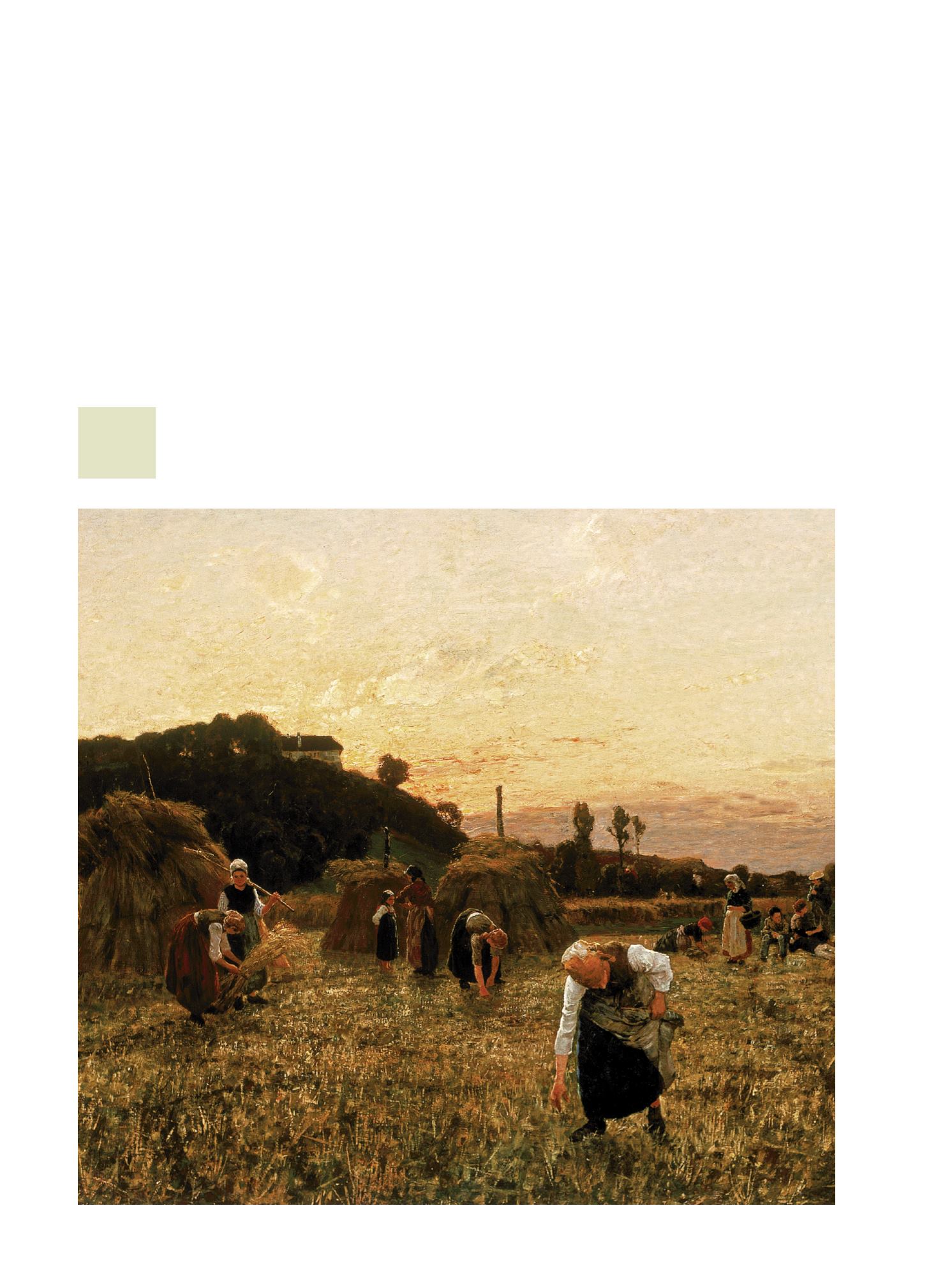
1. Jules Breton
Espigadoras al atarde-
cer,
1863 (detalle)
Oleo sobre Lienzo,
81,8 x127, 5 cm
Coleccion Perez
Simon, Mexico
.


