44
·amura·
L
as costas chilenas presentan sorpresas y
fascinantes contrastes, con bahías hermo-
sas y salvajes. Chile se extiende desde el
Trópico de Capricornio hasta la Patagonia, con
gran variedad de climas y paisajes. En este viaje
quisimos conocer dos de las más insólitas costas
de ese país: la Isla de Pascua y la costa central,
desde Pichilemu hasta Zapallar, un recorrido que
incluye Viña del Mar y Valparaíso.
Isla de Pascua o Rapa Nui
Situada en medio del Pacífico, la Isla de Pascua es
la más aislada del planeta, el lugar más remoto. La
isla más cercana, Pitcairn, se encuentra a 1,900
km, colonizada y todavía habitada por los descen-
dientes de los insurrectos del Bounty, deportados
a esa isla. A 2,500 km se hallan las Islas
Mangarévas, parte del Archipiélago de Polinesia, y
las Marquesas a 3,200 km.
La costa de Chile, país al que pertenece Rapa
Nui, se sitúa a 3,700 km, y el avión de LanChile
que nos llevó tardó cinco horas desde Santiago,
un recorrido que hubiera necesitado largos días
de navegación. Al llegar alquilamos una pequeña
lancha para recorrer la sorprendente costa de esa
isla volcánica.
Rapa Nui tiene 24 km de largo por 12 de
ancho, formada por la lava de tres conos volcáni-
cos: Terevaka, al norte, con una altura de 652 m,
Pukatiki, al este, con 400 m, donde forma la
T
he Chilean coasts offer surprises and fasci-
nating contrasts with beautiful and wild
bays. Chile extends from the Tropic of
Capricorn to Patagonia, with a wide variety of cli-
mates and landscapes. On this trip, we wanted to
visit two of the country’s most unusual land-
scapes: Easter Island and the Central Coast, from
Pichilemu to Zapallar, a voyage that includes Viña
del Mar and Valparaíso.
Easter Island or Rapa Nui
Located in themiddle of the Pacific, Easter Island is
the most isolated island on the planet. The closest
Island, Pitcairn, is 1,900 km away and was colo-
nized and is still inhabited by the descendents of
themutineers of the Bounty, who were deported to
the island. The Mangarévas Islands, part of the
Polynesian Archipelago, are 2,500 km distant and
the Marquesas Islands are 3,200 km away.
The coast of Chile, the country to which Rapa
Nui belongs, is 3,700 kmaway and the LanChile air-
craft that took us there took five hours from
Santiago, a trip that would have taken long days of
sailing. On arrival, we rented a small launch to
tour the surprising coastline of this volcanic
island.
Rapa Nui is 24 km long and 12 km wide and is
formed from the lava of three volcanic cones:
Terevaka, to the north, with a height of 652 meters,
Pukatiki, to the east, with a height of 400 meters
compás int •
compass int
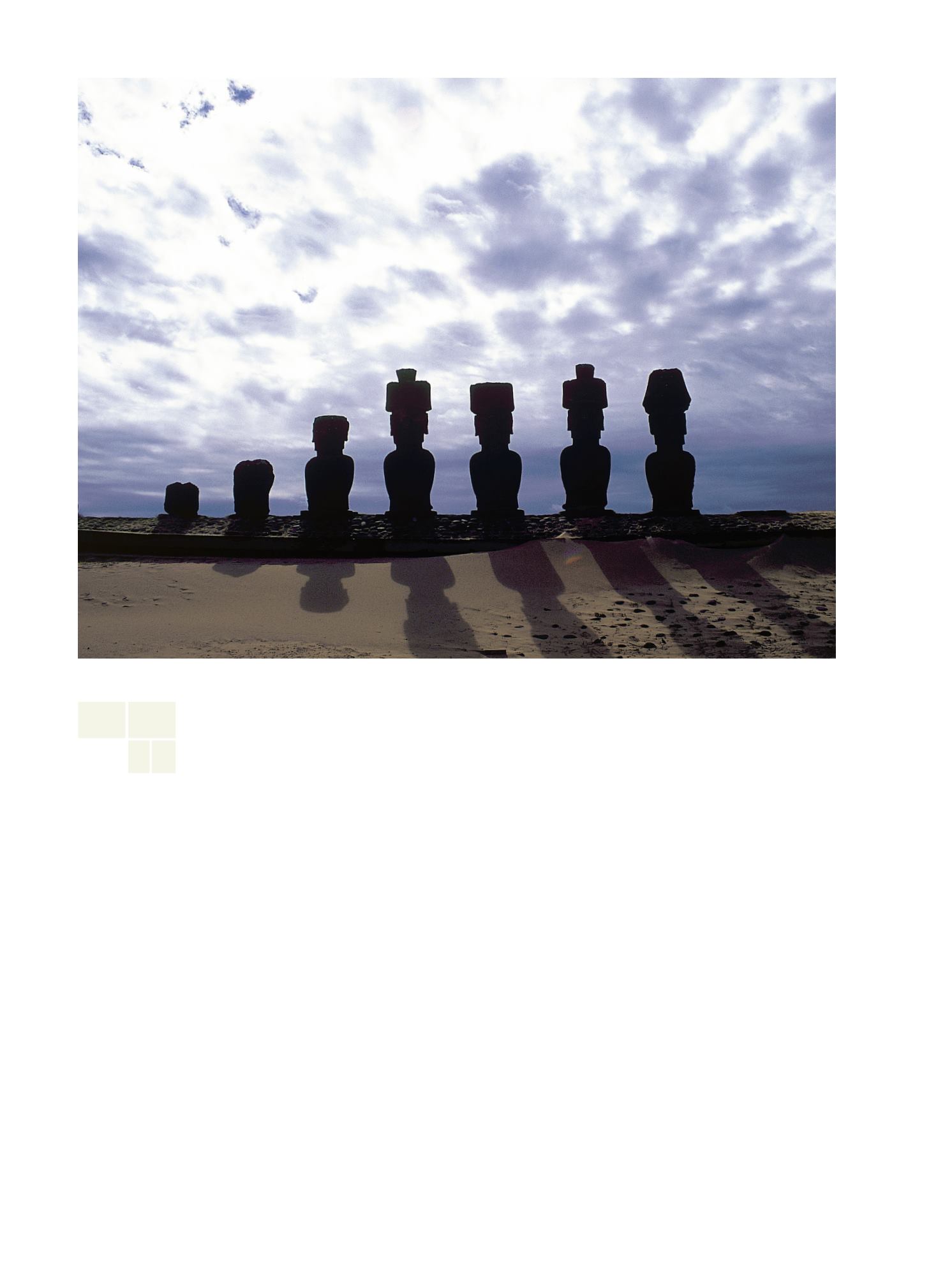
1. Los Moai dominan la playa de
Anakena donde sus sombras
se dibujan sobre la arena
The Moai dominate the
beach of Anakena where
their shadows are drawn on
the sand
2.
Hanga Tu Hata, uno de los
lugares más sagrados de la
isla, con un extenso recinto
dominado por la larga hilera
de Moai.
Hanga Tu Hata, one of the
most sacred places on the
island, with an extensive
area dominated by the long
line of.
3. Ahu Akivi es el único lugar
sagrado tierra adentro donde
los Moai ven hacia el océano.
Ahu Akivi is the only sacred
place inland where the Moai
look out to the ocean.
1
2
3 3


