50
·amura·
compás int •
compass int
ahu y a encontrar un pequeño puerto protegido
en Hanga Hoonu para visitar los lugares sagrados.
Recorrimos la costa de los grandes acantilados
que bordean el volcán Poike hasta llegar a la costa
sur, un poco más protegida, con mar tranquilo,
hasta atracar en la pequeña cala de Tongariki.
Entonces apareció el bello sitio de Hanga Tu Hata,
donde se erigen los moai a la orilla de las olas,
dentro de un gran recinto religioso.
Aprovechamos para visitar el volcán Rano
Raraku, donde se encuentran las canteras que
permitieron que se tallaran los moai y donde
encontramos muchos sin terminar, y en su cráter,
una laguna aseguraba el agua potable de la isla.
Nuestra última etapa nos llevó a descubrir la
costa sur, donde se alojan pequeñas calas, gran
variedad de ahu, y finalmente la orilla del volcán
Rano Kau, que contiene otra laguna, con Orongo y
sus casas elípticas en la orilla, con acantilados
impresionantes que forman una barrera natural
contra las olas. Es donde se localizan los islotes o
motu
(Kau Kau, Iti, Nui) donde el hombre pájaro
encontraba el huevo simbólico. Finalmente llega-
mos a Hanga Roa, encantados de haber visto uno
de los tesoros de la Tierra. Todavía nos esperaban
más sorpresas, cuando buceamos para descubrir
fondos marinos, peces de colores, mantarrayas y
tiburones.
La Isla de Pascua es uno de los lugares más
insólitos de la Tierra, que encanta, sorprende y
conquista, por la historia, los moai y la gentileza
de su gente, donde la música tiene ritmos poline-
sios con letras en español.
Desde Pichilemu hasta Zapallar
De regreso a Santiago por un vuelo de LanChile
visitamos los mejores viñedos de la región al pie
The next day we went to see the beautiful
Ovahe beach, the sites at Te Pito Kura with their
ahu
and to find a small protected port in Hanga
Hoonu to visit the sacred places. We sailed the
coast of the high cliffs that edge the Poike vol-
cano until we reached in slightly more protected
south coast, with its calm sea to moor in the
small cove of Tongariki. Then the beautiful site of
Hanga Tu Hata appeared where the moai rise up
at the sea’s edge, within a great religious site.
We took advantage to visit the Rano Raraku
volcano, the site of the quarries where the moai
were carved andwherewe foundmanyunfinished
statues and in the volcano’s crater, a lagoon that
holds the island’s drinking water.
The last leg of our took us to discover the
South Coast, with its small coves and its wide
variety of ahu, and finally to the foot of the Rano
Kau volcano, which contains another lagoon,
with Orongo and its elliptical houses on the edge,
with impressive cliffs that form a natural barrier
against the sea. This is where the islets or
motu
(Kau Kau, Iti, Nui) can be found, where the bird-
man found the symbolic egg. Finally, we arrived
at Hanga Roa, delighted to have seen one of the
Earth’s treasures. More surprises awaited us
when we dived to discover the marine depths,
such as multi-colored fish, rays and sharks.
Easter Island is one of the most unusual
places in the world, which charms, surprises and
conquers for its history, the moai and the gentle-
ness of its people, whether music has Polynesian
rhythms with lyrics in Spanish.
From Pichilemu to Zapallar
On returning to Santiago on a LanChile flight, we
visited the best vineyards in the region of the
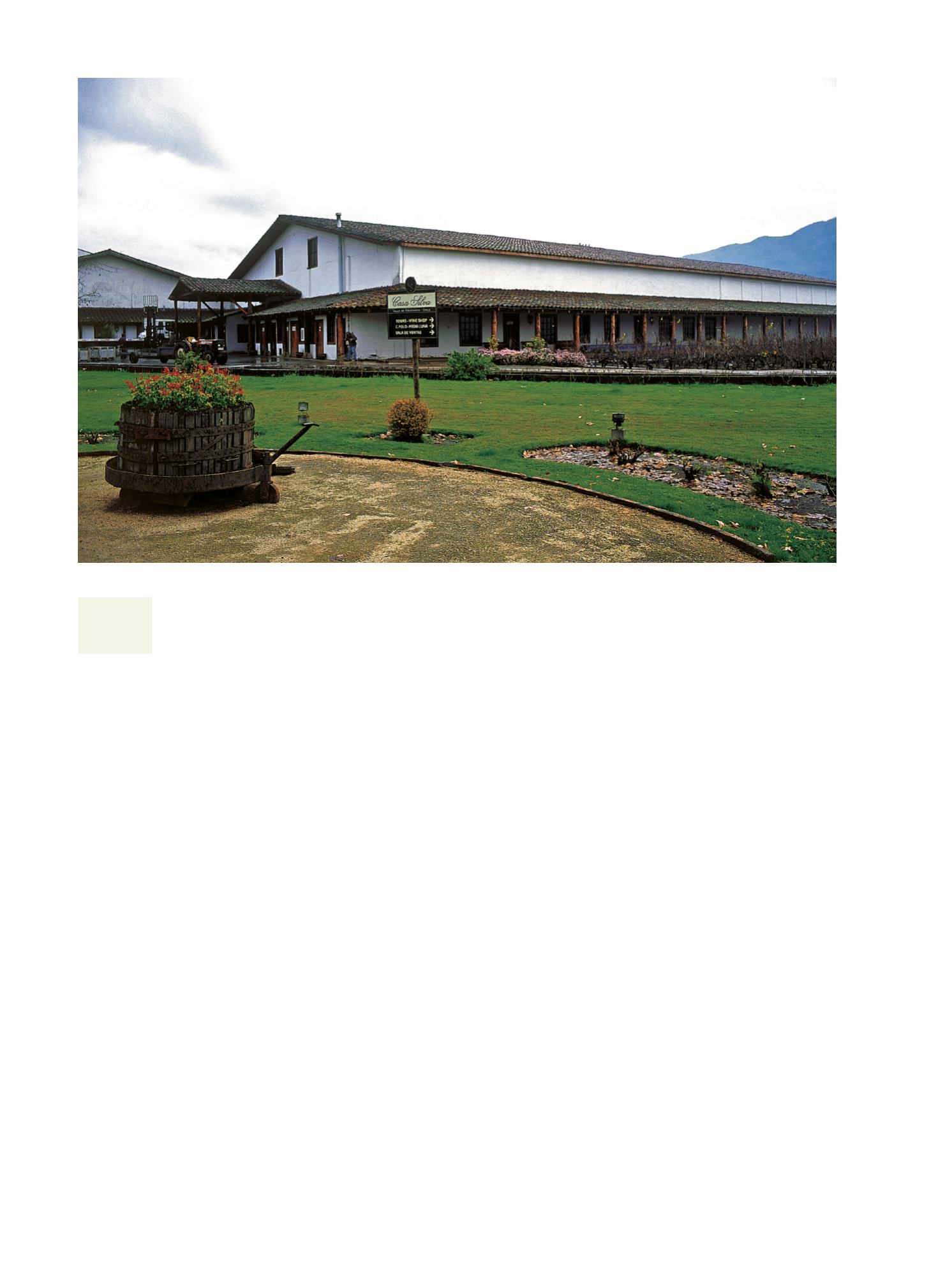
Casa Silva es uno de los mejores
viñedos al pie de los Andes
Casa Silva is one of the best
vineyards at the foot of the Andes


