47
compás int •
compass int
·amura·
from Peru. Norwegian scientist Thor Heyerdahl
set about to prove this theory in 1955 with his
Kon Tiki
expedition, a vessel made from balsa
wood and hemp that grows around Lake Titicaca.
According to spoken legend, Hotu Matua was
the first to arrive in about 450 A.D. the people con-
centrated on growing crops and constructing the
moai, which serve as a reminder of the most illus-
trious ancestors. Ceremonies were held in the
sacred place, the inhabitants lived in small boat-
shaped oval stone houses, called
hare paenga.
The island was so prosperous that it is calcu-
lated that in the 10th century it had as many as
10,000 inhabitants. Civil wars killed off the
“short-eared” population, the population
decreased, the trees had disappeared and the
moai had fallen down.
The new age forgot the cult of the moai and
dedicated itself to the culture of birds. The peo-
ple awaited the arrival of migratory birds, which
according to spoken legend, was sent by the god
Make-Make. The birdman ceremony consisted of
a competition in which the representative of
each of the tribes, with their bodies painted
climbed down the cliffs of the Rano Kau volcano
to swim towards the Motu Nui islets, some two
kilometers away in order to steal one of the eggs
of the Manutara bird. They returned to deliver
the egg to their
ariki
(King) who turned them
into Tangata Manu, the religious and political
chief of the island for a year.
The Dutch expedition led by Jacob Roggeveen
arrived in April 1722 and called it Easter Island, to
Thor Heyerdahl, con su expedición
Kon Tiki
, una
embarcación hecha con el pastizal que crece en el
lago Titicaca.
Según la leyenda oral, Hotu Matua fue el pri-
mero en llegar, más o menos en el 450 d.C. La
gente se dedicaba a cultivar y a construir los
moai, que tenían como función recordar a sus
ancestros más ilustres. Las ceremonias tenían
lugar en el recinto sagrado, los habitantes vivían
en casas de piedra ovaladas en forma de barco,
llamadas
hare paenga.
La isla era tan próspera que se calcula que en
el siglo X llegó a tener 10,000 habitantes. Las
guerras internas acabaron con los “orejas cortas”,
la población disminuyó, los árboles habían desa-
parecido y los moai habían caído.
La nueva época olvidó el culto de los moai y se
dedicó al culto de las aves. Esperaban la llegada
de las aves migratorias, que según la tradición
oral eran enviadas por el dios Make-Make. La
ceremonia del hombre pájaro consistía en una
competencia donde cada representante de las tri-
bus, con el cuerpo pintado, bajaba el acantilado
del volcán Rano Kau para nadar hasta los islotes
Motu Nui, distantes unos dos kilómetros, donde
capturaban uno de los huevos del pájaro
Manutara. Regresaban para entregar el huevo a
su
ariki
(rey) que lo convertía en Tangata Manu,
jefe religioso y político de la isla durante un año.
La expedición holandesa con Jacob
Roggeveen llegó en abril de 1722, y la llamó Isla
de Pascua, por el día en que la descubrieron. Fue
visitada por el inglés James Cook, el español
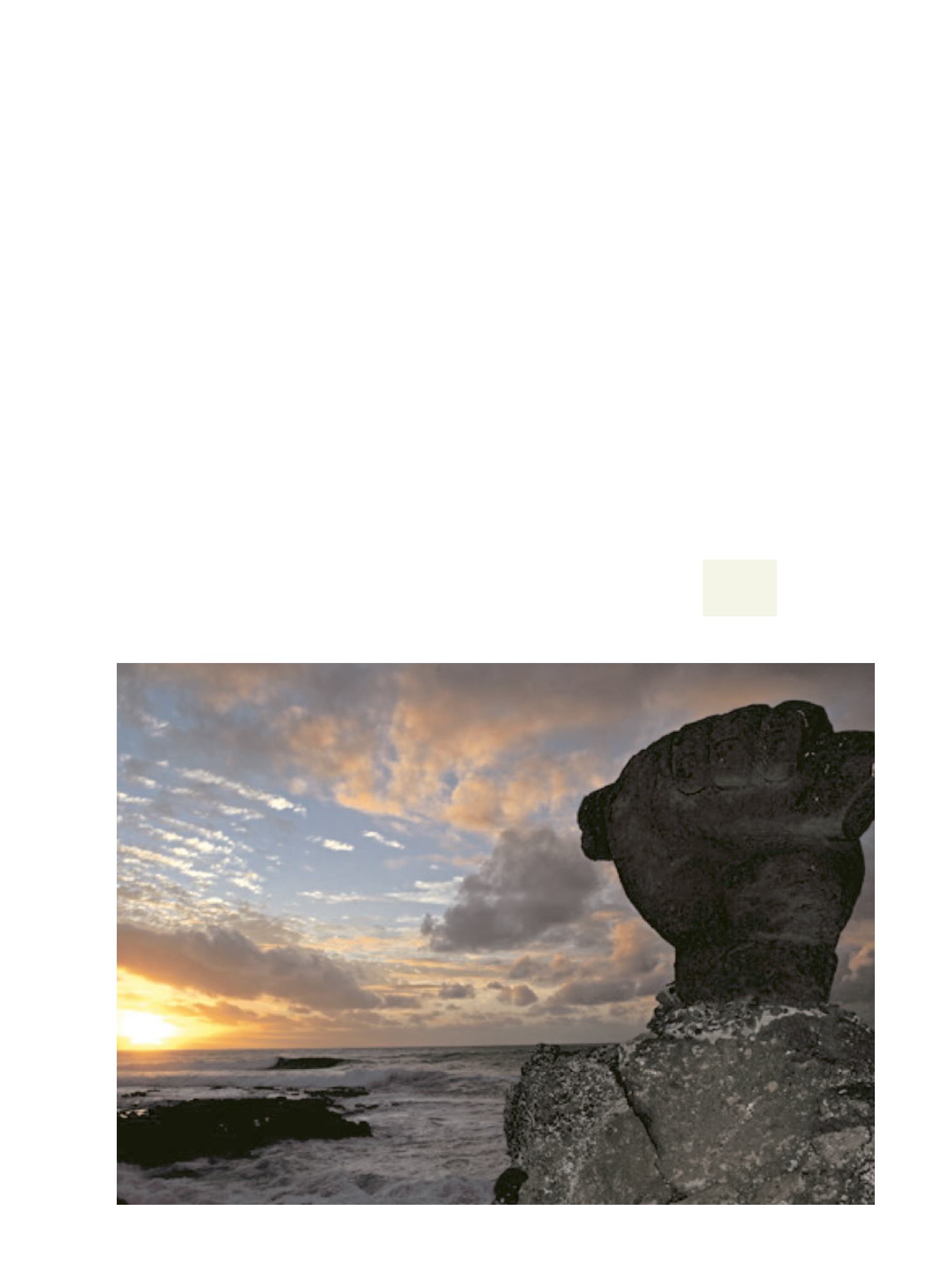
La pequeña marina de Hanga Roa,
vigilada por uno de los Moai en el
atardecer
The small marina of Hanga Roa,
watched over by one of the
Moai at sunset


