Una vez obtenido el itinerario se decidió trazar
una ruta hacia el sur, ya que se tiene que tomar muy
en cuenta la época de lluvias, los famosos monzo-
nes que causan grandes inundaciones, por lo que el
tiempo ideal de hacer el viaje es de octubre a marzo,
partiendo de Mumbai hacia las regiones de Maharas-
tra, Karnataka, Tamil Nadu, Orissa, Bihar, Madhya Pra-
desh, Delhi, Rajasthán y, por último, la de Gujarat para
retornar a Mumbai y de ahí a México.
Pero antes de iniciar este recorrido, daremos un bre-
ve repaso a los orígenes hindúes y para ello nos remon-
tamos a la formación del Imperio Indoeuropeo, con el
sánscrito como idioma, luego de la invasión de los arios
procedentes de lo que ahora es Irak e Irán. Hacia el 600
a.C., aparece el budismo con la figura representativa de
Sidarta Gautama (Buda) y su auge hasta el año 321.
Otra influencia muy marcada en la India fueron los
Partos de Irán y con el emperador Asoka (s. II a.C.,) es
cuando el budismo toma mucho auge hasta la invasión
de los turcos (1000-1027) y mongoles (1241-1421),
después llega el Sultanato de Delhi (1206 a 1526) para
luego dar paso a la época del Islam (1440 a 1526), se-
guida del regreso de los mogoles (1526 a 1761).
Es en 1498 que Vasco Da Gama descubre la In-
dia y a raíz de ello inicia la migración portuguesa,
holandesa, inglesa, francesa y danesa hasta quedar
los ingleses en posesión de la colonia de 1852 hasta
1947. Este último fue el año en que logra su inde-
pendencia, de la mano de su líder espiritual y social,
Mahatma Gandhi.
Once the trip was planned, it was decided to
trace the route south, since the raining season had
to be taken into consideration because of the fa-
mous monsoons that cause big floods, that’s why
the ideal time to travel is from October to March,
starting from Mumbai towards the regions of Ma-
harashtra, Karnakata, Tamil Nadu, Orissa, Bihar,
Madhya Pradesh, Delhi, Rajasthan and Gujart, then
going back to Mumbai and then to Mexico.
But beforegettingstartedwiththe journey,wewill
have a brief reviewof theHinduorigins and for thiswe
will go back to the formation of the Indoeuropean Em-
pire,withtheSanskrit asa language, after theArian in-
vasion who were originally fromwhat we know today
as Irak and Iran. Towards 600 B.C Buddhism appeared
with the representative figure of Sidharta Gautama
(Buddha) and itspeakwasuntil theyear 321.
AnotherimportantinfluenceinIndiawasthebirthof
IranandwithEmperorAsoka(2ndcenturyB.C)Buddhism
becomesverypopularuntiltheTurquishinvasion(1000–
1027) and the Mongol invasion (1241–1421), after this
came the Sultanate of Delhi (1206–1526) to then make
way to the Islam (1440–1525), followed by the return
oftheMongols(1526–1761).
It is in 1498 when Vasco da Gama discovers India
and because of this, the Portuguese, Dutch, English,
French and Danish migrations took place until the
Englishtookoverthecolonyfrom1852until1947.This
last year was the year of their independence from the
handof social andspiritual leader,MahatmaGandhi.
1
2
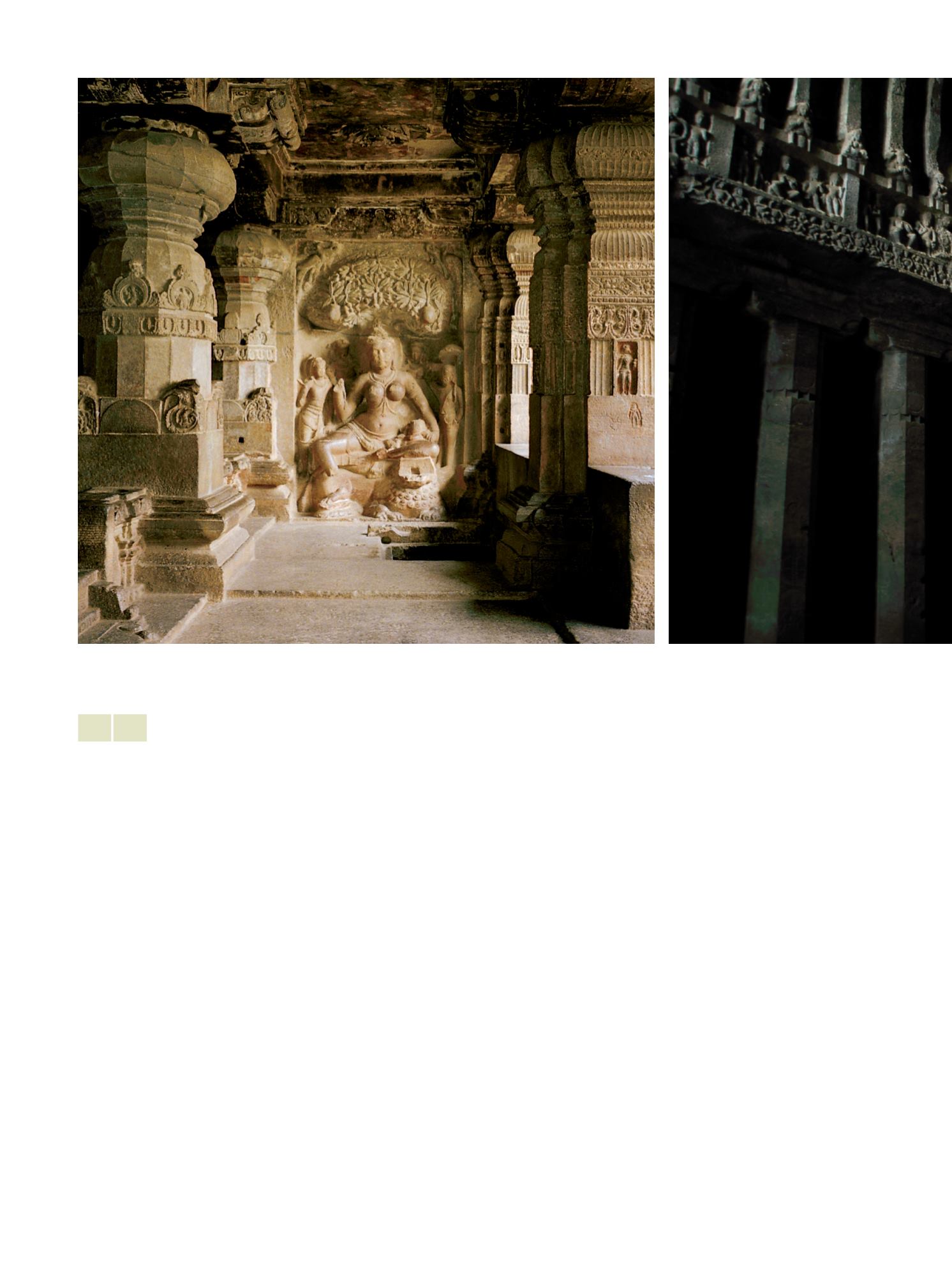
1. ELLORA Cueva
templo No. 33
Jainista 800 d.C.
/
Cave temple No. 30
Janis 800 A.C.
2. AJANTA Cueva
templo No. 10
Budista S. II a.C. /
Cave Temple No.
10 Buddhist 2nd
Century B.C.
·amura·
42
compás int •
compass int


