120
·amura·
Los cinco videos retratan -en conjunto y a modo de
ficción- las experiencias que documentó Ahtila en
entrevistas con mujeres psicóticas. Y es otra obra,
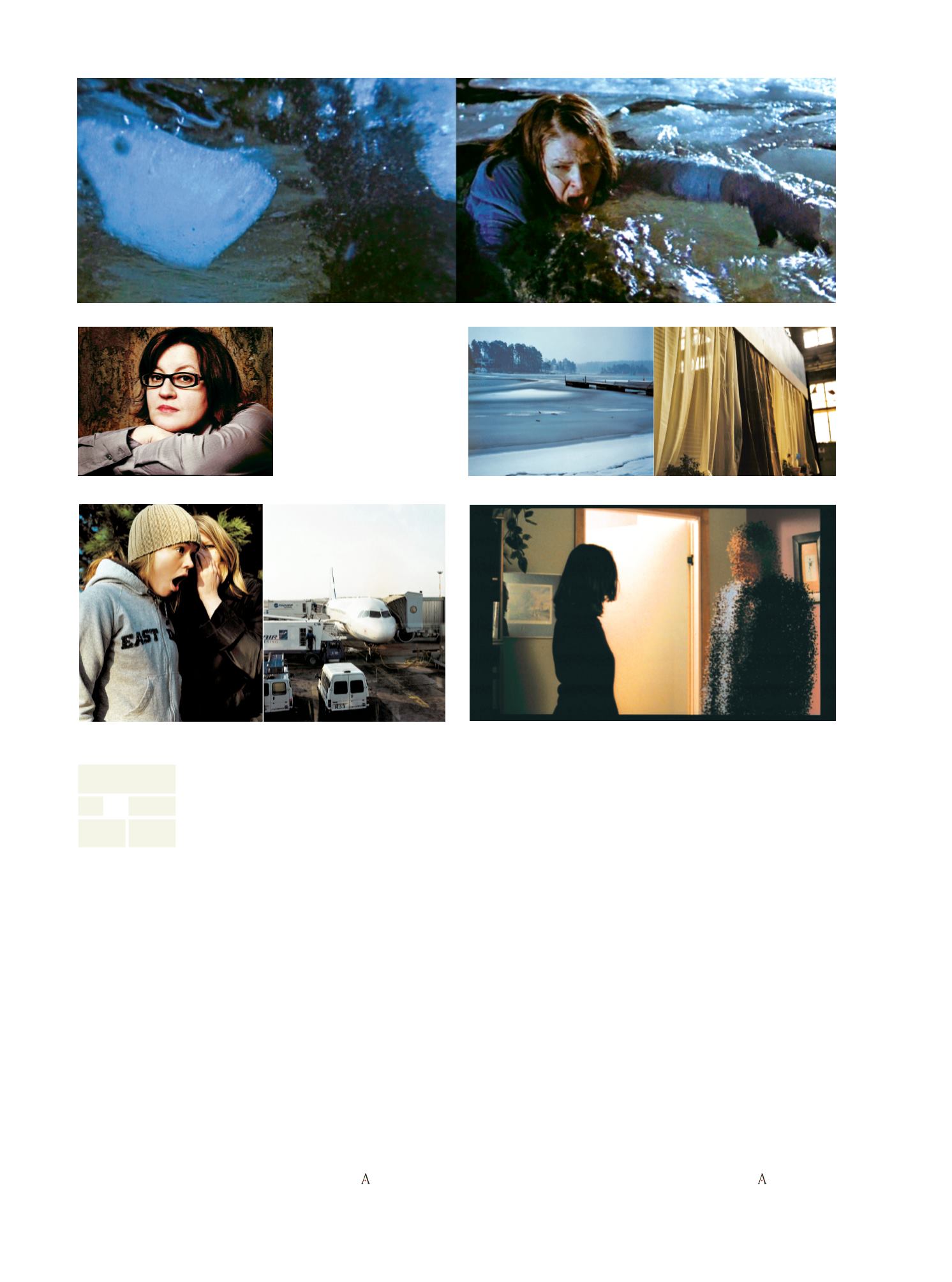
Scenographer’s Mind
(2002) –que consiste en una
serie de 18 fotografías de mediano y gran formato-
la que arroja luces sobre los procesos de construc-
ción de la imagen como equivalente a los procesos de
construcción del sentido. Esta obra constantemente
hace referencia a
The House
y podríamos pensar que
funciona como su remanente. Pero en este caso la
imagen fija, a diferencia de la imagen en movimiento
del video, explora delicadamente la importancia del
espacio en la creación de una conciencia y en el mejor
de los casos, en la creación de un sentido. En la obra
de Eija-Liisa Ahtila, el espacio funciona como un
reflejo del mundo interior de los personajes: un espe-
jeo de la conciencia. En su obra, las realidades fantás-
ticas, nos sumergen en los estados existenciales de
sus personajes por medio de modificaciones a la per-
cepción temporal y espacial. Y es mediante estas
percepciones-reflejo que Eija-Liisa toca situaciones
límite en la vida, como son el apego, la separación y
el duelo, el penoso proceso de crecer, el encuentro
con la muerte, el encuentro con el otro y sobre todo
el encuentro con uno mismo y los oscuros rincones
de la mente.
belongs to a collection of work called
The Present
.
Together and fictionally, the five videos portray the
experiences documented by Ahtila during inter-
views with psychotic women. It is another work,
Scenographer’s Mind
(2002), which consists of a
series of 18 medium and large-format photo-
graphs,whichsheds light ontheprocessof the con-
struction of an image as an equivalent to the
process of the construction of sense. This work
makes constant reference to
The House
and we
could think that itworks as its remnant. But in this
case, the fixed image, unlike the moving video
image, delicately explores the importance of space
in the creation of awareness and in the best of
cases, the creation of a sense. In Eija-Liisa Ahtila’s
work, space functions as a reflection of the interior
world of the characters: a mirror of awareness. In
her work, fantastic realities submerge us in the
existential states of her characters by modifying
the space and time perception. And it is through
these perceptions/reflections that Eija-Liisa touch-
es on extreme situations of life, such as attach-
ment, separation and grief, difficult process of
growing up, the encounter with death, encounters
with others and above all encounters with oneself
and the dark corners of themind.
los conquistadores •
the conquerors
1.
Consolation Service
, 1999
35mm film and 2-screen DVD installation,
16:9, aspect ratio 1:1.85, Stereo Surround,
original language Finnish,
English subtitles,
23’40’’
Courtesy Marian Goodman Gallery,
New York and Paris
© Crystal Eye – Kristallisilmä Oy,
Helsinki 2008
©VG Bild-Kunst, Bonn 2008
2.
Scenographer´s Mind I to IX,
2002
A series of 18 photographs, 2 per frame,
each diptych: 2 color prints, mounted,
framed as set, with hand coloredmat
I, IV, VI, VIII, IX: 89 x 206 cmwith frame
II, III, V, VII: 170 x 107 cmwith frame
Courtesy Marian Goodman Gallery,
New York und Paris
© Crystal Eye – Kristallisilmä Oy, Helsinki
©VG Bild-Kunst, Bonn 2008
*.
Eija-Liisa Ahtila
Photographer Nauska
© Crystal Eye Ltd, Helsinki
1
1
2
*
2


