velas •
sails
106
·amura·
unas diez personas de tripulación por cada uno tene-
mos un total de 800 veleristas. Los más rápidos
hacen siete días, y los lentos, 15.
AMURA:
¿En qué tipo de velero van ustedes?
RVC:
Vamos en el
Ruahatú,
es un Concordia 47
diseñado por Fash. Es un velero combinado, muy de
carreras y también de c
ruising.
No es como esos
veleros que no tienen nada dentro, tiene cocina,
camas, camarotes.
AMURA:
¿Cuál es el reto de esta regata?
RVC:
Es un desafío de navegantes, es competiti-
vo todo el tiempo. Hay que ir sacando la mayor velo-
cidad que se pueda. Y esto implica trabajar las 24
horas del día, estar haciendo ajustes al barco.
AMURA:
¿Cómo es el día arriba del barco?
RVC:
La primera regata es salir y pasar la Isla de
Catalina, donde tienes que tener una estrategia para
manejar una corriente. Sales con la brisa del día, en la
mañana, es la típica regata que todo mundo sale
como si fueran a una boya que es la punta de
Catalina. De ahí la concentración estratégica es cómo
veleas ese canal de Catalina, porque hay corriente y
el objetivo es que llegues al viento sinóptico, es
decir, ese viento con el que sales se va a acabar por-
que es una brisa. A las seis o siete de la noche se
acaba, más te vale que llegues a estos vientos que ya
son vientos gradientes, que no dependen del calen-
tamiento de la brisa del día.
La primera parte de la regata es preguntarte
cómo llegas al viento sinóptico, porque si no llegas la
primera noche te vas a quedar sin viento, o con muy
RVC:
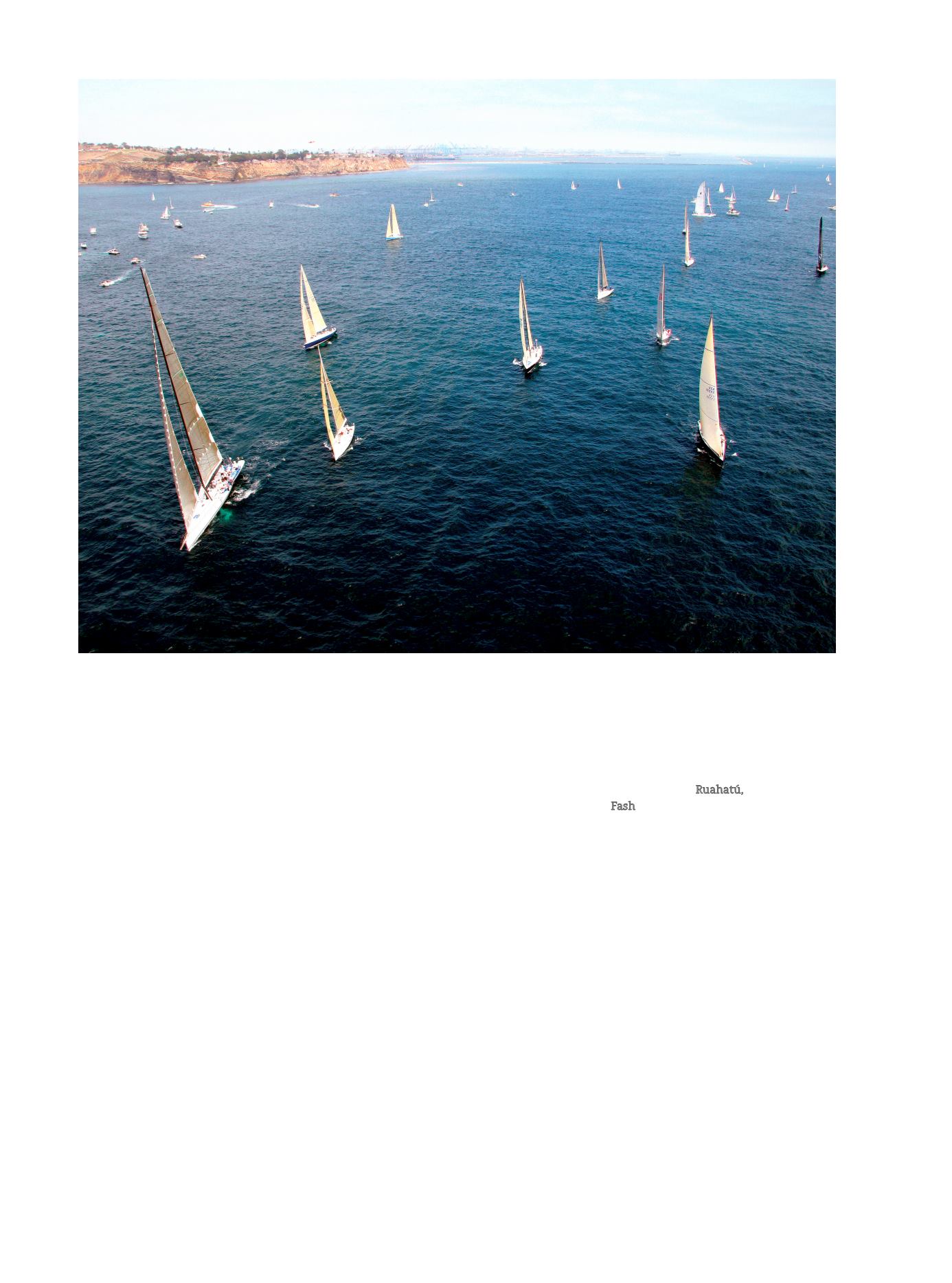
This competition takes place every two years
and almost 80 yachts compete. If you assume that each
boat has a crew of 10, that’s a figure of 800 participants.
The fastest boats complete the course in 7 days and the
slowest in 15; double the time.
AMURA:
What type of boat will you use?
RVC:
We’re sailing the Ruahatú, a 47’ Concordia
designed by Fash and is a combined boat; very good for
racing and cruising. It’s not like one of thosewithnothing
below decks, it has a galley, beds, cabins, everything.
AMURA:
What is the challenge of this regatta?
RVC:
It is a challenge for navigators that is competitive
all the time, in which you’ll continue to get the highest
speed as you can fromthe yacht and thismeans working
24 hours a day, constantly making adjustments to
the boat.
AMURA:
What is life like aboard?
RVC:
The first regatta is setting off and passing
Catalina Island, where youhave to have a strategy to take
advantage of a current. You go out in the day’s breeze in
the morning; it is the typical regatta when everybody as
if heading for a buoy at the point of Catalina, from there
the strategic concentration is how you sail through that
channel of Catalina because there is a current and the
objective is that you arrive at the synoptic wind; that
wind that youuse to set off will end because it is a breeze.
At 6 or 7 p.m., the wind will stop so you had better arrive
with thesewinds because theyaregradientwinds that do
not depend on the heating of the day’s breeze.
The first part of the regatta is to ask how I reach that
synopticwind, because if youdon’t on the first night, you


