·amura·
130
personajes •
characters
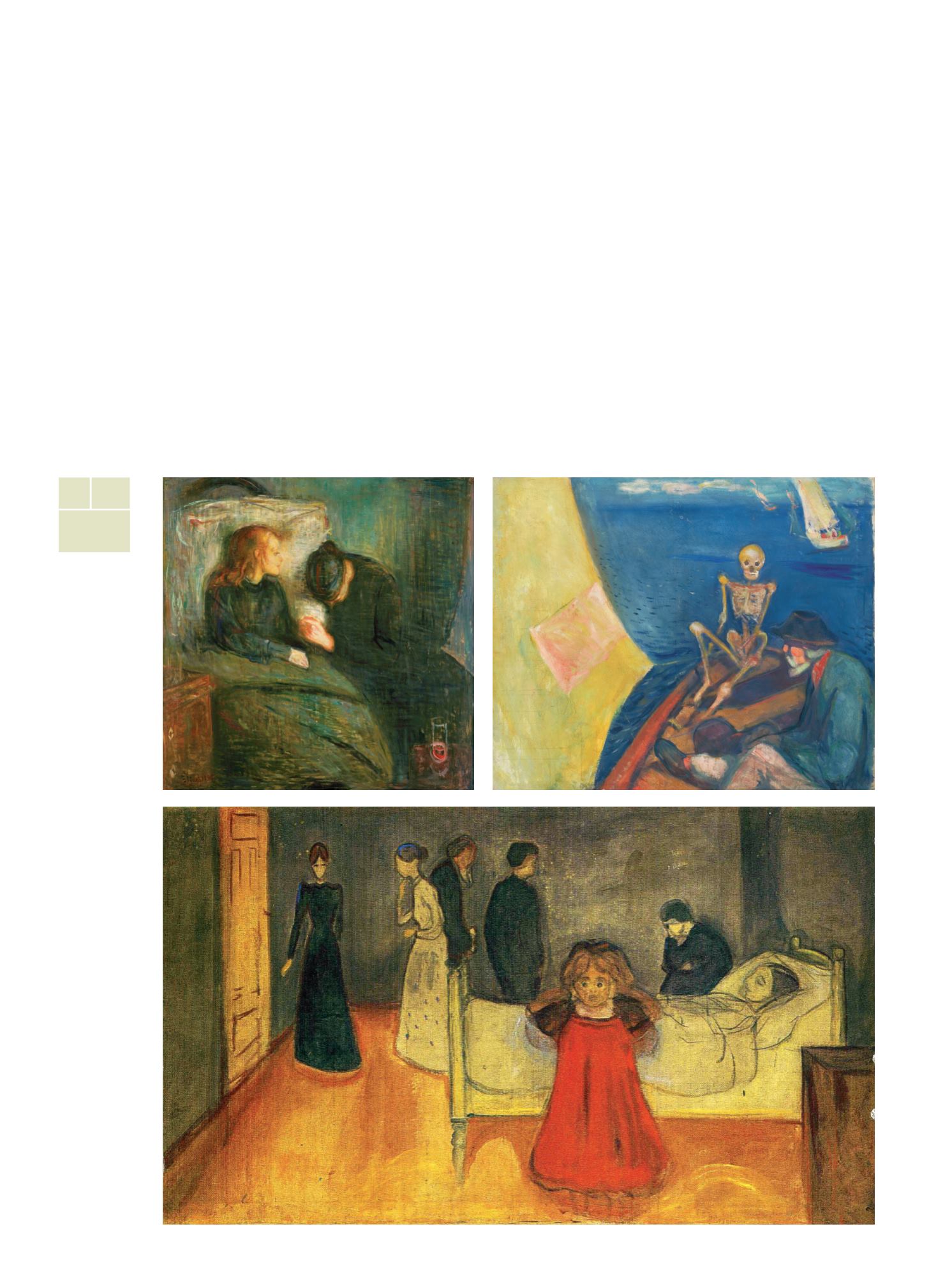
2, 3 y 4. Marcado por
la enfermedad y la
muerte de su hermana
y su madre, estos
motivos se encuentran
presentes en muchos
de sus cuadros.
/
Marked by the illness
and death of his sister
and mother, these
motifs are present in
many of his paintings.
Munch,juntoaHenrikIbsenyEdvardGrieg,constituyeeltrío
de los más grandes artistas noruegos. La pérdida de su madre
Laura Christine y su hermana Sophie debido a una tubercu-
losis, marcaron su infancia y adolescencia e influyeron para
siempre su vida. Esto se hace constar en obras como
La niña
enferma
(1885- 1886),
Muerte en la pieza del enfermo
(1895),
La madre muerta y la niña
(1897-1899), en las que expresa su
experiencia ante el dolor, la muerte, la soledad, la angustia y la
inevitablevejez.Desupadrerecordaba:“Mipadre,Christian,era
médicomilitar. Después de lamuerte demi madre, él se convir-
tió a la religión con una intensidad que parece haberlo hecho
indiferente al éxitomundano y sólo podía asustar a sus hijos”.
A los 21años, se acerca a los círculos bohemios deOslo, con
revolucionarias ideas en cuanto a libertad sexual y artística.
Inició estudios de ingeniería, los cuales abandonaría por la pin-
tura y posteriormente por múltiples viajes que realizó a París
para conocer la obra de Van Gogh, Toulouse-Lautrec, Gauguin
y Whistler, entre otros. Su obra evolucionó del naturalismo, al
simbolismo y finalmente a un estilo propio: el expresionismo.
En sus primeras pinturas es notoria la influencia de estos artis-
tas especialmente Gauguin, por la simpleza de las formas y el
uso de colores poco convencionales.
Munch, Henrik Ibsen and Edvard Grieg constitute the
trioof the greatest Norwegianartists. The loss of hismoth-
er and his sister to tuberculosis marked his infancy and
adolescence and influenced his life forever. This is obvious
in pieces like
The sick girl
(1885 – 1886),
Death in the room
of the sick
(1895) and
The dead Mother and the Girl
(1897 –
1899) in which he shows his experience with pain, death,
solitude, anguish and the inevitable old age. He remem-
beredof his father “My father, Christian, was amilitarydoc-
tor. After my mother’s death, he turned to religion with so
much intensity that it seemed to make him indifferent to
theworldly success and he could only frightenhis kids”.
At 21, hegets closer to thebohemiancircles of Oslo, with
revolutionized ideas regarding sexual and art freedoms. He
began his Engineering studies which he dropped in favor of
painting; afterwards, throughhismultiple travelling, he got
to know the work of Van Gogh, Toulouse-Lautrec andWhis-
tler, amongst others. His work evolved from naturalism to
symbolismand finally to his own style: the expressionism.
Inhisfirst paintings the influenceof theseartists isnotori-
ous, especiallyGauguin’sby the simplicityof the formsand
the use of unconventional colors.
2
3
4


