personajes •
characters
9
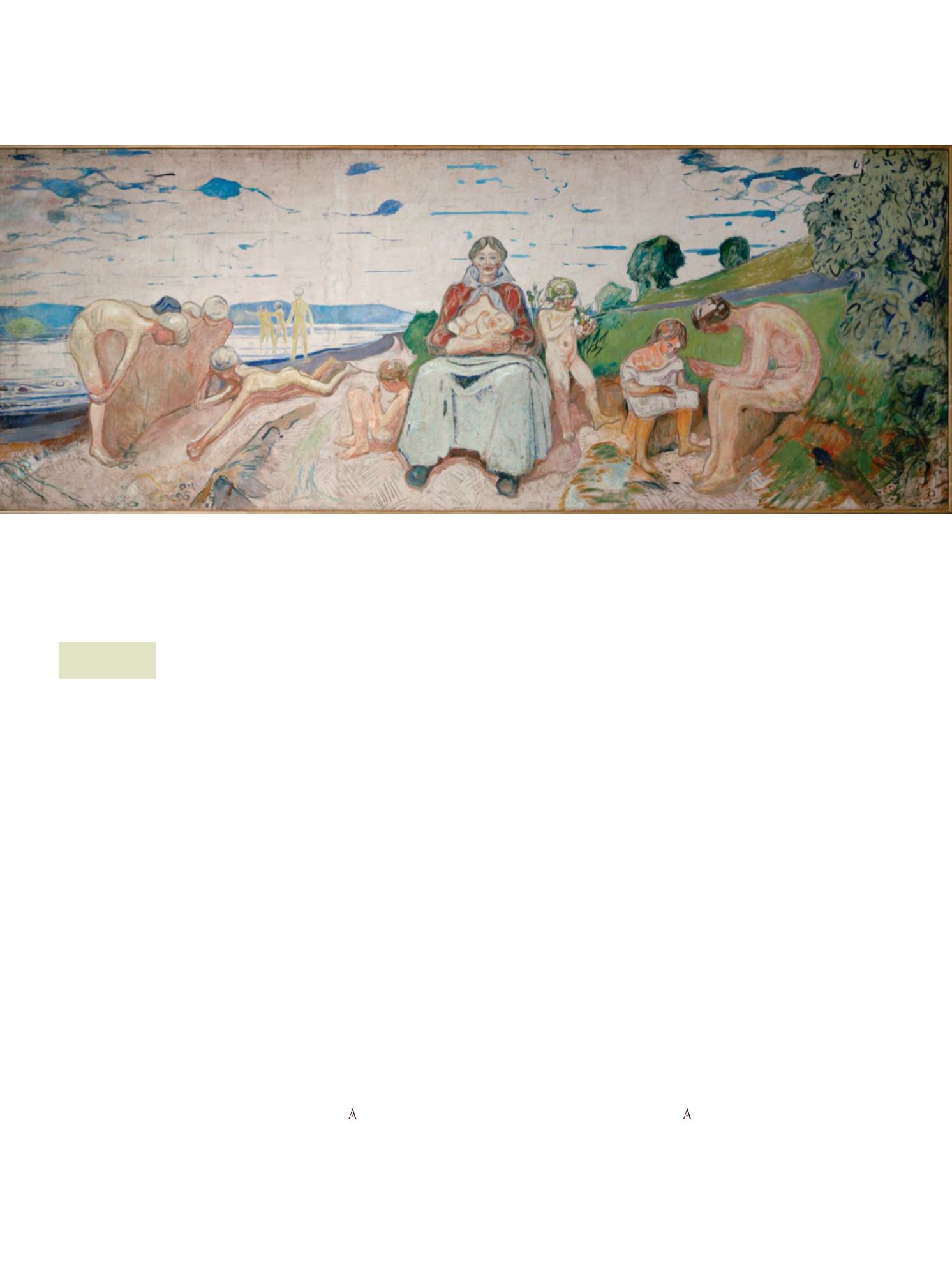
9. Forskerne, Edvard
Munch, 1910.
/
Forskerne, Edvard
Munch, 1910.
Años finales
Durante la invasión nazi a Noruega en 1940, los alemanes
retiraron sus cuadros de las galerías por considerarlos de-
generados y productos de un demente. Munch siempre
manifestó su aversión a la ideología nazi. Sin embargo, en
la Segunda Guerra Mundial, el pintor se hace mundialmente
conocido y en 1942 expuso sus cuadros en Nueva York por
primera vez. Munch dijo repetidamente: “no quiero morir
súbitamente o sin saberlo, quiero tener esa última expe-
riencia también”. En sus últimos autorretratos da cuenta
de su eventual confrontación con la muerte. Es así como en
el último:
Autorretrato entre el reloj y la cama
(1940-1943)
sitúa su ya frágil figura, entre el símbolo del inexorable
paso del tiempo y una cama en la que puede esperar la
muerte. El 23 de enero de 1944 muere en Noruega, solita-
rio, tal como había vivido toda su vida, sin más compañía
que la de sus dos perros, en su casa a las afueras de Oslo.
Al morir, legó más de 1,000 cuadros, 15,400 grabados,
4,500 dibujos y acuarelas y seis esculturas a la ciudad de
Oslo, que le rindió homenaje con la inauguración del Museo
Munch en 1963.
Tal como él decía, sin padecer la enfermedad y sufri-
miento, no habría logrado alcanzar una obra tan genialmente
innovadora. Así entonces, Munch constituye probablemente
el mejor ejemplo en la historia del arte de la influencia
de un trastorno psíquico en la creación artística, ya que
además el propio pintor era plenamente consciente de
esta relación.
O
·amura·
134
Final years
During the Nazi invasion of Norway in 1940, the Germans
tookall his paintings off of thegalleries because they con-
sidered them degenerated and the product of a madman.
Munch always expressed his aversion for the Nazi ideol-
ogy. However, during theWWII, the painter became world
famous and in 1942 he exposed his work in New York for
the first time. Munch repeatedly said: “I don´
t want to die
suddenly or without knowing it, I want to have that last
experience too”. In his last self-portraits he describes his
eventual confrontationwithDeath. That is how, inhis last
self-portrait:
Self-portrait between the clock and the bed
(1940-1943) he sets his already fragile figure between the
symbol of the inexorable pass of time and one bed where
he can wait for Death to come. On January 23rd of 1944 he
died in Norway, alone, as he had lived his whole life, with
no more company than that of his two dogs, in his house
outside of Oslo. He left over 1,000 pictures, 15,400 engrav-
ings, 4,500 drawings and six sculptures to the city of Oslo,
which, in return, honored him with the opening of the
MunchMuseum in 1963.
Just as he said, without suffering the illness and
the pain, he could not have managed to reach this level
of genially innovation in his work. That is how Munch
constitutes probably the best example in the history of
art of the influence of a psychic illness in the artistic
creation, for the artist himself was totally conscious of
this relationship.


