·amura·
131
personajes •
characters
Enfermedad y creatividad
Entre la vida de Munch y Van Gogh existe cierto paralelismo,
ambas están marcadas por el dolor y la angustia y, muy pro-
bablemente, por una enfermedad bipolar que incluso motivó
hospitalizaciones psiquiátricas. También coincidieron en su
pasión por las mujeres y las relaciones amorosas tormentosas;
así como por el obsesivo y psicótico afán de autorretratarse.
Sin embargo, Munch, a diferencia de Van Gogh, gozó en vida de
fama y reconocimiento.
El mismo Munch pintó aproximadamente 50 autorre-
tratos a los largo de su vida, manía que algunos estudiosos
atribuyen a la necesidad de tener certeza de su propia
existencia, de sentirse y validarse viéndose en una tela
o en una foto.
Son sus propias descripciones sobre las alucinaciones
que padecía las que alimentan la teoría de un trastorno bi-
polar; la misma expresión que emana de su obra maestra
El
grito
(1893) evidencia su condición, acentuada tras un viaje
a Europa durante el cual tuvo un incidente con Tulla Larsen,
con quien mantenía una tormentosa relación. Luego de que
ella amenazara con suicidarse con un arma, ésta se disparó
durante el forcejeo y significó la pérdida de una falange de la
mano izquierda de Munch.
El pintor fue hospitalizado en varias ocasiones entre los
años 1905 y 1909 por alcoholismo asociado a productividad
alucinatoria, ánimo depresivo e ideación suicida. Durante ese
periodo produce varios autorretratos. Los hechos de violen-
cia, riñas, peleas y agresiones no le eran ajenos, incluso tuvo
percances con otro pintor, lo que significó que se alejara de su
patria por cuatro años.
Sickness and Creativity
Between Munch’s and Van Gogh’s lives there is a certain
parallelism, both being marked by pain and anguish
and, quite probably, by a bipolar sickness that promoted
psychiatric hospitalizations. They also coincide in their
passion for women and tormented love relationships;
as well as by the obsessive and psychotic need to create
self-portraits. However, Munch, as opposed to Van Gogh,
enjoyed fame and recognition while being alive.
Munch himself painted approximately 50 self-
portraits throughout his life, obsession that some
scholars attribute to his need to have the certainty of
his own existence, of feeling and validating himself
through seeing his image on a portrait or a picture.
It is their own descriptions of the hallucinations he suf-
fered that serve as a base for the theory of a bipolar illness;
The expression that emanates of his masterpiece
The Scream
(1893) makes his condition evident, which accentuated after
a trip to Europe during which he had an incident with Tulla
Larsen, with whom he had a stormy relationship, after she
threatened him that she was going to commit suicide with a
gun, whichwent off during the struggle, resulting in the loss
ofapartofafingerofMunch’slefthand.
The artist was hospitalized in several occasions be-
tween 1905 and 1909 due to alcoholism associated to hal-
lucinatory productivity, depression and thinking of sui-
cide. During this period he produces various self-portraits.
The violence, arguments, fights, and aggressions were not
unfamiliar to him, he even got into trouble with other art-
ist which resulted inhis leaving his Country for four years.
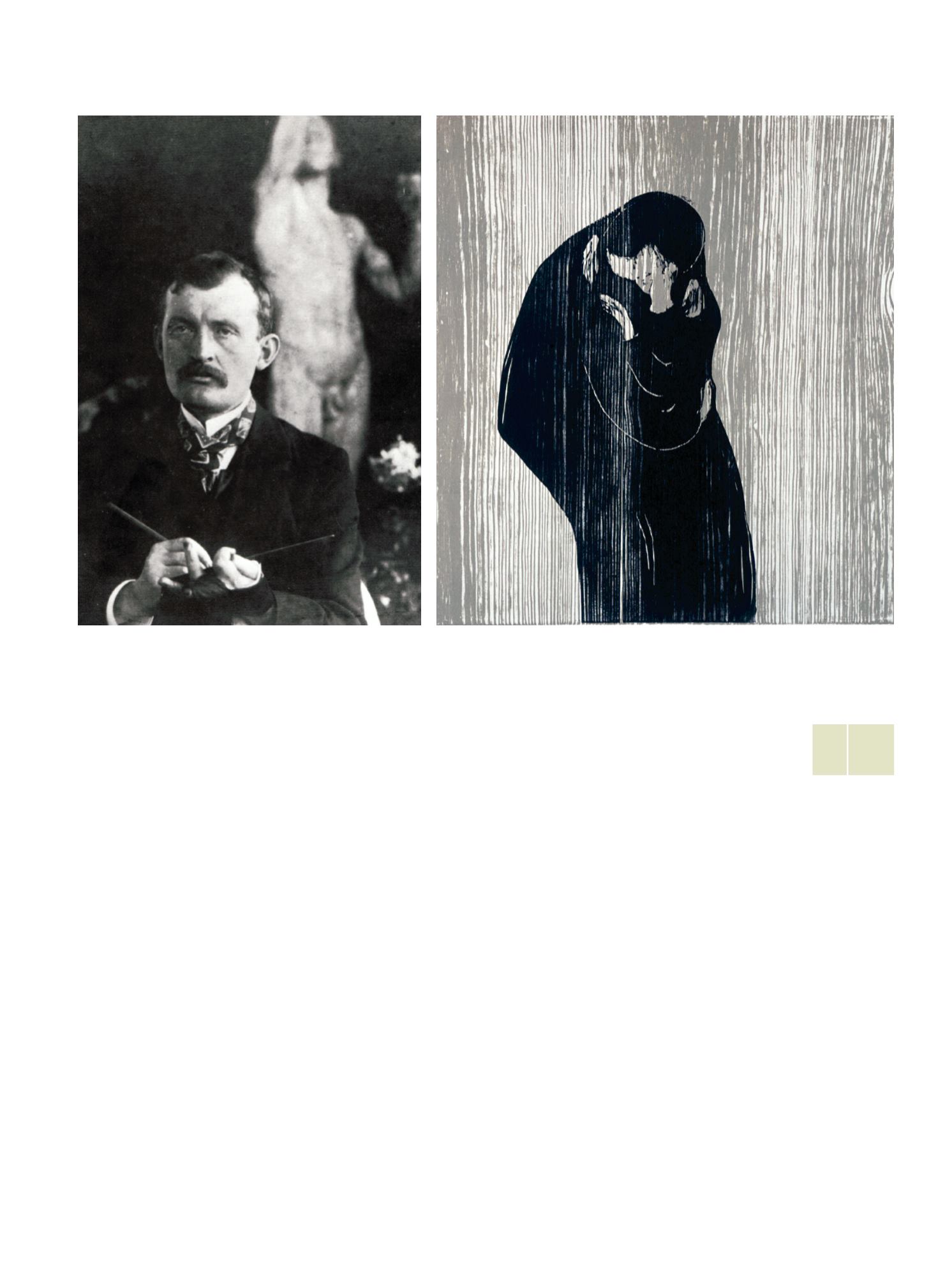
5y6.Laobrade
Munchevolucionó
delnaturalismo,al
simbolismoyfinalmente
aunestilopropio:
elexpresionismo.
/
Munch’sworkevolved
fromnaturalism,
symbolismandfinally
tohisownstyle:
expressionism.
5
6


