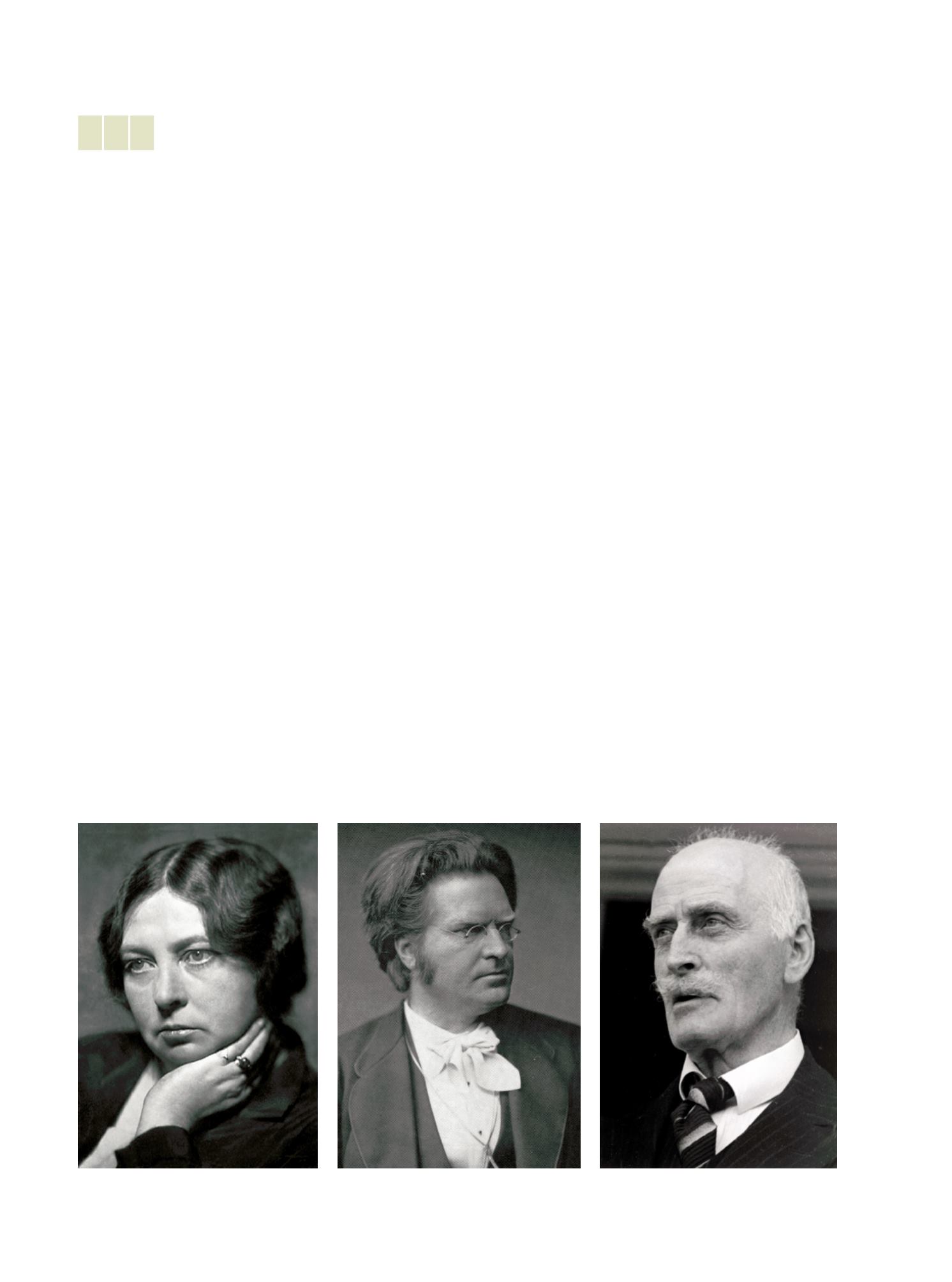
5. Retrato de Sigrid
Undset. /
Sigrid
Undset portrait.
6. Retrato de
Björnstjerne
Björnson. /
Björnstjerne
Björnson portrait.
7. Retrato de Knut
Pedersen, “Knut
Hamsun”. /
Knut
Pedersen, “Knut
Hamsun” portrait.
Premios Nobel de Literatura
Sigrid Undset (1882-1949)
Tras la muerte de su padre, Sigrid debió ocuparse de la
manutención familiar, actividad que se multiplicó por
partida doble después de contraer nupcias, situación
que derivó en fracaso. Tomó consciencia de la percep-
ción de la mujer “moderna”, se rebeló y entró al debate
político y social en favor de la mujer. En 1940 se exilió
en Estados Unidos, donde se distinguió como activista.
Una de sus obrasmás conocidas es Kristin Lavransdatter
(1920), una crítica vertida en narrativa que desentraña
la percepción, más que describir o contemplar.
Recibió el Premio Nobel de Literatura en 1928.
Bjørnstjerne Bjørnson (1832-1910)
Bjørnson fue un hombre de su época, escribió perti-
nazmente sobre los temas sociales, políticos, morales
y estéticos que aquejaban su entorno. Este escritor y
político, nutrido por la cultura del esfuerzo, la coope-
ración y la reciprocidad, dirigió la independencia de
Noruega en 1905. Conocía bien las duras condiciones
para la sobrevivencia de los campesinos, lo cual dejó
asentado en su novela Colina al sol (1857).
Recibió el Premio Nobel de Literatura en 1903.
Knut Pedersen, “Knut Hamsun” (1859-1952)
Comprometido con el neorromanticismo, fue recono-
cido por su profundó espíritu escandinavo, el cual se
demuestra en Hambre (1890), en la que capta analíti-
ca y poéticamente los efectos del hambre en los seres
humanos. Crítico del automatismo y la inhumanidad
de la civilización industrial. Autodidacta dedicado, por
vocación, a escribir creativamente desde que volvió
de Estados Unidos a Noruega. Debido a su apoyo al ré-
gimen nazi creyendo que regresaría la “grandeza del
espíritu emprendedor de los vikingos”, perdió sus car-
gos y reconocimientos.
Recibió el Nobel de Literatura en 1929.
5 6 7
·amura·
124
los conquistadores •
the conquerors
Nobel Prizes of Literature
Sigrid Undset (1882-1949)
After her father died, Sigrid had to support the fam-
ily, activity that doubled once she got married. This
situationdidnot last long, for hermarriage failed. She
discovered the “modern” female, rebelled and entered
the political and social debate in favor of the woman.
In 1940 she exiled himself to the USA, where she was
identified as an activist. One of his best known books
is Kristin Lavransdatter (1920), which is a criticism
poured into a narrative that disentangles the percep-
tion, more thandescribe or contemplate.
She received theNobel Prize of Literature in1928.
Bjørnstjerne Bjørnson (1832-1910)
Bjørnson was a man of his time, constantly writing
about the social, political, moral and esthetic top-
ics that affected his environment. This writer and
politician, nourished by the culture of the effort,
thecooperationandthereciprocation,conductedthein-
dependency of Norway in 1905. He knew well the
hard conditions for survival of the peasants, which
he reflected in his novel Hill under the Sun (1857).
He received the Nobel Prize of Literature in 1903.
Knut Pedersen, “Knut Hamsun” (1859-1952)
Committed with the Neoromanticism, he was recog-
nizedforhisDeepScandinavianspirit,whichheshows
inHunger (1890). Inthisbookhe captures inananalyt-
ical and poeticway the effects of hunger in the human
beings. Hewas a critic of the automationand the inhu-
manity of the industrial civilization. Since he got back
to Norway from the USA, this self-taught dedicated,
by vocation, to creatively write. He supported the Nazi
Regime wrongly believing that the “greatness of the
entrepreneur spirit of the Vikings” would come back;
becauseofthissupport,helosthispositionsandawards.
He received the Nobel Prize of Literature in 1929.
Foto /
Photo
:
JERMUNDILLE / NATIONALGEOGRAPHIC / DPF /WPD / Kleihues


