·amura·
40
compás int • int compass
Pedro I El grande
Con un imponente físico que pasaba de los dos metros
de altura y por las grandes aportaciones que brinda a
Rusia gana el sobrenombre de Pedro El Grande.
Sus primeros años como zar, Pedro comparte el
poder con su medio hermano Iván V, que es hijo del
primer matrimonio de su padre, pero debido al a las
deficiencias mentales de Iván, Sofía, su madre, lo ayu-
da con el gobierno, poniendo obstáculos y recelando a
Pedro. En 1869 Pedro da un golpe de Estado y manda a
un convento a Sofía.
Pedro se deja influir por Europa, con lo que de
cierta forma saca a Rusia del atraso en educación que
existía. Una de sus primeras reformas fue darle a la
mujer el derecho de no tener que cubrirse el rostro en
la vía pública, además del derecho a la vida social. Otra
de las imposiciones fue que la nobleza rusa le impidió
utilizar el cuchillo para limpiarse los dientes ni utilizar
el dedo índice para limpiarse la nariz.
Las reformas que imponía Pedro eran un produc-
tivo crecimiento de la estabilidad, tanto económica
como cultural de la nación, una reforma fiscal que au-
mentaba la base de contribuyentes y la creación de
la escuela Politécnica daba una nueva perspectiva de
Rusia, aunado a esto convierte a San Petersburgo en
la nueva capital.
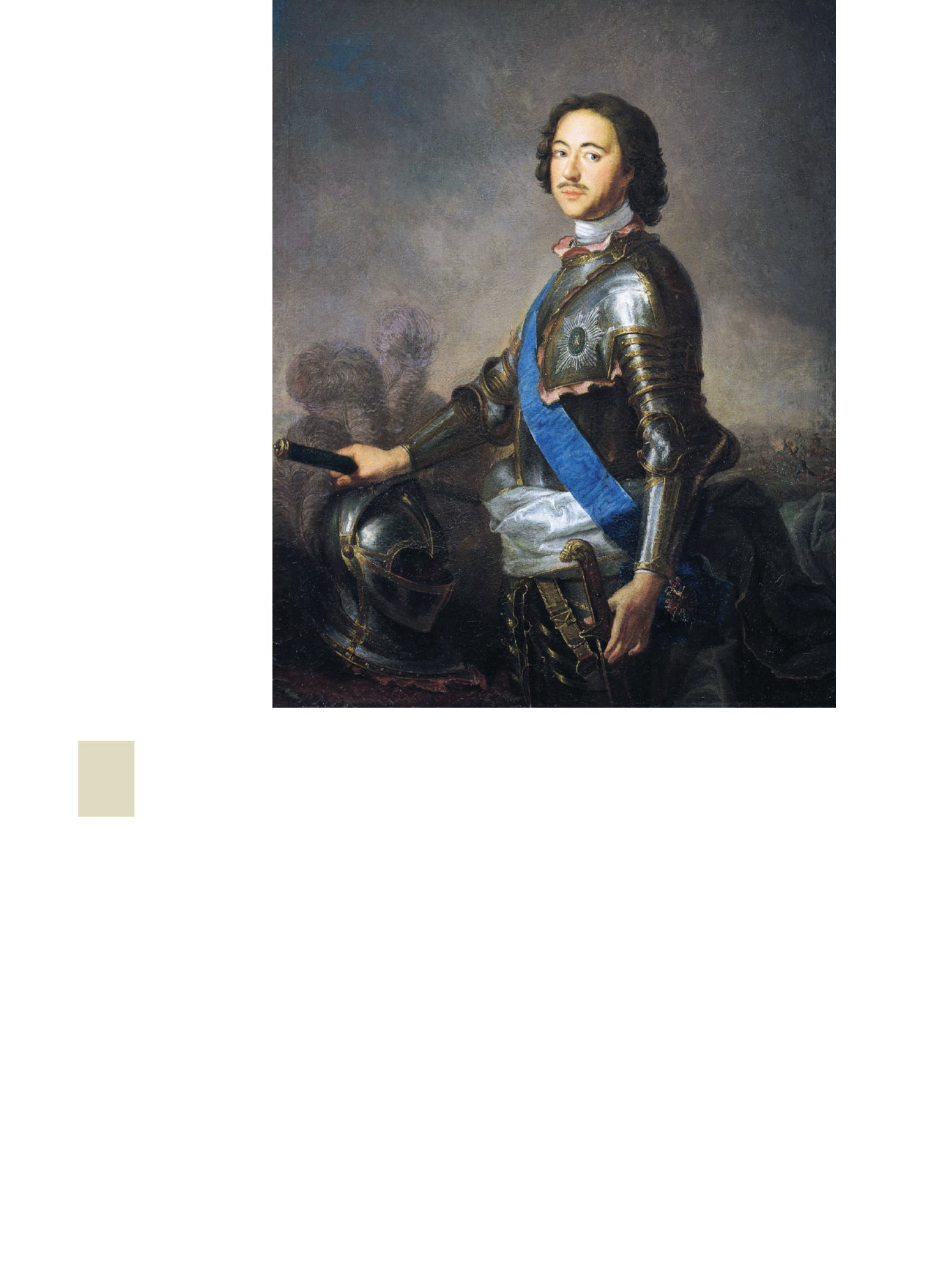
4
4. Zar Pedro I “El
Grande”, 9 de junio
1672 - 8 de febrero
1725 /
Tsar Peter I
“The Great” June 9,
1672 - February 8,
1725.
Peter I The Great
With an imposing physique, over two meters tall,
and for the exemplary contributions to his country,
he earns the nickname of Peter the Great.
On his firsts years as tsar, Peter shared power
with his half-brother Ivan V, who is the product of
his father’s first marriage, yet due to Ivan’s mental
deficiencies, Sophia, his mother, aided him in rul-
ing, imposing obstacles and suspecting of Peter. In
1689, Peter initiated a coup d’état and sent Sophia
to a convent.
Peter let himself be influenced by Europe, by
which he in some way pulls Russia out of the edu-
cational slump it had found itself in. One of his first
reforms was to give women the right to not have to
cover their faces on public roads, as well as a right to
have a social life. Another imposition prohibited the
Russian nobility from using a knife to clean their
teeth, or to use the index finger to clean their nose.
The reforms imposed by Peter where a pro-
ductive increase in stability, economic as well
cultural for the nation, a fiscal reform that in-
creased taxes and the creation of the polytech-
nic school that would give shape to a new Russia,
added to this is the renaming of Saint Petersburg
as capital.
Foto /Photo: RETLAW PHOTO / CINDY PEARSON / ROVING / LIFE TOURISM / ROUDER / maxi rodriguez/ ABAY / GELIO / CLICK TRAVEL / OKH


