



 137 / 156

·amura·
135
personajes •
characters
LA CONTRADICCIÓN
DE WALCOTT
Walcott, más que un poeta, es un autor que se pre-
ocupa por las situaciones sociopolíticas y cultura-
les de su entorno. Encontró una voz propia que ha
sido escuchada entre críticos, lectores, académi-
cos y otros escritores, quienes a su vez han cons-
truido una imagen autoral y han formado expecta-
tivas sobre él y su obra.
Derek Walcott está consciente de su imagen au-
toral, y puede aceptarla o rechazarla. De forma con-
tradictoria, hace ambas. Se reconoce a sí mismo como
un hombre caribeño que creció y vivió en Santa Lucía
(frecuente protagonista de su obra); acepta su rol de
representante, pero cuestiona si el ser un hombre ca-
ribeño significa ser un escritor caribeño.
Escribe, muchas veces intercambiando el inglés y
el criollo francés en su retórica, sobre la realidad de la
isla. Critica sus orígenes y su situación política median-
te la sátira y la farsa en sus obras teatrales, mediante
recursos literarios en sus versos, y a la vez se siente
orgulloso de su herencia cultural –es un escritor que se
preocupa por temas raciales, pero que a la vez niega la
cuestión de la raza porque es un problema social que
debería estar erradicado; el ser criollo no define quién
es como escritor o como persona, pero a la vez sí.
La poesía es un arte de muchos significados. Wal-
cott comentó, en una entrevista con Nancy Schoen-
berger, poeta y novelista, que “para que uno com-
prenda la poesía por completo, uno debe convertirse
en poeta”. Esto es lo que Walcott exige de su lector.
Las ideas y temas que aborda son desafiantes, y no
teme incomodarnos con sus cuestionamientos sobre
la historia de Santa Lucía. Y aunque su obra es pri-
mordialmente considerada como poesía, también es
narrativa, es épica, es dramaturgia, y a la vez no se
adhiere a ningún género. Su literatura está ligada a
la historia –la historia del pasado, la historia de las
Indias Occidentales y Santa Lucía, pero también la
historia que se escribe actualmente en el caribe y en
el resto del mundo.
THE WALCOTT
CONTRADICTION
Walcott, more than a poet, is an author who wor-
ries about the sociopolitical and cultural circum-
stances that surround him. He found his own voice
and has been heard amongst critics, readers, aca-
demics and other writers, who in turn have con-
structed an authorial figure and built expectations
around him and his work.
Derek Walcott is aware of his authorial image,
and he can either accept it or reject it. Paradoxically,
he does both. He recognizes himself as a Caribbean
man who grew up and lived in Saint Lucia (frequent
protagonist of his work); he accepts his representa-
tive role, but he questions whether being a Carib-
bean man equals being a Caribbean writer.
He writes, plenty of times interlacing English and
the local French Creole, about reality on the island.
He criticizes his origins and his political situation
through satire and farce in his plays, through literary
devices inhis verses, and at the same time he is proud
ofhisculturalheritage—heisawriterwhoseconcerns
lieonracialthemes,butatthesametimehedeniesthe
prospect of race because it is a subject that should be
eradicated by now; to be creole does not definewho he
is as awriter or as a person, and yet it does.
Poetry is a craft of multiple meanings. Wal-
cott commented, during an interview with Nancy
Schoenberger, poet and novelist, that “for one to
understand poetry completely, one has to become a
poet.” This is what Walcott demands of his readers.
The ideas and themes he deals with are bold, and
he’s never afraid to make us uncomfortable with
his questioning of Saint Lucia’s history. And even
if his work is primarily considered as poetry, it is
also narrative, epic, drama, and at the same time it
doesn’t adhere to any genre. His literature is linked
to history—the history of the past, the history of
theWest Indies and Saint Lucia, but also the history
that is currently being written in the Caribbean and
the rest of the world.
11. Busto en la Plaza
Derek Walcott /
Bustat
DerekWalcottSquare
12. Derek Walcott Square
13.
Pleno verano
, obra
de Derek Walcott /
Midsummer
byDerek
Walcott
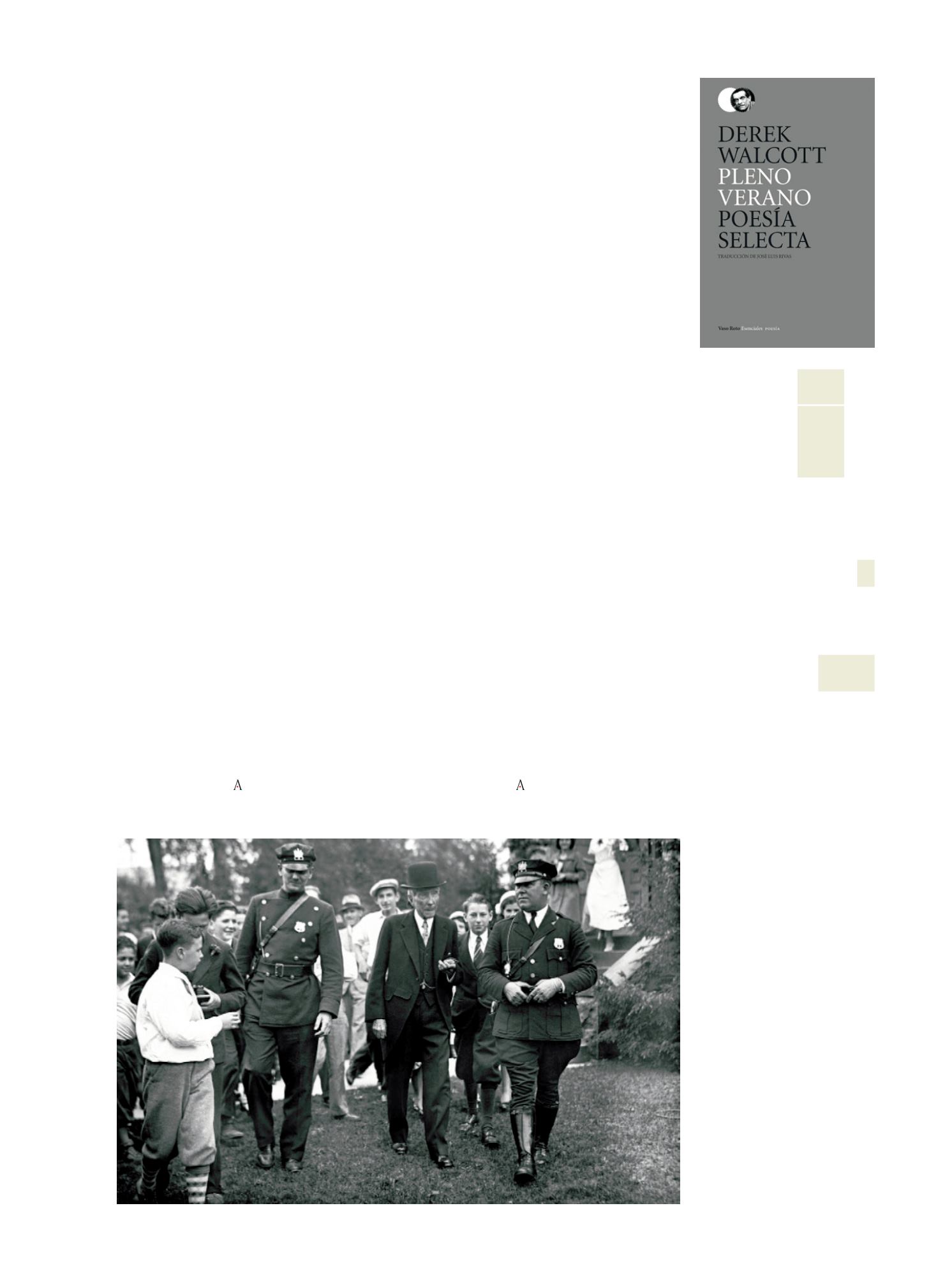
14.John Rockefeller
11
12
13
14