


 165 / 184

·amura·
159
IereOciB cVMtVrBM •
culture and heritage
L
ike thosemany ancient legends, the ori-
gins of the Scottish are lost in the mists
of time. According to the most com-
mon legend, a Scythian leader named
Gaythelos (Gollam) married Scota, the
daughter of the Egyptian pharaoh Symedes. The
couple, along with the Scythian clan of her husband,
ventured through the Mediterranean and finally ar-
rived to Portugal, where they settled. According to
the Scythian traditions, the clan took the name of
the wife of their leader as their own, hence the origin
of the name Scots. Subsequently, these peoplewould
move to Ireland to finally drop anchor in Scotland, a
region that would take its name precisely fromthem,
even though in their original language, Gaelic, the
name of the newKingdomwas Alba.
However, history is more interesting than
the legend. It seems the Scots, indeed, were a
people who dwelled somewhere in Spain, al-
though there is nothing to prove the relation-
ship with Egyptians. What is clear is that it’s ori-
gin was Scythian and, therefore, they were Celts.
So all the legend does is relay to us the migra-
tions of the Celts who ended up occupying much
of Europe. They moved to Ireland and eventually
founded two Kingdoms, one in Scotland, called
Dal Riata, and one in Wales. They shared the ter-
ritory with the Picts (another people of Scythian
origin), while the south of the island was occu-
pied by the Britons. So, Scots and Picts are the
earliest known inhabitants of Scotland.
After the Roman conquest of Britain and in or-
der to prevent incursions from the north - called
Caledonia by the Romans for the huge number of
Caledonian pines that covered it - Romans built
the famous Hadrian’s Wall in northern England.
The arrival of the Anglo-Saxons in the Fifth cen-
tury ended the Scot and Pict rule in the territory.
Both nations were fragmented into small clans and
fought each other. This is a dark age, full of legends
and mythological characters, Kings that tried again
and again to unify the Kingdom but failed in the at-
tempt. Finally, in 847 Kenneth MacAlpin achieved
the union of the Scottish clans and submitted the
last Pict King, Drest IX, thus founding the Kingdom
of Scotland and becoming its first King.
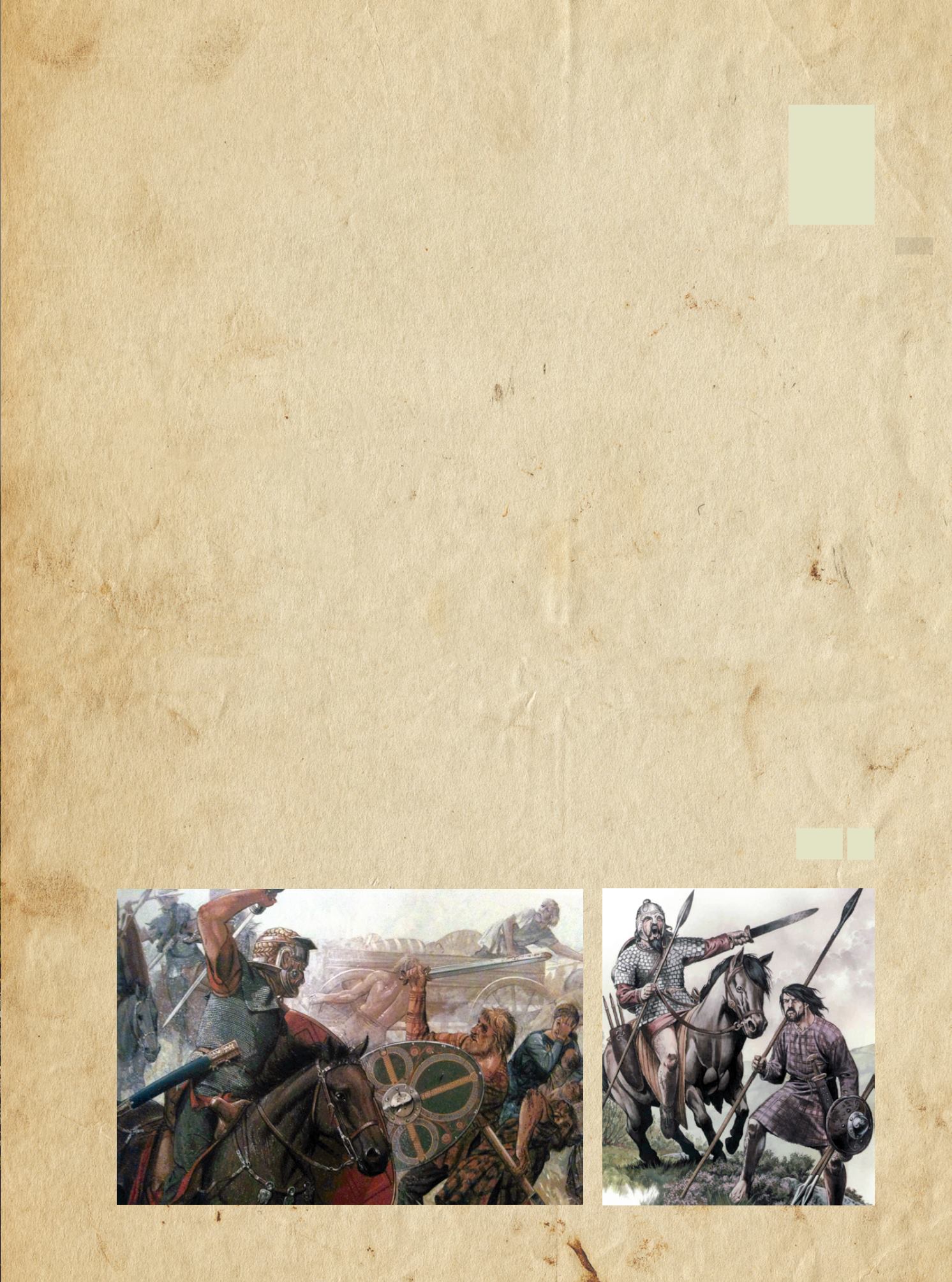
1.Elpuebloescocéses
resultadodeunarduo
procesodeunificación
yunabastahistoria./
TheScottishpeople
istheresultofan
arduousprocessof
unificationandavast
history.
2.Conquistaromana
deBritaniayelpueblo
picto./
Roman
conquestofBritain
andthePictpeople.
3.Representación
de larebeliónpicta./
Representationofthe
Pictishrebellion.
1
C
omo muchos pueblos de la antigüedad,
los orígenes de los escoceses se pier-
den en la bruma de los tiempos. Según
la leyenda más extendida, un líder esci-
ta llamado Gollam se casó con Escota,
hija del faraón egipcio Symedes. El matrimonio, jun-
to con todo el clan escita del esposo, viajaron por el
Mediterráneo para finalmente llegar a Portugal, don-
de se establecieron. De acuerdo con las tradiciones
escitas, el clan tomaba como propio el nombre de la
esposa de su líder, y de ahí el origen del nombre de
Escotos. Posteriormente, este pueblo se trasladaría
a Irlanda para recalar finalmente en Escocia, región
que tomaría su nombre precisamente de ellos, aun-
que en su lengua original, el gaélico, el nombre del
reino fue el de Alba.
Pero como siempre, la historia es más interesante
que la leyenda. Todo parece indicar que los escotos,
en efecto, eran un pueblo que habitó en algún lugar
de España, mientras que no hay nada que pruebe su
relación con los egipcios. Lo que sí está claro es que su
origen fue escita y, por lo tanto, eran celtas.
Así que la leyenda lo único que hace es contarnos
las migraciones de los pueblos celtas que terminaron
ocupando buena parte de Europa. Éstos se trasladaron
a Irlanda y finalmente fundaron dos reinos, uno en Es-
cocia, llamado Dal Riada, y otro en Gales. Compartie-
ron el territorio con los pictos (otro pueblo de origen
escita), mientras el sur de la isla era ocupado por los
britanos. Así, escotos y pictos son los primeros habi-
tantes conocidos de Escocia.
Tras la conquista romana de Britania y para evitar
las incursiones provenientes del norte, llamado por
los romanos Caledonia por el enorme número de pinos
caledonios que lo cubrían, fue que éstos construyeron
el famoso muro de Adriano en el norte de Inglaterra.
La llegada de los anglosajones en el siglo V puso
fin al poder escoto y picto en el territorio. Ambos
pueblos se fragmentaron en pequeños clanes que lu-
charon entre ellos. Esta es una época oscura, llena de
leyendas y de personajes mitológicos, de reyes que
intentan unificar de nuevo el reino pero que fracasan
en el intento. Finalmente, en 847 Kenneth Mac Alpin
consigue unir a los clanes escotos y somete al último
rey picto, Drest IX, fundando así el reino de Escocia,
convirtiéndose en su primer rey.
2
3