


 110 / 134

·amura·
106
Ballena azul
(
Balaenoptera musculus
)
Está distribuida por casi todos los océanos del pla-
neta, excepto el Ártico, y solo se halla en los ma-
res de Bering, el Mediterráneo y el de Ojotsk. Las
mayores poblaciones permanecen entre el Pacífico
Norte y el Antártico Norte. Es considerado como el
animal más grande que ha existido en el mundo,
ya que supera en altura a los extintos dinosaurios.
Mide hasta 30 m de longitud y llega a alcanzar un
peso de 180. 000 kg. La ballena azul produce un so-
nido más intenso que el de cualquier otro animal.
Entre 1914 y 2013, la cantidad total de la ballena
azul se redujo un 70-90 %, por lo que está clasi-
ficada en peligro de extinción. Puede ser avistada
entre Alaska y Baja California, en dos temporadas:
desde junio a octubre, y de febrero a julio.
Ballena de cabeza
arqueada
(
Balaena mysticetus
)
Mejor conocida como ballena boreal o de Groenlandia, lle-
ga amedir entre14y20mde longitudyapesar de75.000
a 100.000 kg. A diferencia de otros cetáceos que migran
para alimentarse y reproducirse en aguas más cálidas, la
ballena boreal reside únicamente en las aguas del Ártico y
subÁrtico. Aunqueen laactualidadse trasladadesdeAlas-
ka para pasar losmeses de invierno en el suroeste del Mar
de Bering, ymigra hacia el norte en la primavera, a raíz de
queseabrieron las rendijasdel hieloen losmaresdeChuk-
chi y Beaufort; todo esto debido a los efectos del cambio
climático. Se dice que puede llegar a vivir 200 años, lo que
le convierte en el mamífero más longevo. Como otros ce-
táceos, fue cazada comercialmente durante siglos has-
ta que en 1996 se estableció una moratoria global para
prohibir esta práctica execrable. Actualmente su total se
estima enmás de 24.900 ejemplares, que antes de lamo-
ratoria eran apenas 3.000, aunque aún se mantiene en la
lista de los animales en peligro de extinción.
The Blue Whale
(Balaenoptera Musculus)
They are distributed across almost all of the oceans of
the planet, except the Arctic, and only are present in
the seas of Bering, theMediterraneanandOkhotsk. The
largest populations remain between the North Pacific
and theNorthAntarctic. It is considered the largest ani-
malthathaseverexistedintheworld,sinceitsurpasses
in height the extinct dinosaurs. It measures up to 30m
in length and weighs up to 180,000kg. The blue whale
produces a soundmore intense than any other animal.
Between1914and2013, thenumbers in thebluewhale
populationwere reduced 70-90%, reasonwhy it is clas-
sifiedas indanger of extinction. It canbe spotted in the
territories that span Alaska and Baja California during
two seasons: from June to October, and between Febru-
aryand July.
The Bowhead
Whale
(Balaena Mysticetus)
Also known as polar whale or Greenland right whale,
it can measure between 14 and 20m in length, and
weigh from 75,000 to 100,000kg. Unlike other ceta-
ceans that migrate to feed and reproduce in warmer
waters, the bowheadwhale only dwells in Arctic and
sub-Arctic waters. Nowadays, it travels from Alaska
to spend the winter in the south-west of the Ber-
ing Sea, and migrates north in the spring now that
the ice cracked opened in the seas of Chukchi and
Beaufort due to climate change effects. Some say
this whale can live to 200 years, which makes it the
longest livingmammal. Like other cetaceans, it was
commercially hunted for centuries until a global
moratoriumwas established in 1996 to ban this hei-
nous practice. Currently, its numbers are estimated
at more than 24,900 specimens; before the morato-
rium, there were only 3,000. Despite this, it remains
on the list of endangered animals.
ESPECIESDE BALLENAS
WHALE SPECIES
Existen dos tipos de ballenas: las barbadas y las dentadas, clasificadas
así por la forma en que se alimentan, y que a su vez se subdividen en
diferentes especies.
There are two types of whales: baleen and toothed, thus classified because
of the way in which they feed. These two categories are subdivided into dif-
ferent species.
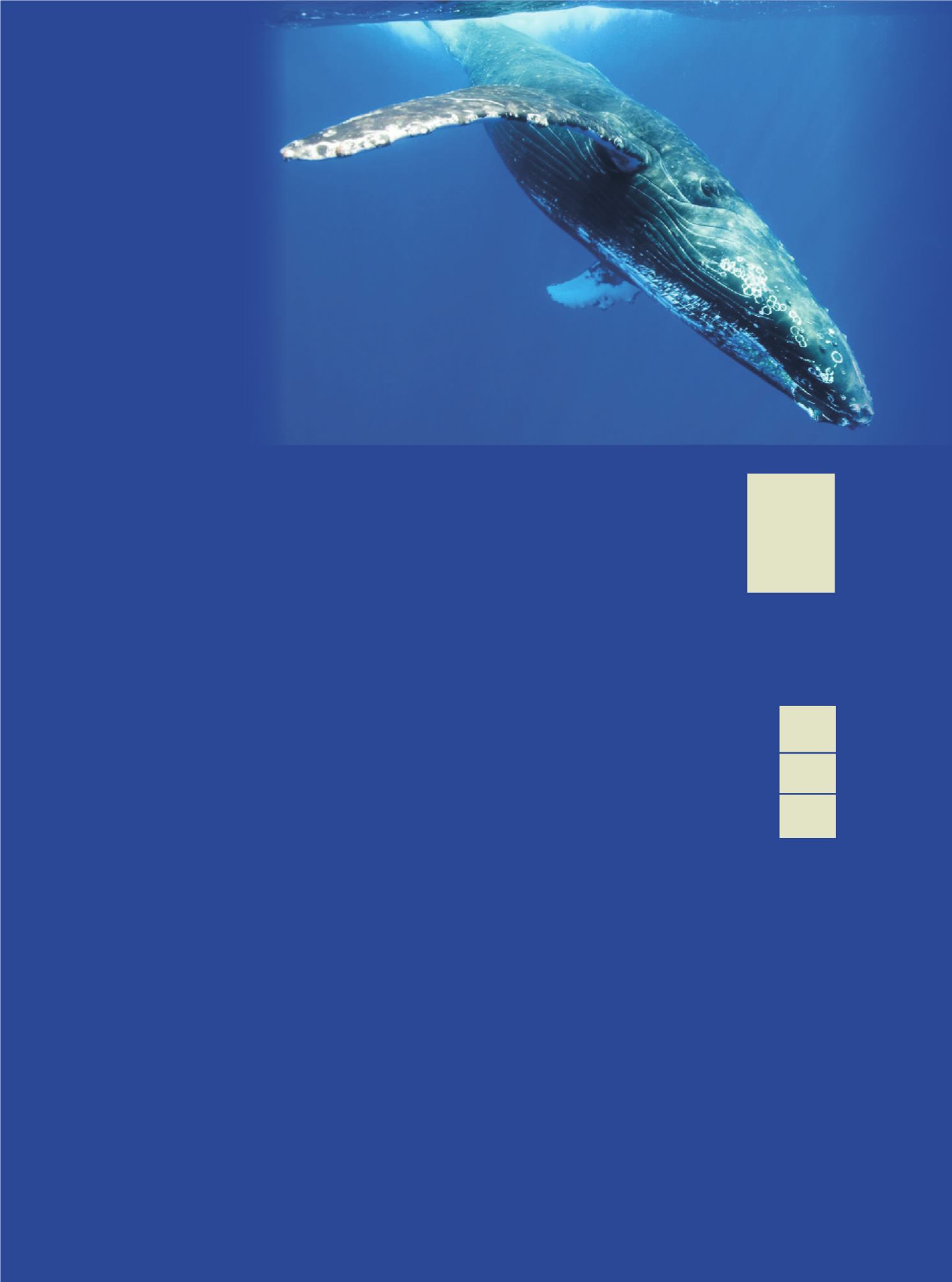
10.Laballenaazul
seencuentraen
aguassubtropicales
ypolaresentodoel
mundo./
TheBlue
Whale isfoundin
subtropicalandpolar
watersworldwide..
11.LaballenaBoreal
tieneunacabeza
enormequeutiliza
pararomperelhielo
espeso./
TheBoreal
whalehasahuge
headthatituses
tobreakthrough
thickice.
12.Lasballenas
francastienenuna
particularnaturaleza
dócil./
Rightwhales
haveaparticular
docilenature.
13.Lasballenas
francaspigmeasson
lasmáspequeñasde
lasballenas./
Pygmy
rightwhalesare
thesmallestofthe
baleenwhales.
especies •
species
10
11
12
13