


 112 / 134

·amura·
108
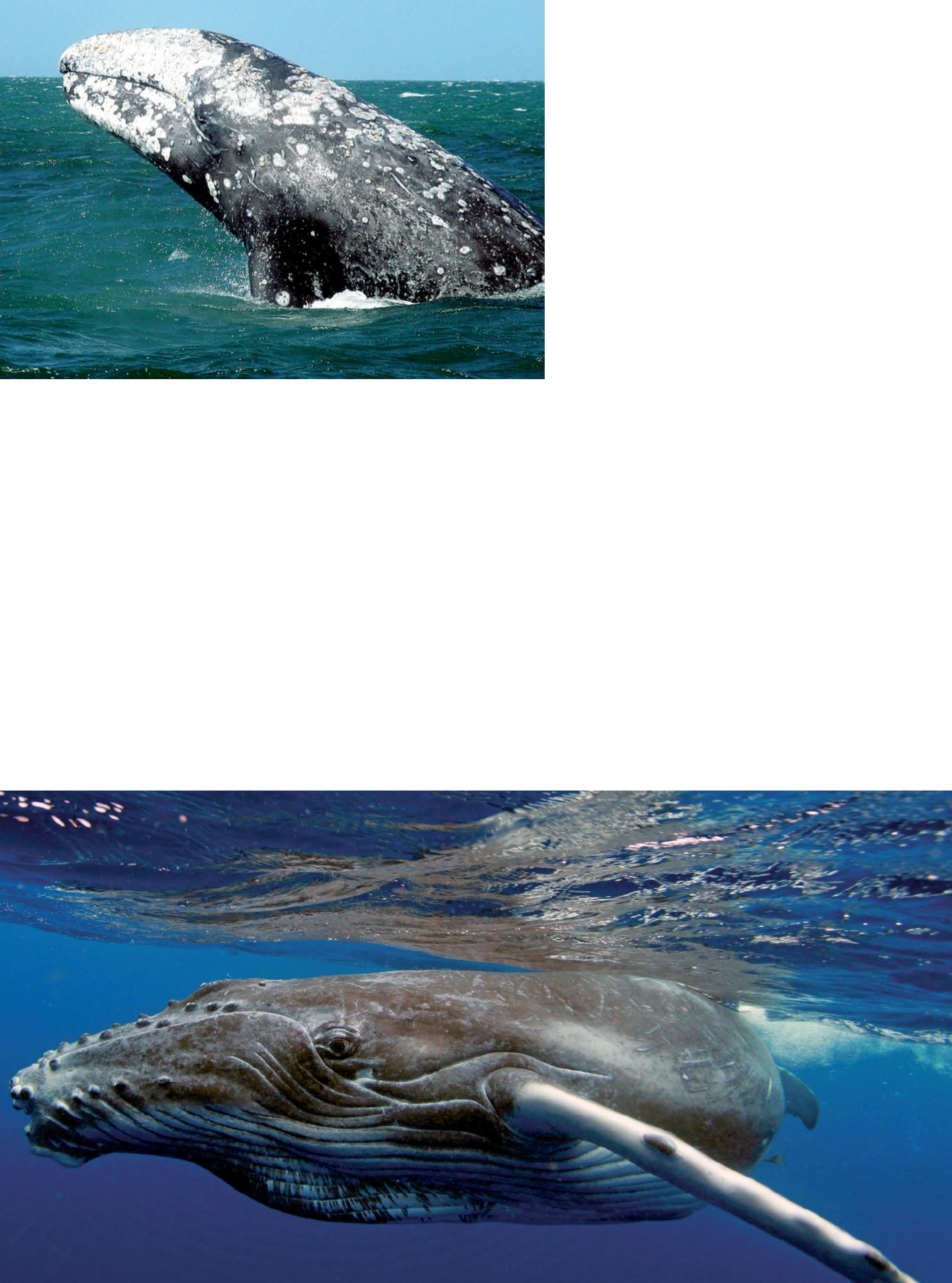
Ballena gris
(Eschrichtius robustus
)
Es la ballena que recorre distancias más largas en su migración. En la actualidad solo habitan
en el norte del Océano Pacífico. Dejan su territorio en los meses de noviembre o diciembre,
partiendo del Mar de Bering, donde comienza su recorrido anual a través de las costas de Alas-
ka, pasando por Canadá, el norte de Estados Unidos y California, hasta llegar a un santuario de
protección en las cálidas y poco profundas aguas de Baja California Sur, México. En estas aguas
permanece hasta abril, entre tanto, algunas integrantes del grupo inician y otras terminan su
ciclo reproductivo. La ballena gris se extinguió en el Atlántico Norte en el siglo XVIII.
Ballena jorobada
(
Megaptera novaeangliae
)
La Ballena jorobada es también conocida como yubarta o gubarte, se reconocen tres subespecies:
Ballena jorobada del sur; Ballena jorobada del Pacífico Norte y Ballena jorobada del Atlántico Norte.
Al igual que la Ballena Azul, en realidad pertenece a un género de cetáceo conocido como Rorcual,
(unmamífero muy parecido a las ballenas). Se encuentra en todos los océanos, excepto en los ma-
res polares. Pasa el verano alimentándose a lo largo de la costa entre California y Alaska. Llegado el
tiempo de reproducirse, migra a las aguas tibias de Hawaí, México, Costa Rica, y Japón. La población
en Californiamigra aMéxico y Costa Rica, y la que habita en Alaskamigra hacia Hawaí.
Gray Whale
(Eschrichtius Robustus)
This whale travels the longest distances when
migrating. They currently live in the north of
the Pacific Ocean. They leave their territory in
November or December, starting at Bering Sea,
where their annual journey through the coasts
of Alaska begins, passing through Canada, the
north of the United States and California, until
they arrive to a protected sanctuary in the warm
and shallowwaters of Baja California Sur, Mexico.
They remain there until April; in the meantime,
some members of the group begin and others
end their reproductive cycle. The North Atlantic
gray whale became extinct in the 18th century.
Humpback Whale
(
Megaptera Novaeangliae)
There are three recognized subspecies of the
humpback whale: the North Pacific, North At-
lantic and Southern Hemisphere Humpback
Whales. Along with the Blue Whale, it be-
longs to a genus of cetaceans known as
Ror-
qual
(a mammal very similar to whales). You
can find it in every ocean, except in the polar
seas. They spend the summer feeding along
the coast between California and Alaska. They
migrate to the warm waters of Hawaii, Mexico,
Costa Rica, and Japan during breeding season.
The population in California migrates to Mex-
ico and Costa Rica, and the one that dwells in
Alaska migrates to Hawaii.
especies •
species