


 111 / 134

·amura·
107
especies •
species
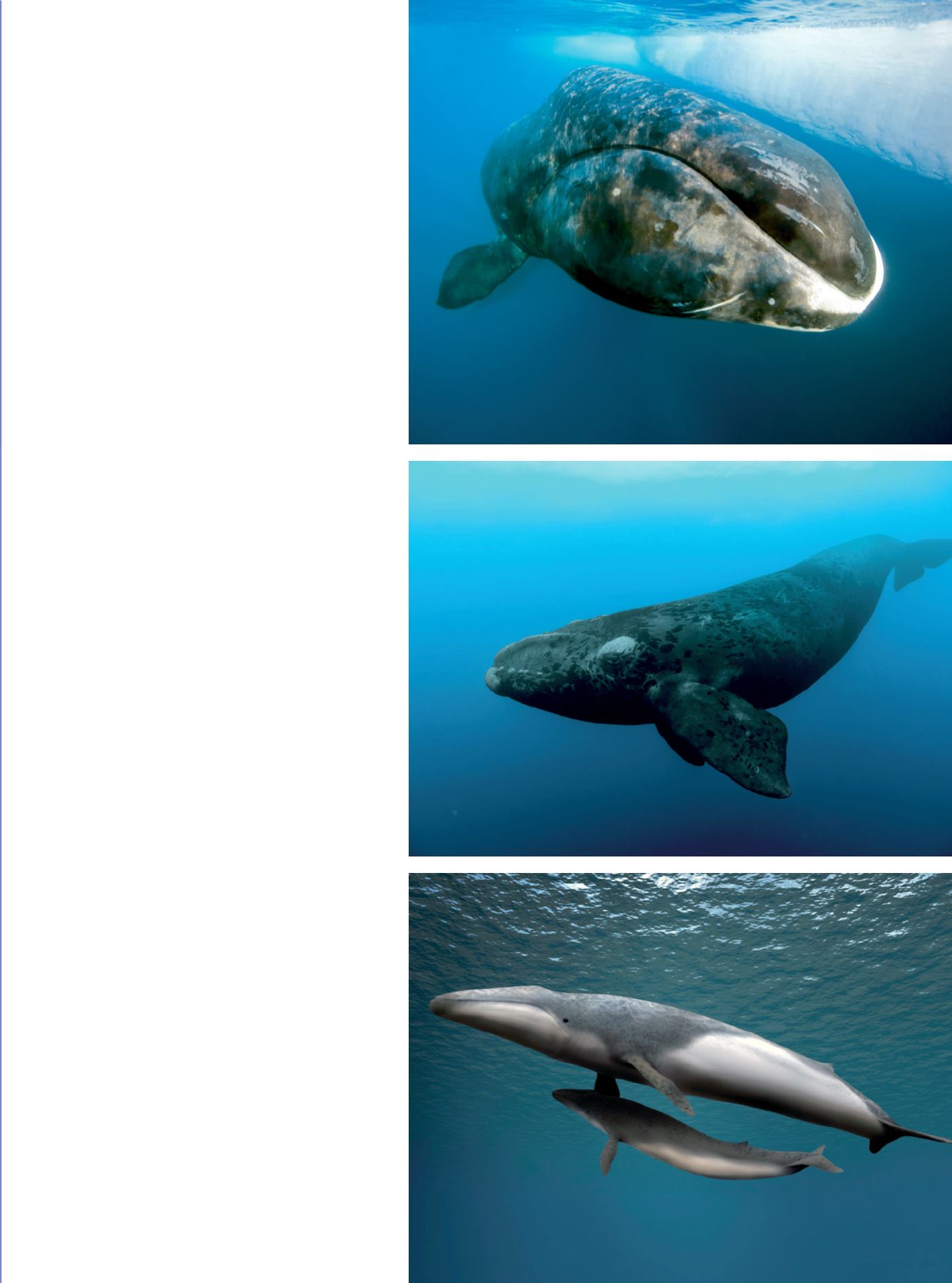
Ballena franca Austral
(
Eubalaena australis
)
Por su distribución geográfica se consideran tres grupos
diferentes de ballenas francas, ya que unas viven en el
Atlántico Norte, otras se encuentran en el Pacífico Norte,
y la gran mayoría en las regiones del Atlántico Sur, Pací-
fico e Indico Sur, entre los 20° y 60° de latitud. Algunos
de los países donde es posible avistarlas son: Argentina,
Brasil, Chile, Sudáfrica, sur de Australia y algunas islas
oceánicas. Viven en grupos de hasta 12 especímenes,
pero es más habitual encontrarlas en comunidades de 2
o 3 animales. Su población se estima en 8.000 individuos
solamente. En las costas argentinas vive el grupo más
numeroso del mundo, que fue declarado Monumento
Natural por una ley nacional del gobierno argentino.
Ballena franca pigmea
(
Caperea marginata)
Se consideraba extinta, hasta el año 2012 en que fue
hallado un espécimen en las costas de Nueva Zelan-
da. Es oriunda del Hemisferio Sur, y su nombre se
debe a su tamaño de 6.5 m y su peso que no rebasa
los 3.500 kg. A este ejemplar se le ha apreciado como
un verdadero fósil viviente, que hasta el momento es
el único superviviente de su estirpe.
The Southern
Right Whale
(Eubalaena Australis)
Because of its geographical distribution, there are
three different types of southern right whales; one
group lives in the NorthAtlantic, others in the North
Pacific, and the majority live in the South Atlantic,
South Pacific and South Indian oceans, between 20
º
and 60
º
of latitude. Some of the countries where it is
possible to catch sight of themare Argentina, Brazil,
Chile, South Africa, the south of Australia and some
oceanic islands. They live in pods of up to 12 speci-
mens, but it is more common to find them in com-
munities of 2 or 3 whales. Their population is esti-
mated at 8,000 individuals only. The largest group
in the world lives in the Argentine coasts, and was
declared as Natural Monument by a national law es-
tablished by the government of Argentina.
The Pygmy Right Whale
(Caperea Marginata)
It was considered extinct until 2012, when a speci-
men was found at the coasts of New Zealand. It is
native to the Southern Hemisphere, and its name
is based on its size of 6.5m and its weight that does
not exceed 3,500 kg. This specimen has been appre-
ciated as a true living fossil, which until now is the
only survivor of its kind.