·amura·
118
los conquistadores •
the conquerors
The final section of the exhibition will explore
British creativity in relation to manufacturing in-
dustries, new technologies and architecture. During
the post-war years, Britain was internationally re-
nowned for its inventive product design and globally
recognised for its feats of engineering from the Mini
to Concorde. Since the oil crisis of the early 1970s tra-
ditional British manufacturing was in decline, while
the nation’s service industries started to expand.
The strength of Britain’s advances in new technolo-
gies will be illustrated by objects such as the Sinclair
ZX80 home computer (1980) and Jonathan Ive’s iMac
for Apple (1998). There will also be an immersive
computer-gaming installation at the centre of the fi-
nal gallery, featuring specially designed projections
of five video games developed in Britain. The last
sectionwill also examine Britain’s expertise in archi-
tecture and structural engineering and will display
architectural renderings and models of the Falkirk
Wheel created by RMJM (2002), Foster & Partner’s 30
St Mary Axe building (2004) and a newly commis-
sioned model of Zaha Hadid’s London Aquatics Cen-
tre (2011), opening in the summer of 2012.
Tickets will be available for the general public
for £12 (concessions available), while V&AMembers
will enjoy a free entrance.
The Victoria & Albert Museum website is will be
available or advance bookings (
.
Mark Brazier Jones, todos ilustrando el impulso radical
del arte y el diseño británicos.
La última sección explorará la creatividad Bri-
tánica en relación a las industrias de la fabricación,
nuevas tecnologías y arquitectura. Durante los años
que siguieron a la Guerra Mundial, Inglaterra fue in-
ternacionalmente reconocida por el diseño de sus
productos y respetada mundialmente por sus logros
mecánicos desde el Mini hasta el Concorde. La fuer-
za de los avances Británicos en nuevas tecnologías
será ilustrada por objetos como la computadora de
casa Sinclair ZX80 (1980) y la iMac de Jonathan Ive
para Apple (1998). En la última sección se exhibirán
proyecciones especialmente creadas para cinco vi-
deojuegos desarrollados en Inglaterra, y también se
examinará la pericia británica en cuanto a arquitectu-
ra y diseño estructural, y demostrará “renders” y mo-
delos arquitectónicos de la Falkirk Wheel creada por
RMJM (2002), el edificio 30 St Mary Axe de Foster &
Partner’s (2004), y el ya comisionado modelo de Zaha
Hadid’s London, Aquatics Centre (2011), que abrirá
sus puertas en 2012.
La entrada costará £12 para el público en gene-
ral, mientras que los miembros del museo tendrán
entrada libre.
La pagina web del Museo Albert & Victoria (www.
vam.ac.uk) estará a la disposición del público para
reservaciones.
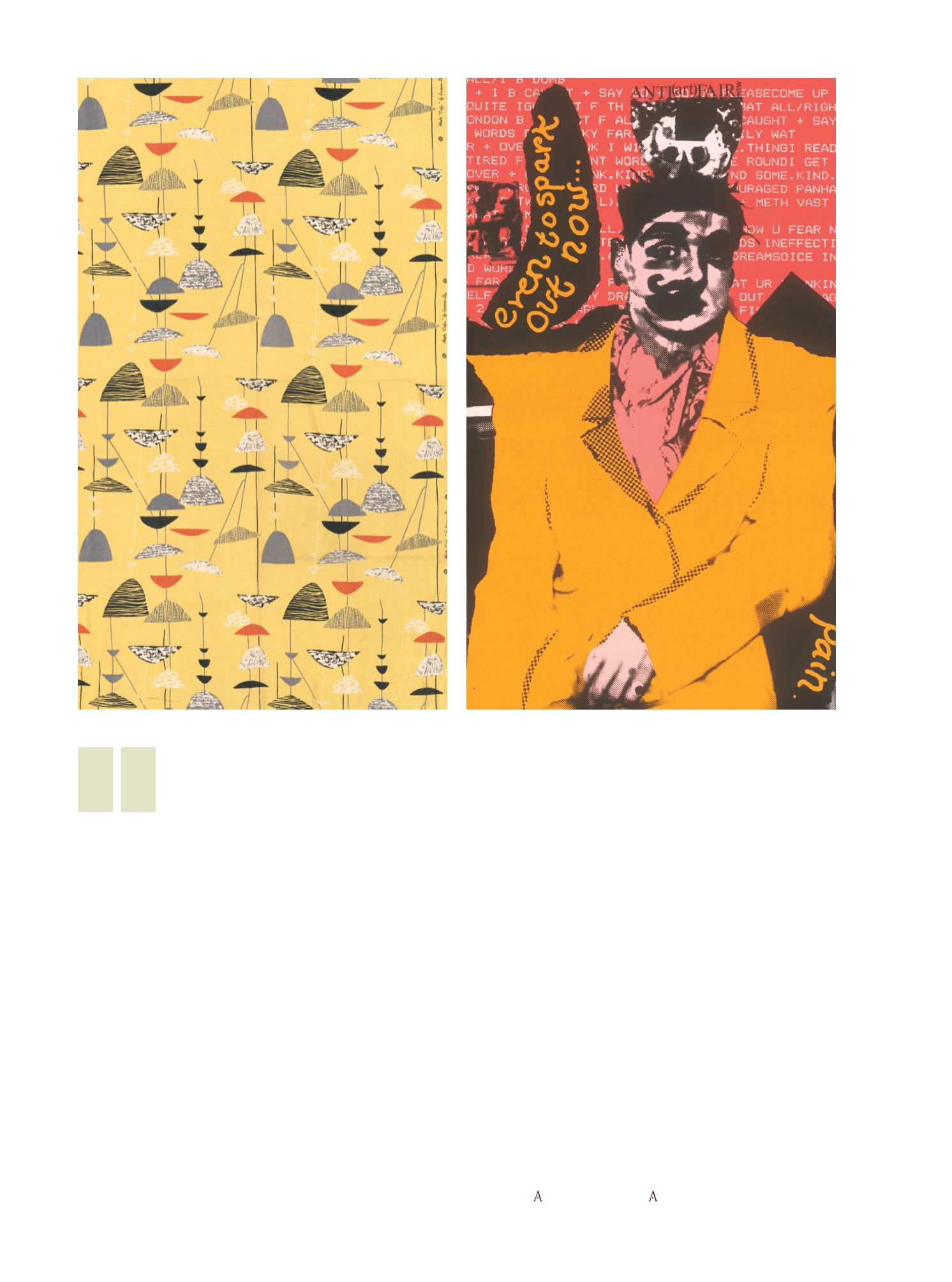
1.
‘Calyx’
furnishing
fabric
Lucienne Day,
manufactured by
Heal & Son Ltd
1951
Courtesy of the
Estate of Lucienne
Day / Photograph
©Victoria and
Albert Museum
2.
“Even to spark
out now would be
no pain”
, poster
promoting the
“Anti-Art Fair”
with
a portrait of Trojan
Designed by John
Maybury
1986
Courtesy of John
Maybury ©
Victoria and Albert
Museum
1
2


