·amura·
116
los conquistadores •
the conquerors
En la exhibición se mostrarán modelos y dibujos
arquitectónicos creados para el New Towns como Har-
low y Milton Keynes. La recuperación económica de
los últimos años de la década de 1950 y 1960 también
generó una nueva demanda por parte del consumi-
dor. Diseñadores como David Hicks, Max Clendinning,
y David Mellor, así como tiendas departamentales de
alto rango como lo fue el Habitat de Terence Conran
fueron aceptadas por una creciente y adinerada clase
media la cual desarrolló un gusto por un estilo moder-
no y Europeo para sus casas.
La segunda sección será dedicada a la naturale-
za subversiva de los diseños británicos desde 1960
hasta finales de la década de 1990. El sistema de The
British Art School ha fungido por décadas como un
motor para cultivar talento artístico radical. Richard
Slee, Zandra Rhodes y Damien Hirst son sólo algunos
de los reconocidos artistas internacionales que se
graduaron de escuelas de arte británicas, y obras de
ellos se presentarán en la exhibición. La galería cen-
tral será dividida en estudios estructurados alrededor
de una ‘calle’ central que explorará los movimientos
contraculturales desde el ‘Swinging London’ de los
años sesenta, pasando por la escena punk y la emer-
gente ‘Cool Britannia’ de los años setenta y noventas.
La cultura popular del Reino Unido se ha alimentado
constantemente del espíritu creativo del país, con las
obras de diseñadores de moda como Vivienne West-
wood y Malcom McLaren, fotógrafos como David Bai-
ley y Terry O’Neill, artistas como David Bowie y Brian
Eno, diseñadores gráficos como Peter Saville y Barney
Bubbles, y diseñadores de muebles como Tom Dixon y
On show will be models and architectural draw-
ings created for New Towns such as Harlow and
Milton Keynes. The economic recovery of the late
1950s and 1960s also generated new kinds of con-
sumer demand. Designers including David Hicks,
Max Clendinning and David Mellor and high- street
stores such as Terence Conran’s Habitat were em-
braced by a growing, affluent middle class who de-
veloped a taste for modern, European-inspired de-
sign for their homes.
The second section of the exhibition will be
dedicated to the subversive nature of British design
from the 1960s to the 1990s. The British Art School
system has long acted as an engine for cultivating
radical artistic talent. Richard Slee, Zandra Rhodes
and Damien Hirst are just some of the internation-
ally recognised artists to have graduated from Brit-
ish art schools and examples of their work will be
featured in the exhibition. The central gallery will
be divided into studios structured around a central
‘street’ space that will explore the counter-cultural
movements from1960s ‘Swinging London’, through
to the 1970s punk scene and the emergence of ‘Cool
Britannia’ in the 1990s. British street culture has
long fuelled the country’s creative spirit, with the
work of fashion designers such as Vivienne West-
wood and Malcolm McLaren, photographers David
Bailey and Terry O’Neill, performers David Bowie
and Brian Eno, graphic designers Peter Saville and
Barney Bubbles, and furniture designers Tom Dixon
and Mark Brazier Jones, all illustrating the impul-
sive radicalism of British art and design.
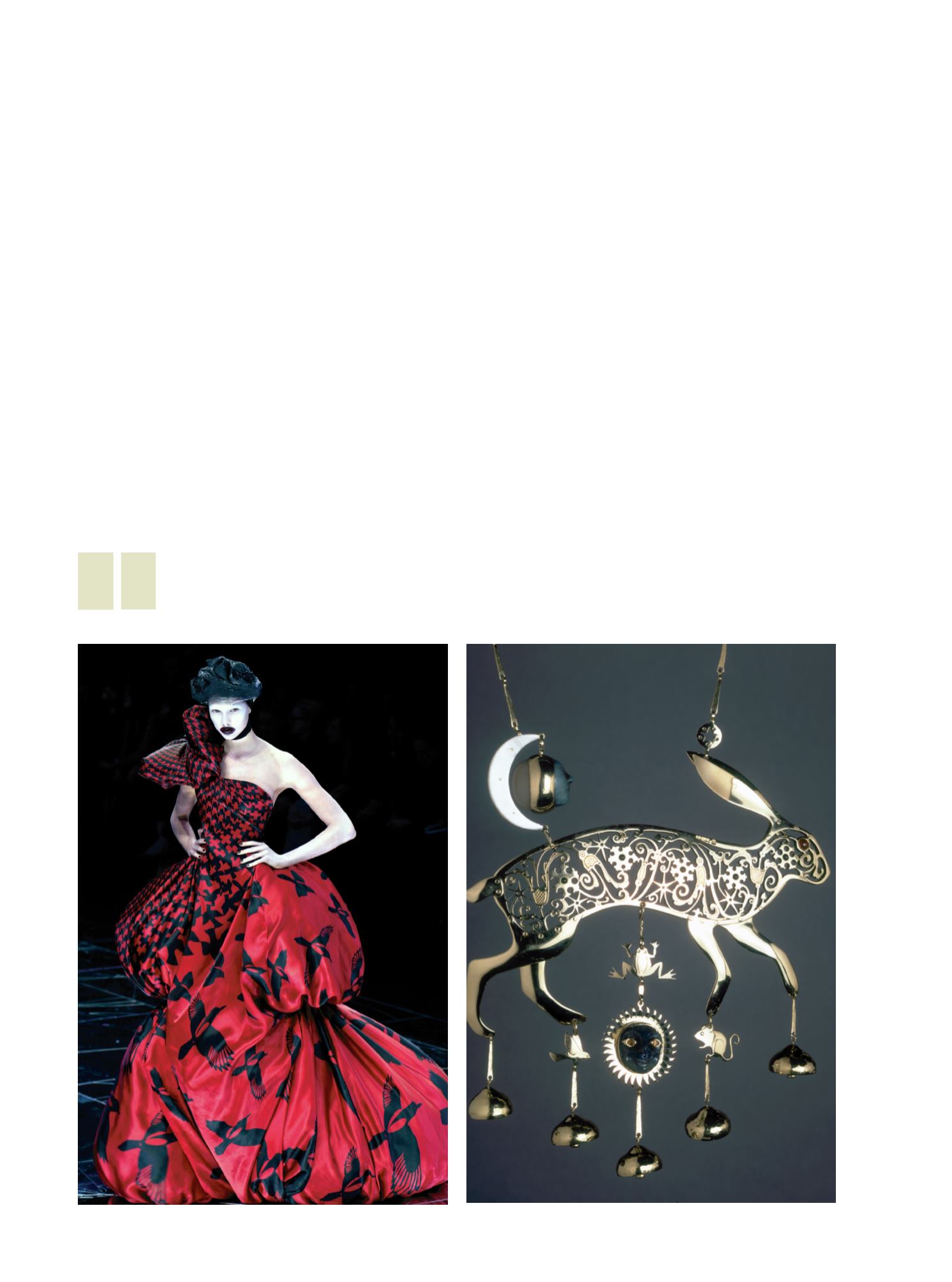
1
2
1. Evening gown
Alexander McQuee
Autumn-winter
2009 Francois
Guillot/AFP/Getty
Images
2. Hare jewel from
‘Masquerade’
Kit Williams
1979
Private collection.
Sotheby’s Picture
Library / Kind
permission of Kit
Williams


