·amura·
139
Diseño •
Design
Post-OMA arquitectos: Neutelings, Den Born
Kees Christiaanse (1953) es socio de los prime-
ros días de OMA y en la actualidad dirige una de las
empresas de desarrollo de arquitectura y urbanismo
más influyentes en los Países Bajos: KCAP. El acrónimo
de Kees Christiaanse And Partners, uno de los cuales
es Han den Born (1958), que también trabajó en OMA
por un corto tiempo. KCAP, proyectos los cuales se
caracterizan por la racionalidad, una forma de sentido
común profesional. La productividad es alta. Ellos son
capaces de trabajar en diferentes proyectos en todo
el mundo al mismo tiempo. Por ahora Christiaanse ha
completado más edificios a su nombre que al de Kool-
haas. Él está más interesado en el desarrollo urbano
de la arquitectura, y tiende a crear, los bloques de pi-
sos para nada ostentoso y en ocasiones austeros, a
menudo provocadas por una típica interpretación ori-
ginal post-OMA de programa y ubicación. Sus diseños
tienden a no tener mucho que ver en el exterior, pero
su intención es crear tantos metros cuadrados útiles
como sea posible para los usuarios.
Willem-Jan Neutelings (1959) se opone diame-
tralmente a Christiaanse. Su trabajo se basa princi-
palmente en las ideas XVIII y del siglo XIX acerca de
la arquitectura con la atención de la simetría y monu-
mentalidad. También está interesado en la ornamen-
tación y decoración integral en los edificios; un tema
que no tiene lugar dentro de OMA. La singularidad
implacable y extrañeza obstinada de sus diseños po-
drían considerarse como una reminiscencia de OMA.
Trabajar con Michiel Riedijk en su oficina Neutelings
Riedijk Architects, es la apertura de espacios desafiantes;
ha diseñado el InstitutoHolandés para el Sonido y la cons-
trucción de la Visión enHilversum. Aquí puso demanifies-
to sus raíces mediante la producción de una construcción
completamente imposible,mientrasquealmismo tiempo
lograba la creación de un nuevo tipo de edificio. A diferen-
cia de Christiaanse, Neutelings trabaja desde una estética
escultórica. Él ve la arquitectura como una forma de arte,
mientras que el fundador de KCAP considera la arquitec-
tura como la planificación. Una diferencia importante con
Koolhaas es que el maestro ve a un presupuesto ajustado
sobretodocomoundesafío,mientrasqueparaNeutelings
puede ser una razón para no embarcarse en un proyecto.
Post-OMA architects: Neutelings, Den Born
Kees Christiaanse (1953) is a partner from the
early days of OMA and currently heads up one of the
most influential architectural and urban develop-
ment firms in the Netherlands: KCAP. The acronym
stands for Kees Christiaanse And Partners, one of
whom is Han den Born (1958), who also worked at
OMA for a short while. KCAP projects are character-
ised by rationality; a form of professional common
sense. Productivity is high. They are capable of
working on different projects all over the world at
the same time. By now Christiaanse has more com-
pleted buildings to his name than Koolhaas. He is
more interested in urban development than archi-
tecture, and tends to create austere, unprepossess-
ing and anonymous tower blocks, often brought
about by a typical post-OMA original interpretation
of programme and location. His designs tend not to
be much to look at on the outside, but his intention
is to create as many useful square metres as pos-
sible for the users.
Willem-Jan Neutelings (1959) is diametrically
opposed to Christiaanse. His work is based primar-
ily on eighteenth and nineteenth-century ideas
about architecture with attention for symmetry
and monumentality. He is also interested in orna-
mentation and integrated decoration in buildings;
a theme that has no place within OMA. The unre-
lenting singularity and stubborn strangeness of his
designs could be seen as reminiscent of OMA.
Working with Michiel Riedijk, his bureau
Neutelings Riedijk Architects has designed the
Netherlands Institute for Sound and Vision
building in Hilversum. Here he revealed his roots
by producing a completely impossible construc-
tion, while at the same time creating an entirely
new type of building. Unlike Christiaanse, Neu-
telings works from a sculptural aesthetic. He
sees architecture as an art form, whereas the
founder of KCAP regards architecture as plan-
ning. One major distinction with Koolhaas is
that the master sees a tight budget primarily as
a challenge, while for Neutelings it can be a rea-
son for not embarking upon a project.
5
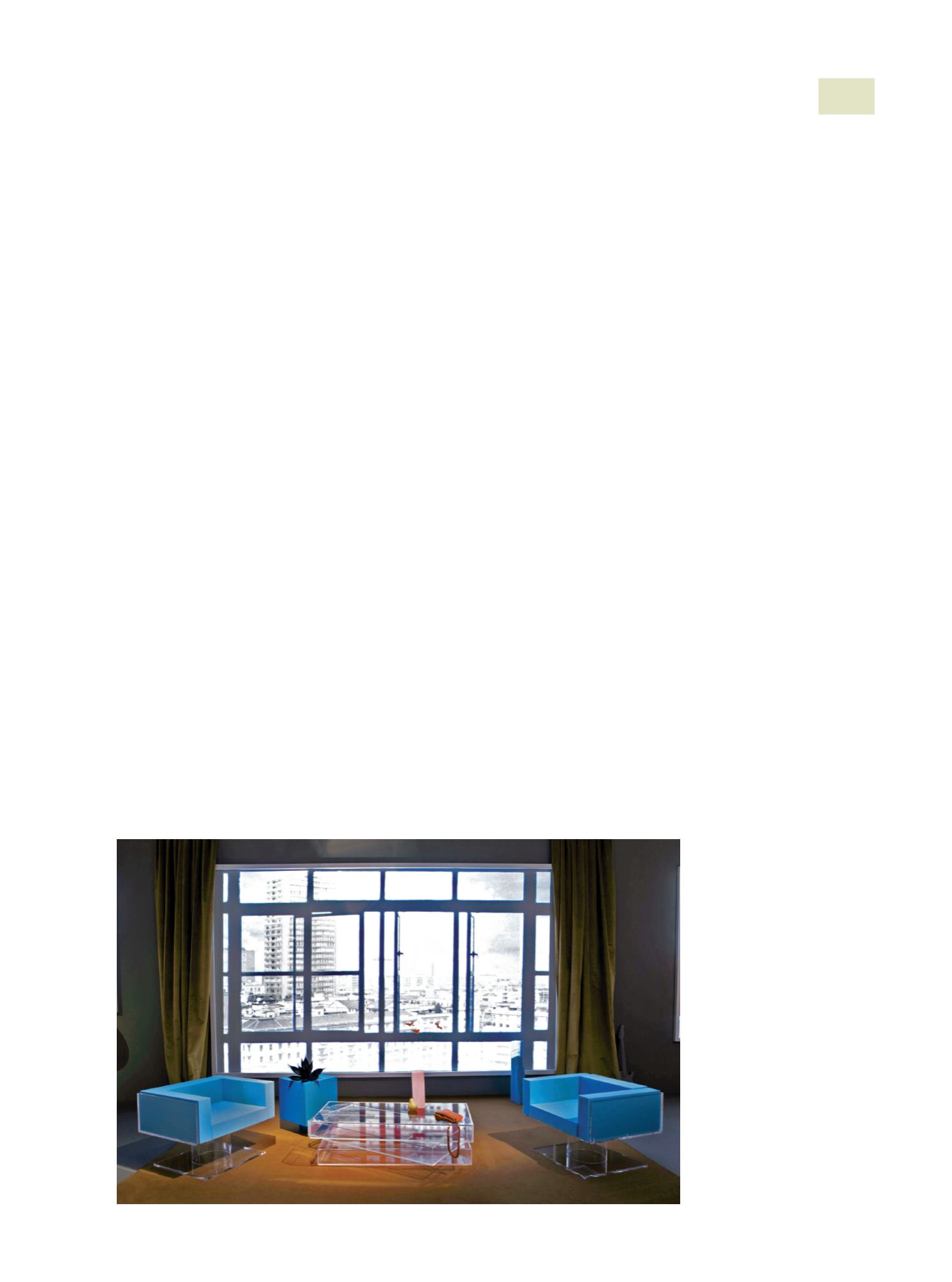
5. Muebles de OMA
y Rem Koolhaas,
colección para
Knoll.
/Furniture
from OMA and
RemKoolhaas’s
collection for
Knoll.


