129
catadores •
tasters
·amura·
Tequilas sugeridos
RecommendedTequilas
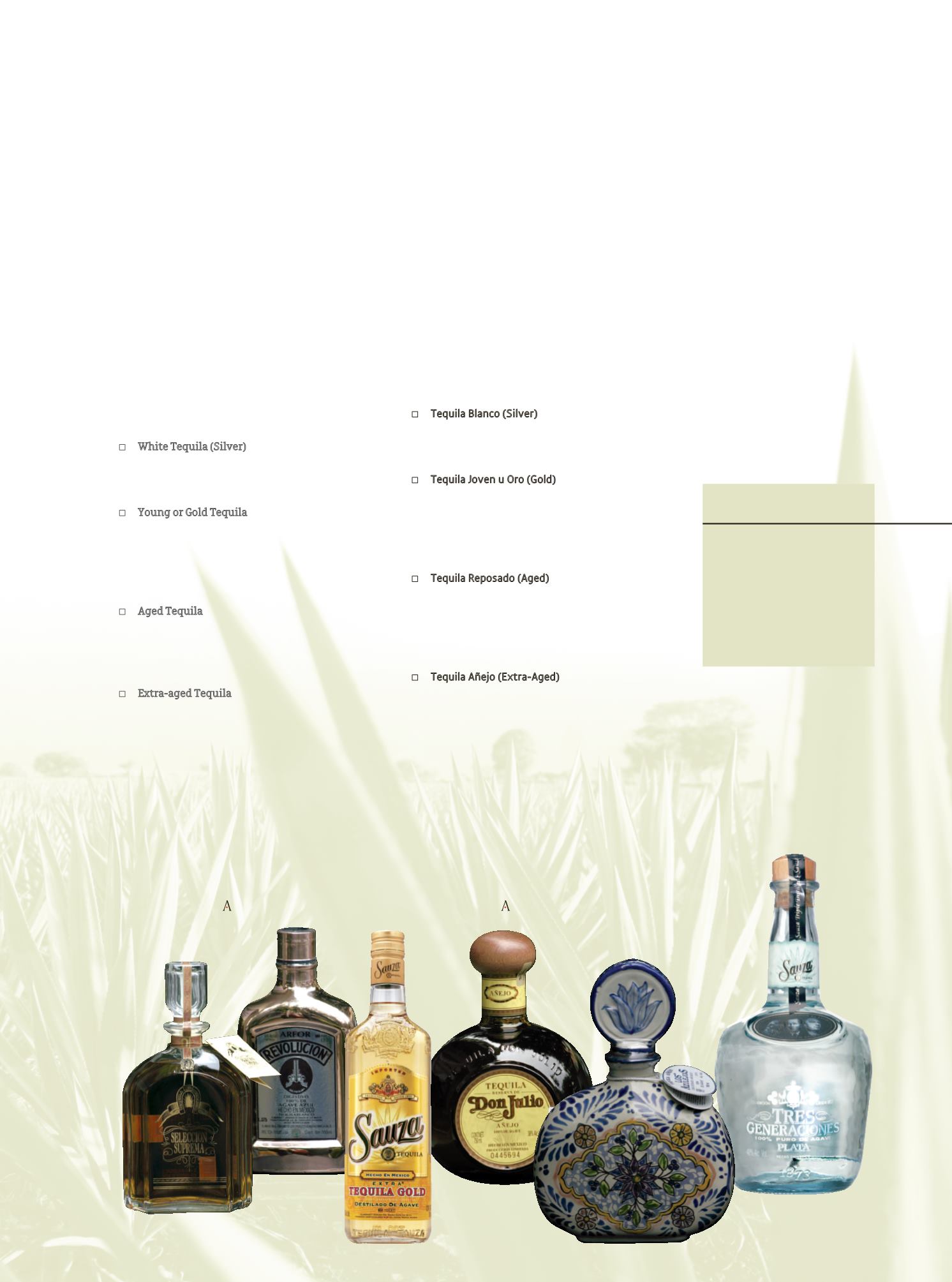
• El Tesoro de Don Felipe
• Reserva de la Familia
(Casa Cuervo)
• Los Azulejos
• Don Julio Real
• Herencia de Plata
• Tequila Don Fulano
(
• Herradura Selección Suprema
origen del mundo, cuya materia prima tarda más de
siete años en madurar.
Clasificación del tequila
La primera tipología de tequilas es definitivamente la
procedencia de sus azúcares. Es decir, los tequilas 100
% agave azul (que según la Norma Oficial Mexicana de-
ben ser embotellados en la planta de envasado que con-
trole el propio fabricante, que debe estar ubicada dentro
de la zona de denominación de origen) y los tequilas que
tienen 51 % de azúcares provenientes del agave y 49 %
de otros azúcares, como el de caña. Con frecuencia se
utilizan para mezclar en coctelería. A estos tequilas los
identificaremos fácilmente, ya que en la etiqueta sólo
dice “Tequila”, y no ”Tequila 100 % agave”.
Así, la otra división son los tequilas “madurados” o
“abocados” y los “blancos”. Estos últimos sin añejamien-
to o reposo ni edulcorantes.
Los requisitos de los cuatro tipos de tequila que la
norma establece son los siguientes:
• Tequila Blanco (Silver)
Producto cuya graduación alcohólica comercial
debe, en su caso, ajustarse con agua de dilución
hasta su grado comercial.
• Tequila Joven u Oro (Gold)
Producto susceptible de ser abocado, cuya gra-
duación alcohólica comercial debe, en su caso,
ajustarse con agua de dilución. El resultado de las
mezclas de tequila blanco con tequilas reposados
o añejos se considera como “tequila joven” u oro.
• Tequila Reposado (Aged)
Producto susceptible de ser abocado, que se deja
por lo menos dos meses en recipientes de madera
de roble o encino, cuya graduación alcohólica co-
mercial debe, en su caso, ajustarse con agua de di-
lución.
• Tequila Añejo (Extra-Aged)
Producto susceptible de ser abocado, sujeto a un
proceso de maduración, de por lo menos un año,
en recipientes de madera de roble o encino, cuya
capacidad máxima sea de 600 litros y con una gra-
duación alcohólica comercial que debe, en su caso,
ajustarse con agua de dilución.
Hoy por hoy, el tequila se ha convertido en uno
de los destilados más apreciados por nacionales y
extranjeros. Su fama no tiene límites, así como los
mariachis nos han dado a conocer en todo el conti-
nente con su música, ¿quién podría imaginar a un
mariachi vestido de charro tomando otra bebida que
no sea tequila?
Tequila is the only beverage in the world, with a
denomination of origin, which requires a raw materi-
al that takes over seven years to mature.
Tequila classifications
Tequilas are first classified by the origins of their
sugars. That is to say, the 100% blue agave tequilas
(that, in accordance with the Official Mexican
Guidelines, must be bottled in a plant that is con-
trolled directly by themanufacturer, and that must be
located within the region of the denomination of ori-
gin) and the tequilas that have 51% sugars that are
the product of agave and 49% from other sources, like
sugar cane. Often they are used for cocktails. These
tequilas are easily identified because their labels only
say “Tequila” and not “100% agave tequila”
The other division includes the “mature” or
“decanted” tequilas and the “whites.” The latter is nei-
ther aged nor rested and has no added sweetening.
The requisites for the four types of tequila estab-
lished by the guidelines are the following:
• White Tequila (Silver)
A product whose commercial alcoholic content
must be diluted with water to reach its commer-
cial proof.
• Young or Gold Tequila
A product that can be decanted, whose commer-
cial alcoholic content can be diluted with water.
The result of the mixtures of white, or silver,
tequila with rested, or aged, tequilas is catego-
rized as “young” or gold tequila.
• Aged Tequila
This product can be decanted and is left at least
two months in oak or helm oak containers. Its
commercial alcoholic content, when necessary,
has to be diluted with water.
• Extra-aged Tequila
A product that can be decanted, is subject to an
aging process of at least a year in oak or helm oak
containers, with a maximum capacity of 600 liters
(158.5 gallons), and with a commercial alcoholic
content that, if need be, must be dilutedwithwater.
Today, tequila has become one of the distilled
alcoholic beverages most appreciated by Mexicans
and foreigners. Its popularity has no limits, like the
mariachis who have brought us fame throughout the
continent with their music. Could anyone imagine a
mariachi dressed in a charro costume drinking any-
thing but tequila?


