127
catadores •
tasters
·amura·
“Pinot Noir”
that gives body, strength and persist-
ence, and
“Pinot Meunier,”
that complements the
other two varieties to produce a full-bodied wine with
a good aroma.
Most champagne manufacturing starts out with a
mixture of these three varieties, although it can also
be made with just one kind of grape. If it is white, the
champagne is called “Blanc de Blancs,” and if it is a
coupage,
or mixed with red grapes, it is called “Blanc
de Noir.”
The process begins with the grape harvest at the
end of August or the beginning of September, depend-
ing on the climate. Champagne is one of the few regions
of the world that is still not totally mechanized. The
harvesters collect the grapes in small baskets that hold
no more than 3 kg. They hand the baskets over to the
loaders who transfer the bunches of grapes to larger
baskets, holding 40 kg, thereby preventing the grapes
fromgetting squeezed and starting to ferment.
The
pressing
takes place, delicately and gradual-
ly, in pneumatic presses, in order to guarantee that
only the best must or juices are extracted. It is impor-
tant to take special care with the red grapes, since the
skin or peel can have an irreversible affect on the
color of the juice.
Fermentation, like the wine harvesting and press-
ing, is done separately. The must obtained when the
grapes are pressed is left to repose in stainless steel
vats. The juices that will be fermented are clarified in
the vats and the yeasts transform the must into wine.
This is the stage when the wine acquires its freshness,
smoothness and roundness. Next, the sediment is sep-
arated from the wine, leaving a tranquil wine, that is
to say, with no bubbles.
In November or December, the enologist or cellar
master tastes and classifies the wines to make the
mixture
. The When there has been an exceptional
harvest, the cellar master may decide to create a year
or
millésime,
made up exclusively of wines of a partic-
ular year.
Bottling:
The wine mixtures are bottled and a
liqueur composed of sugar and yeasts is added. Then
it is closed temporarily with a screw top cap. While
the wine ages, the yeasts, that produced the efferves-
cence with carbonic gas, free aromatic substances.
This
second fermentation
, which is used exclusively
for champagne, is the key to its development.
Current regulations require a vintage or period of
reposing of 15 months for
no millésime
wines and
three years after harvesting for
millésimes.
When the
latter have reached maturity, the sediment that
forms during vintaging in the bottle must be separat-
ed through a process known as
turning
or
remuage
.
Next comes the
degüelle.
The neck of the bottle is
frozen in a tub filled with a -30° C saline solution in
order to form an ice floe that contains the sediment.
Afterwards, the bottle is uncapped and the ice floe is
ejected by pressure.
Once this process is completed comes
dosifica-
tion,
the final touch in champagne manufacturing.
The cellar master decides on the type of expedition
liqueur (composed of reserve wines and sugar) that
are to be added, depending on the kind of champagne
he wants to make.
Distinguishing good champagne
Wine tasters classify white champagnes as wines that
vary frompale yellow to golden yellows, depending on
nay”
, que aporta frescura, elegancia, sutileza y vivacidad;
y dos tintas, “
Pinot Noir”
que proporciona cuerpo, fuerza
y persistencia, y “
Pinot Meunier”,
que complementa a
las otras dos variedades para conseguir un vino redondo
y con buen aroma.
La mayoría de los champagnes están elaborados a
partir de una mezcla de estas tres variedades, aunque
también se pueden vinificar con una sola uva. Si ésta es
blanca el champagne se denomina “Blanc de blancs”, y
si es un
coupage
o mezcla con uvas tintas se llama
“
Blanc de noir”.
El proceso de elaboración empieza con la
vendimia
o cosecha de las uvas a finales de agosto y principios de
septiembre, dependiendo del clima. Champaña es una
de las pocas regiones del mundo donde no se ha meca-
nizado totalmente. Los vendimiadores salen a hacer
la recolecta a mano en pequeñas cestas, de no más de
3 kg, que entregan a los cargadores para que transfieran
los racimos a otras cestas más grandes, de 40 kg, y de
esta manera evitan que las uvas al ser estrujadas entre
sí empiecen a fermentar.
El
prensado
se lleva al cabo en prensas neumáticas,
de manera delicada y gradual, a fin de garantizar que se
extraigan exclusivamente los mejores mostos o jugos.
Es preciso tener especial cuidado con las uvas rojas, ya
que los hollejos o pieles pueden afectar de manera irre-
versible el color del jugo.
Al igual que en la vendimia y el prensado, la
vinifi-
cación
o
fermentación
también se realiza por separado.
El mosto obtenido del prensado se deja reposar en cu-
bas de acero inoxidable, con lo que se clarifica el jugo
para la fermentación en la cuba, y las levaduras trans-
forman en vino el mosto. En esta etapa es cuando el vi-
no adquiere su frescura, suavidad y redondez. A
continuación se separa el sedimento del vino, el cual es
un vino tranquilo, es decir, sin burbujas.
En noviembre o diciembre, el enólogo o maestro bo-
deguero cata y clasifica los vinos para hacer la
mezcla
.
Cuando la cosecha es de excelente calidad el jefe de bo-
degas decide crear una añada o
millésime,
compuesta
únicamente por los vinos del mismo año.
Embotellado
: Las mezclas de vino se embotellan
con la adición de un licor de tiraje compuesto de azúcar
y levaduras. Luego, se tapa provisionalmente con un ta-
pón tipo “corona”. A medida que el vino envejece las le-
vaduras que contribuyeron a su efervescencia con el gas
carbónico liberan sustancias aromáticas. Esta
segunda
fermentación
, exclusiva del champagne, es la clave de
su desarrollo.
La normatividad vigente especifica 15 meses de
crianza o reposo después del tiraje para los vinos sin año
(
no millésime
) y tres años después de la cosecha para las
añadas o
millésimes
más jóvenes. Cuando éstos han al-
canzado su madurez es preciso separar el sedimento
que se forma durante su crianza en botella a través del
removido
o
remuage.
A continuación se efectúa el
degüelle
, es decir, el
cuello de la botella se congela en una tina que contiene
una solución salina a –30 °C, para formar un témpano
que contiene los sedimentos. Después basta con desta-
par la botella para que el témpano sea expulsado por la
presión.
Una vez terminado este procedimiento viene la
do-
sificación
, que es el toque final en la elaboración del
champagne, donde el maestro bodeguero decide el tipo
de licor de expedición (compuesto por vinos de reserva
y azúcar) que le va a adicionar, lo cual está sujeto al
champagne que desee elaborar.
Maridajes
Laurenti Grande Cuvée Rosé
Aperitivos, para acompañar
cocina de tipo oriental o
postres de manzanas.
Laurenti Grande Cuvée Tradition
Se degusta con pato
o langostinos.
Laurenti Grande Cuvée
Perfecto con pollo y salsas de
hongos silvestres.
Möet & Chandon Brut Imperial
Se degusta libremente con
todo tipo de alimentos de
sabor fuerte.
Möet & Chandon Brut Rosé
Perfecto para bocadillos y
canapés, platos realizados
con cordero, tomillo, jitomate,
berenjenas y aceitunas.
Möet & Chandon, Dry
y Nectar Imperial
Ideal para el
foie gras,
quesos
azules y postres a base de
duraznos, frutos secos
y nueces.
Möet & Chandon
Reserve Imperial
Carnes asadas o a las brasas,
cebollas dulces y setas.
Nicolas Feuillate,
Brut Rosé Vintage
delicioso como aperitivo,
combina muy bien con
postres de frutas rojas.
Pommery Brut Rosé
Carne blanca o postres
de frutas rojas.
Taittinger Brut Reserve
Ideal con carnes blancas,
langostinos o quiche
de hongos.
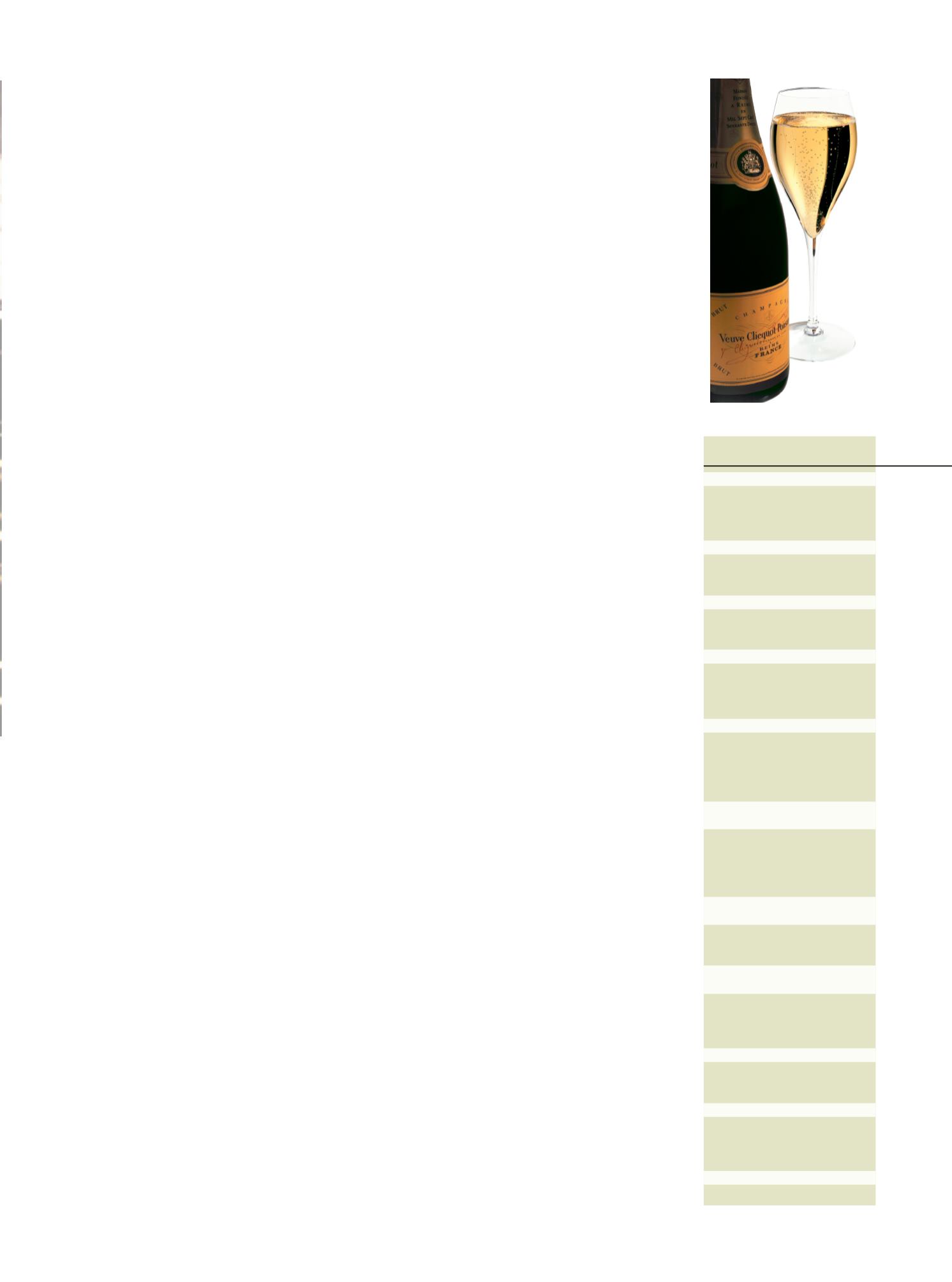
Veuve Clicquot Ponsardin Brut
Langosta y langostinos.


