131
·amura·
I
t is common knowledge that during the past two
decades some works of famous painters have
brought the highest prices in history. This is the
case of
Boy with Pipe
, by Picasso (over 104 million
USD),
Portrait of Dr. Gachet
, by Van Gogh (82.5 million
USD, in 1990),
Still Life with Curtain, Jug and Compote
Bowl,
by Cézanne (60.5 million dollars, in 1999), and
recently
The Massacre of the Innocents
, by Rubens
(auctioned at 49.5 million £). The list could be quite
long. Although these prices may appear excessive to
us, the behavior of the market indicates that in five,
ten or fifteen years they will seem quite low.
In spite of wars, economic crisis and other
imbalances in out society, prices went up between
the decades of the 80s and the 90s. In the case of the
impressionists they rose 400%, Van Gogh, 800% and
Picasso over 1000%. This calculation was based on
evaluations made in 1980 in U.S. and European auc-
tion houses.
The art market, and especially the painting,
sculpture and engravings segment, operates at
prices that oscillate between 14 000 and 18 000 USD
per piece, average. This means that most of the vol-
ume of business is not in the millions USD per work
sold, although it is still spectacular and is a deter-
minant in wanting to find an object with these
characteristics. What is important to understand is
that the volume results from the number of trans-
actions made day to day, which add up to hundreds
of thousands. And, besides that during the last 30
years the tendency has been on the rise since, in the
decade of 1980s, the average was between 3500 and
5500 USD.
We could mention some difficult moments in his-
tory, falling prices, even the withdrawal of galleries,
closing of museums, and the disappearance of bro-
kers, collectors and a good number of artists. In spite
of this, market analysis indicate that operations are
on the rise, which implies that more operators have
entered the market than have left it and that today
there is a greater number of buyers willing to pay
higher prices for works of art. Production of objects
made by artists is also up which results in greater cir-
culation. Of course, unless you resort to magic, like in
any other market, you can win or lose.
E
s bien sabido que durante las últimas dos décadas
hay obras de pintores famosos que han llegado a
las cotizaciones más elevadas de su historia, co-
mo son los casos de
El muchacho de la pipa
, de Picasso
(más de 104 millones de dólares),
Retrato del Dr. Gachet,
de Van Gogh (82.5 millones de dólares, en 1990),
Corti-
na, cántaro y compotera
, de Cézanne (60.5 millones de
dólares, en 1999), y recientemente
Masacre de los ino-
centes
, de Rubens (subastada en 49.5 millones de libras
esterlinas). Y la lista podría ser larga. Estos precios pue-
den parecernos excesivos; sin embargo, el comporta-
miento del mercado indica que en unos dos o tres
lustros más se verán como precios bajos.
Entre las décadas de los años ochenta y los noven-
ta, a pesar de guerras, crisis económicas y otros dese-
quilibrios sociales, se incrementaron los precios. En el
caso de los impresionistas en 400 %, Van Gogh en 800 %
y Picasso en más de 1000 %. Este cálculo se realiza to-
mando como base cotizaciones realizadas en 1980 en
casas de subastas estadounidenses y europeas.
El mercado del arte, y en particular el segmento de
la pintura, la escultura y el grabado, opera en precios
que oscilan entre 14 000 y 18 000 dólares por pieza, co-
mo promedio. Esto quiere decir que el gran volumen de
negocios no está en los millones de dólares por obra
vendida, aunque no deja de ser espectacular y determi-
nante la ambición por encontrarnos con un objeto de es-
tas características. Lo importante es comprender que el
volumen se obtiene de la cantidad de transacciones que
se realizan día a día, las cuales se cuentan por cientos de
miles. Y aparte de esto, es notable observar que duran-
te los últimos 30 años la tendencia ha sido la de creci-
miento de los precios, ya que en la década de 1980 este
promedio se ubicaba entre 3500 y 5500 dólares.
Se podrían señalar algunos momentos históricos di-
fíciles y caídas en los precios, incluida la salida de gale-
rías, cierre de museos y desaparición de corredores,
coleccionistas y de buen número de artistas. A pesar de
ello, el análisis de los comportamientos indica que se han
incrementado las operaciones, lo que implica que han si-
do más las entradas de operadores que las salidas y de
que existe actualmente un mayor número de comprado-
res dispuestos a pagar precios más elevados por las
obras de arte. De igual manera hay más producción de
objetos generados por artistas y, por ende, mayor circu-
los conquistadores •
the conquerors
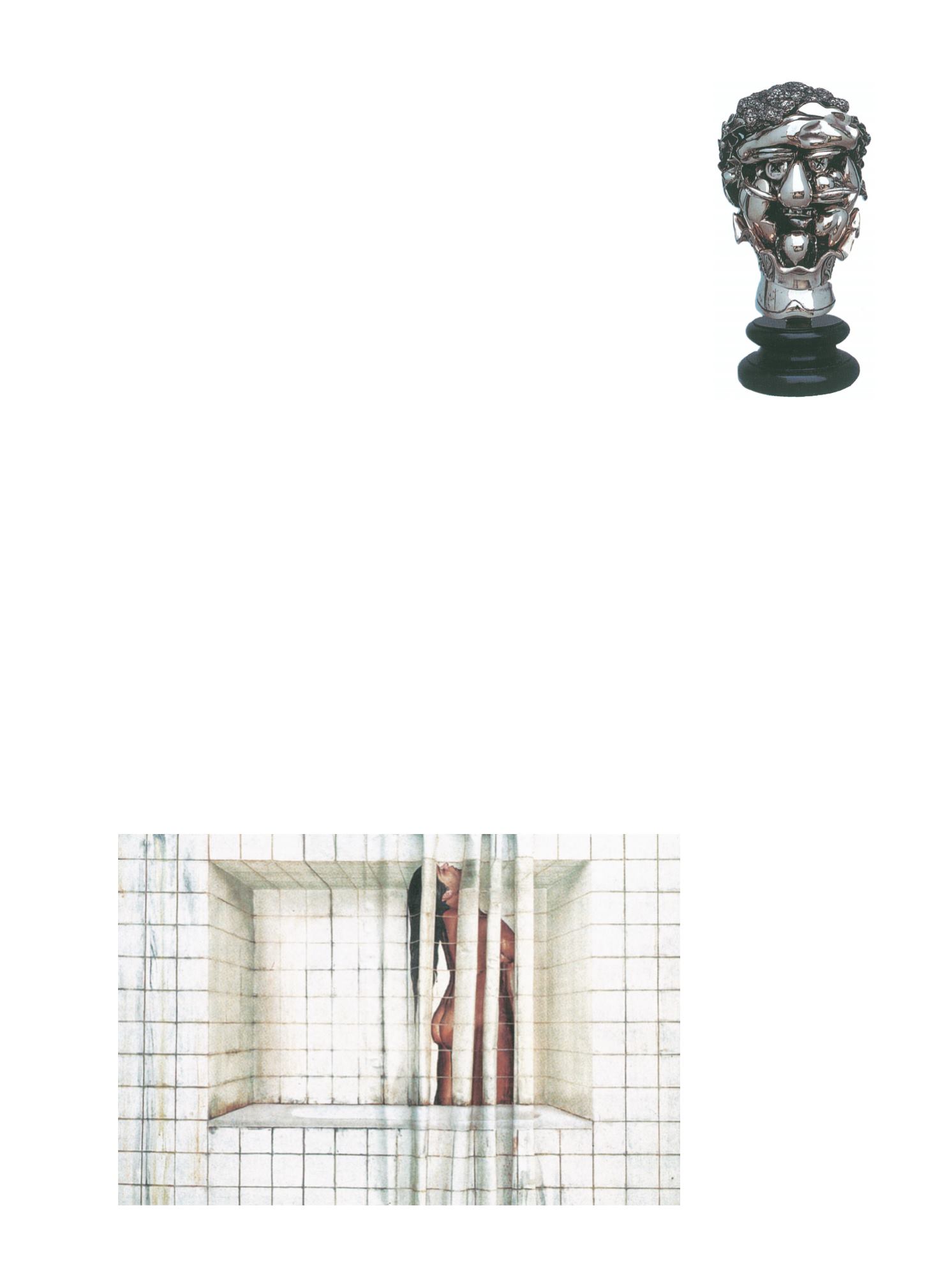
Berrocal
Omaggio ad Arcimboldo
Bronce
(1967-1979)
Rafael Cauduro
La cortina de la regadera
Acrílico sobre tela
(1993)


