A
frica, remote history, everything
points toward the fact that in this
continent it started our long march
to inhabit the planet and, likely, the
universe. In this journey we go, so as
the Africans enter the benefit of modernity with its
transcendental history, that inhabits our guts.
There are two moments linked irresolubly in
this human and social evolution: the awareness
of reality and of the unawareness. We can say that
the latter –the unawareness—never leaves us; it is
indeed the owner of the biological knowledge with
the archaic inheritance. The awareness, entails ef-
fort to know-learn-do, it is the human thing. In this
transition, there is the original mother of mankind,
from the unawareness to the awareness, from in-
stinct to intuition, from object to autonomous sub-
ject, setting up to walk.
What we now understand, is the advance-
ment of the nervous system organization to
create these human realities. Instinct with intu-
ition had to be mixed up. Perception, modifying
the organism, evolves to use the brain, in order
to transform its extremities into tools (hands
and feet), to articulate language, to fulfill de-
sires, to build the social reality; the culture, the
African original woman would not imagine it,
but she tried. It is the learning, with the senses
(ear-sounds, smell-odors, sight-colors, touch-
textures-forms, palate-flavors), that are symbol-
ized and meant with the thought. This way, they
allow us to desire and learn-do intelligently, so
many times, simply doing, an aping of other spe-
cies’ construction with which now we know we
share their deoxyribonucleic acid (DNA) and the
biologic learning of their nervous systems.
1
Á
frica es historia remota; todo indica que
en ese continente se originó nuestra
larga marcha para habitar el planeta y,
probablemente, el universo. Vamos en
el trayecto en que los africanos puedan
acceder a los beneficios de la modernidad, con su tras-
cendental historia que nos habita en las entrañas.
Hay dos momentos que se vinculan irresoluble-
mente en esta evolución humana y social: el de la con-
ciencia de la realidad y el de la inconsciencia. Podemos
decir que esta última –la inconsciencia–, nunca nos
abandona; es de hecho la dueña del conocimiento bio-
lógico con la herencia arcaica. La conciencia entraña
el esfuerzo del saber-aprender-hacer, es lo humano.
En este tránsito se halla la madre original de la huma-
nidad, de la inconsciencia a la conciencia, del instinto
a la intuición, del objeto al sujeto autónomo, que se
erige para andar.
Lo que ahora entendemos, es el avance de la orga-
nización del sistema nervioso para crear estas realida-
des humanas. Se ha tenido que combinar el instinto con
la intuición. La precepción, modificar el organismo evo-
lucionado para usar el cerebro, para volver herramien-
tas sus extremidades (manos y pies), para articular el
lenguaje, para cumplir sus deseos, construir la realidad
social: la cultura. No lo imaginaría la mujer original de
África, pero se empeñó en el esfuerzo. Es el aprendiza-
je, con los sentidos (oído-sonidos, olfato-olores, vista-
colores, tacto-texturas-formas, paladar-sabores), que
se simbolizan y significan con el pensamiento. De este
modo, son los que nos permiten desear y aprender-
hacer inteligentemente, tantas veces, haciendo sim-
plemente remedos de la construcción de otras especies
con las que ahora sabemos compartimos sus partículas
de ácido desoxirribonucleico (ADN) y el aprendizaje bio-
lógico de sus sistemas nerviosos.
·amura·
115
personajes •
characters
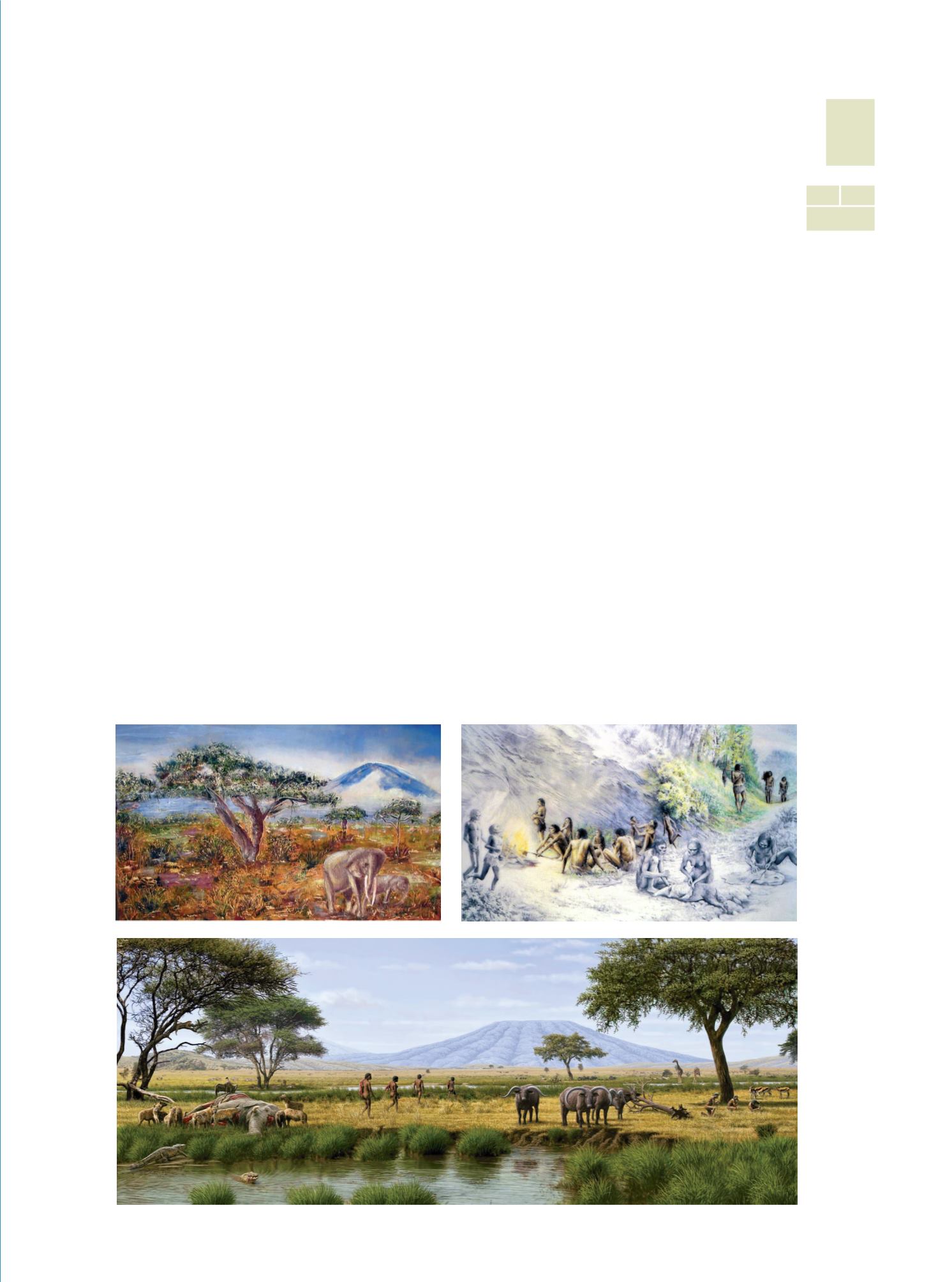
1.Mujerafricana:
madreyorigen. /
Africanwomen:
mother and origin.
2. Según estudios
científicos, en el
continente africano
surgieron los prime-
ros seres humanos.
/
According to
scientific studies,
in Africa the first
humans emerged.
3. Los rasgos
anatómicos de los
primeros habitantes
son de una estatura
media de 1.35 m. /
The anatomical
features of the first
inhabitants are of
an average height
of 1.35 m.
4. En la región
comprendida entre
Kenia y Etiopía, se
han hallado los
restos más antiguos
del hombre. /
In the region
between Kenya
and Ethiopia, have
found the oldest
remains of man.
2
4
3


