E
n África habita el 40% de la población
mundial, se trata de la región con el
promedio más bajo de edad. Esta di-
mensión juvenil, la convierte en el
principio de otra realidad que lleva en
su herencia el origen de la evolución humana. El
continente africano es, por supuesto, parte indis-
pensable del proceso histórico de la globalización
de la economía, con la fuerza del trabajo humano y,
conmaterias primas, se construyó el sistema mun-
dial urbano-industrial, las metrópolis centrales,
los campos algodoneros, la extracción en la minas.
La cultura africana está activa en las bellas ar-
tes, como la danza, la música (clásica, blues, jazz,
rock) y en el canto, con alma en coros de voces po-
pulares; así como en la ópera, la escultura, arqui-
tectura y pintura.
Son insustituibles –por ser únicos– los eco-
sistemas africanos, son prehistoria e historia de
las especies, hábitat de la más rica variedad de
fauna y flora.
Siguiendo datos del informe World Economic
Outlook (FMI, Octubre 2012), en el que 10 de las 20
economías con mayor potencial de crecimiento
hasta 2017, son países africanos: Angola, Nigeria,
Etiopía, Chad, Mozambique, Ruanda, Ghama, Con-
go, Zambia y Tanzania.
Las aportaciones del continente africano, con-
formado por 54 países (contando Sudán del Sur),
provienen de la rica diversidad cultural-lingüística
conformada por cientos de pueblos, que aunque tie-
nen elementos comunes, sería un error generalizar
la etnología o las culturas africanas.
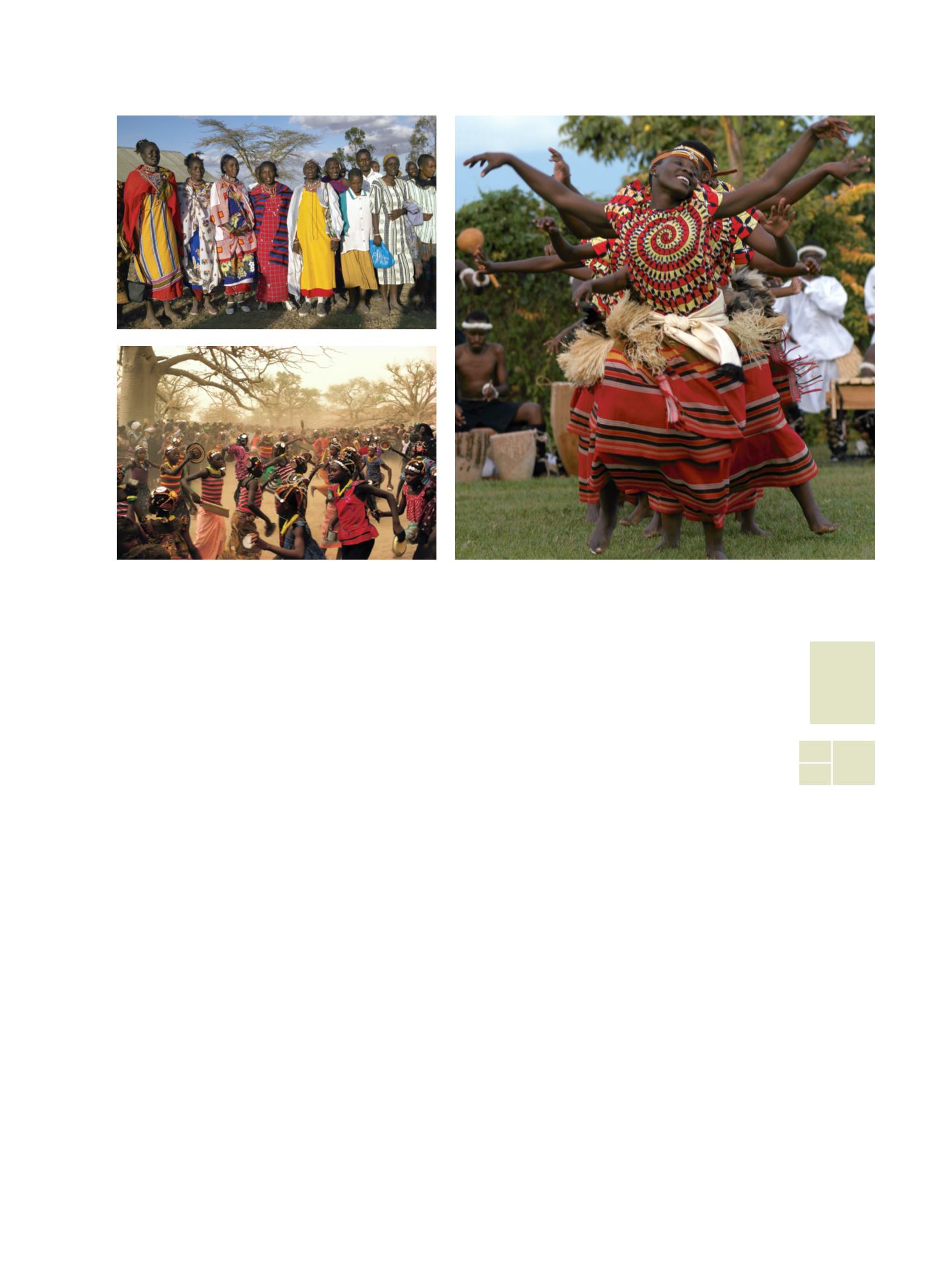
1. La cultura africana
es una de las más
ricas en tradiciones.
/
African culture is
one of themost
rich in traditions.
2. En el continente
africano se han
contabilizado más
de 3,000 distintas
tribus. /
The African
Continent have
more than 3,000
different tribes.
3. La música y la
danza, no sólo son
una manifestación
cultural, sino un
medio de comuni-
cación. /
Music and
dance are not only
a manifestation
cultural but half
communication.
4. Baile tradicional
de Buganda. /
Traditional
Buganda’s dance.
·amura·
107
los conquistadores •
the conquerors
T
he 40% of the world population in-
habits Africa; a region with the low-
est average age whose youth dimen-
sion, transforms it into the inception
of another actuality; by carrying
within its heritage the origin of human evolu-
tion. The African Continent is, of course, an in-
dispensable part of the historical globalization
process of economy; with its human workforce
and materials the worldwide urban-industrial
system was built, the same as the metropolitan
centers, the cotton fields, the mining.
The African culture continues being active
on the Fine Arts such as dance, music (classic,
blues, jazz, rock) and singing with soul in popu-
lar choirs, the same as opera, sculpture, architec-
ture and painting.
Being unique, the African ecosystems are im-
possible to substitute; they are prehistory and
history of the species, habitat of the richest va-
riety of fauna and flora.
According with the World Economic Outlook
(FMI, October, 2012), 10 out of the greatest 20
economies with growing potential up until 2017
are African countries: Angola, Nigeria, Ethiopia,
Chad, Mozambique, Ruanda, Ghana, Congo, Zam-
bia and Tanzania.
The African Continent is formed by 54 coun-
tries, (including South Sudan) whose cultural-
linguistic diversity is formed by hundreds of
peoples having common elements, even though
it would be an error to generalize the ethnology
or African cultures.
2
1
3
4


