·amura·
59
compás int • int compass
Las grutas Mágicas
Cerca de Mumbai, a lo largo de la ruta de Goa, se encuen-
tra el Santuario de los pájaros de Kamala, el hábitat de
casi 146 especies de aves, asimismo están los lagos
Powai, Vihar y la Playa de Versova; además de, lugares
como el Hall de Chaitya, excavado alrededor del siglo II
a.C., el cual inspira un profundo respeto; este tiro natu-
ral en el que intervino lamono demonjes hindús, cuenta
con un tiro de 124 pies de largo y 46.5 de ancho, y una
altura de 45 pies, coronada por una impactante bóveda.
Se conforma por una serie de pilares con una entrada en
la parte principal de la cueva, que permite filtrar la luz
del sol. Po otra parte están las antiguas cuevas budistas
Bhaja, Bedsa y Karla; se trata de santuarios rupestres
que no sólo figuran entre los más antiguos que se con-
servan en la India, sino que son auténticas obras maes-
tras de la arquitectura, escultura y pintura, indisociables
todas ellas de la belleza de sus entornos naturales.
Las Cuevas de Elephanta, son otra maravilla natural
en donde la religión védica encontró el mejor forma-
to para dejar constancia de su paso por la historia.
Aquí el turista se maravilla con las galerías plagadas
de relieves declarados Patrimonio de la Humanidad y
constituyen portentosos alardes de destreza técnica
e inventiva artística.
Pero, sin lugar a dudas, la majestuosidad de los tem-
plos hinduistas se hacen presentes en la histórica ciudad
de Aurangabad, a poco más de 400 km, de Mumbai, aquí
las cuevas de Ajanta y Elora, son los populares sitios de
peregrinaje en Nanded, Shirdi, Nasik y Pune.
Magic grottos
Near Mumbai, along the Goa Route, the Kamala
Bird Sanctuary is located; a habitat for almost 146
bird species; also the lakes Powai, Vihar, and Ver-
sova Beach are there, the same as the Chaitya Hall,
excavated around the II century B. C. inspiring a
deep respect; this natural 124 feet long, 46.5 wide
and 45 feet tall shaft in which the hand of Hindu
monks intervened, is crowned by an astounding
dome. It is formed by a series of pillars with an
entrance at the main part of the cave that lets the
sunlight in. On the other side, the ancient Bhaja,
Bedsa and Karla Buddhist caves are located, sanc-
tuaries in caves which are not only listed among
the oldest preserved in India, but that are authen-
tic architectural, sculptural and pictorial master-
pieces; inseparable all of them from the beauty of
the natural surroundings.
The Elephanta Caves are still another natural
wonder where the Vedic religion found the best
form to leave proof of its passage throughout his-
tory. Here the tourist is astounded by the galleys
plenty of reliefs declared World Heritage and which
constitute grand displays of technical proficiency
and artistic inventive.
There is no place for doubt, though, about the
majesty of Hindu temples, present in the historical
city of Aurangabad, and 400 km away from Maom-
bai. Here, the Ajanta and Ellora caves are popular pil-
grimage places in Nanded, Shirdi, Nasik and Pune.
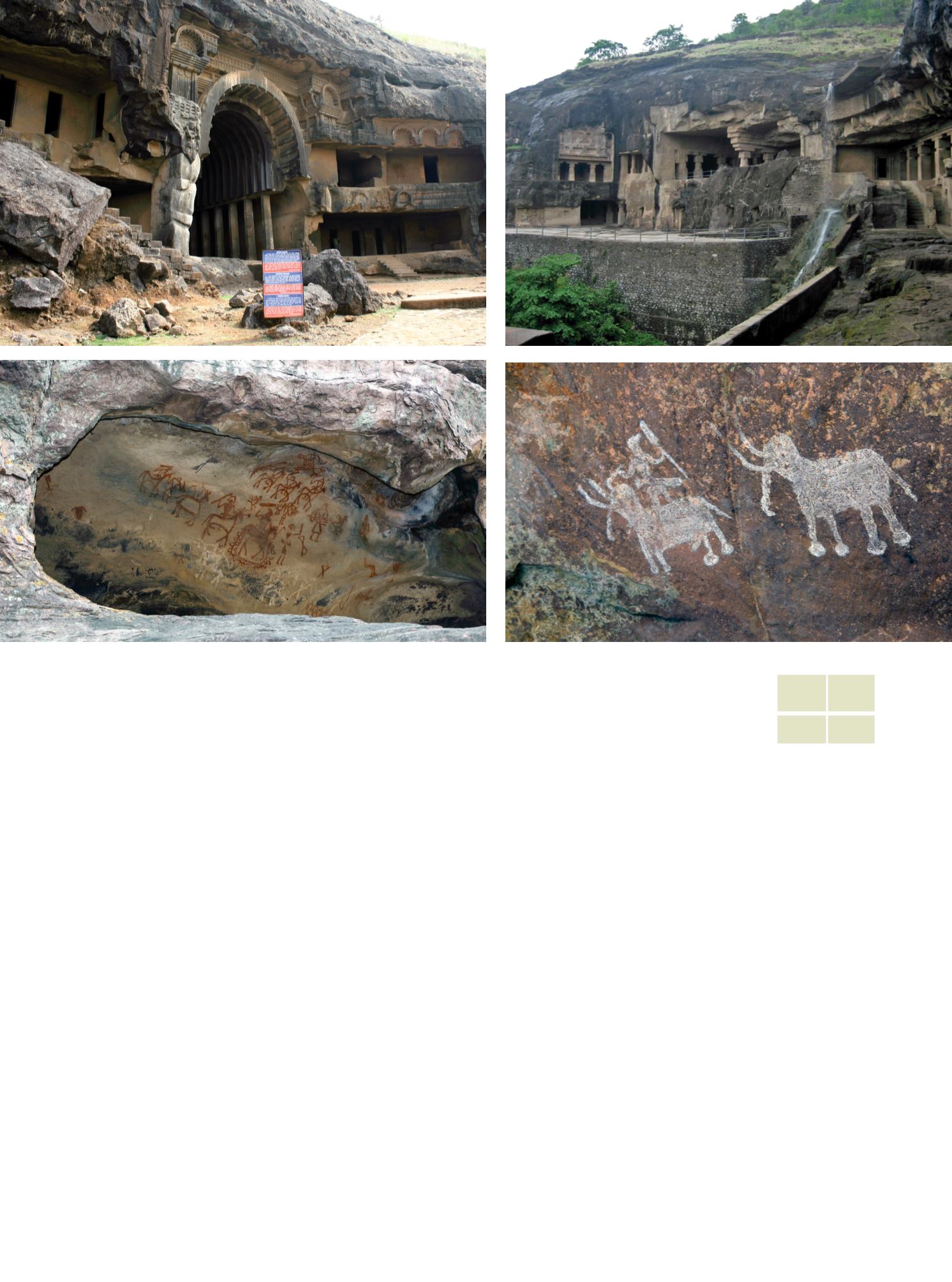
42.Lascuevasde
Bhajaseconforman
de22grutasdelsiglo
IIa.C./
TheBhaja
cavesconsistof22
cavesofthesecond
centuryBC.
43.Lascuevas
Elephantatienen
cincogrutashindúes
ydosbudistas./
The
ElephantaCaveshave
fiveHinducavesand
twoBuddhist.
44.ElRefugiode
RocadeBhimbetka
muestra imágenes
de lavidahumana
ancestralde la India.
/
TheRockShelter
ofBhimbetka
showsimageofthe
ancestralhumanlife
inIndia.
45.Laspinturasenel
RefugiodeRocade
Bhimbetkadatande
hace9milaños./
The
paintingsintheRock
ShelterofBhimbetka
datingfrom9000
yearsago.
44
45
42
43


