62
·amura·
compás int •
compass int
de Quebec. Su Chapelle des Indiens, edificada en
1747, es el edificio religioso de madera más antiguo
que subsiste en Canadá, en un espectacular entorno.
La entrada del fiordo es el lugar elegido por las balle-
nas belugas, que encuentran el alimento traído por
las mareas que entran en el río Saguenay, donde el
agua salada flota por encima del agua dulce del río
que baja desde el lago Saint Jean. En las aguas del
Saint Laurent encontramos beluga, rorcal común,
jorobada, cachalotes y focas.
Desde Tadoussac hasta La Baie
La navegación por el Saguenay debe ser con motor,
debido al hecho de que el viento raramente pasa los
acantilados que lo bordean, esculpidos por el antiguo
glaciar. Es un desconcertante recorrido que permite
descubrir una sucesión de bahías anidadas en el
fondo de hermosos valles boscosos con nombres
que recuerdan los tiempos cuando los “truche-
ments” (cazadores que recorrían esos montes) viví-
an con los indios, comportándose de manera muy
bestial (uno de ellos, Etienne Brulé, verdadera leyen-
da del pasado, murió en manos de sus amigos los
hurones).
Unos insólitos rincones animan el fiordo: L’Anse-
Saint-Jean, adormecido pueblo con su puente
cubierto escondido en una bella bahía; Rivière-Éter-
nité, donde el bosque acaricia las aguas transparen-
tes, paraíso de los pescadores y observadores de la
fauna; Sainte-Rose-du-Nord, un pueblo de cuentos,
olvidado por el tiempo, acogido entre sus verdes pra-
deras y las aguas del río Saguenay.
Finalmente llegamos a La Baie, la ciudad al fondo
del fiordo, en la bahía de los Ha-Ha, al final de la parte
foundation of the city of Quebec. Set in a spectacular
place, its Chapelle des Indiens, built in 1747, is the
oldest religious wood building still standing today
inCanada. The entrance to the fiord is a place favored
by beluga whales, which nourish themselves with
what is brought in by the tides that enter the
Saguenay River, where the salt water floats on the
surface of the fresh river water that descends from
the Saint Jean Lake. In the waters of the Saint
Laurent we sawbeluga, common rorqual, hunchback
and spermwhales as well as seals.
From Tadoussac to La Baie
Sailing on the Saguenay has to be done with amotor
due to the fact that the wind rarely passes the cliffs,
sculpted by the ancient glacier, that frame it. It is a
disconcerting journey that allows you to discover
the series of bays nestled at the bottom of stunning
wooded valleys with names that bring to mind the
times when the “truchements”, the hunters that tra-
versed these mountains, lived with the natives, act-
ing in a quite brutish way: one of them, Etienne
Brulé, a true legend of the past, died at the hands of
his friends, the Hurons.
Some unique nooks and crannies animate the
fiord: L’Anse-Saint-Jean, a sleepy town with a cov-
ered bridge hidden in a beautiful bay; Rivière-Éter-
nité, where the forest caresses the transparent
waters and a paradise for fishing aficionados and
fauna watchers and Sainte-Rose-du-Nord, a story-
book town forgotten by time, enveloped in its
green fields and the waters of the Saguenay River.
Finally, we reached La Baie, a city located at the
end of the fiord, in the Ha-Ha Bay and at the end of
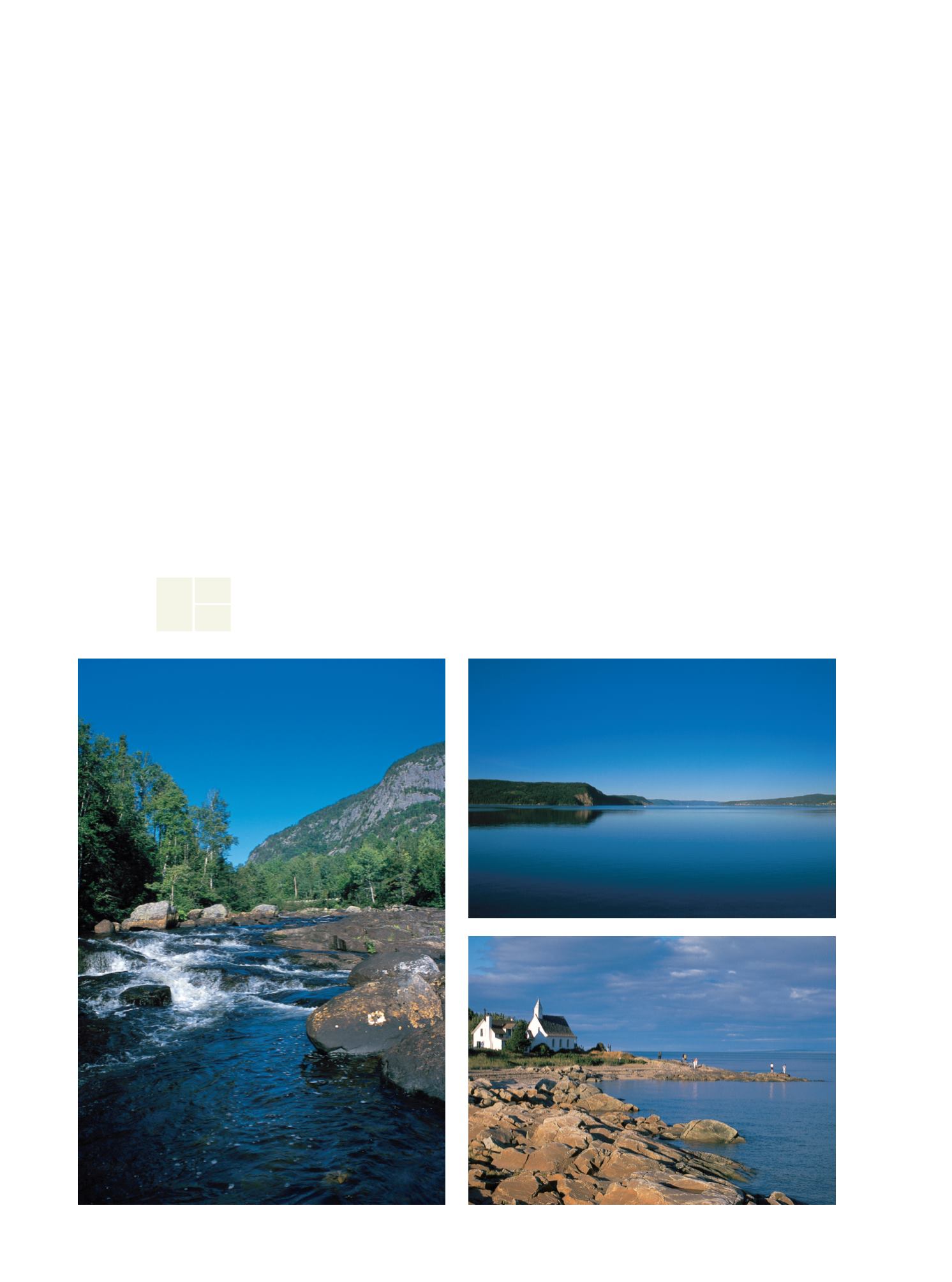
1. Los ríos y cascadas de la región de
Charlevoix.
The river and waterfalls in the
Charlevoix region.
2. El fiordo del Saguenay, un lugar
esculpido por los glaciares.
The Saguenay fjord, a beautiful
place sculptured by glaciers.
3. Port au Persil, sin duda uno de los
lugares más hermosos del gran río.
Port au Persil, without doubt one
of the most beautiful places on
the great river.
1
2
3


