60
·amura·
ows, chapels and water- and windmills that we
toured on bicycle. We remembered that, since 1710
and in its heyday, the islanders made a living by
whale hunting. Oil was extracted mainly from bel-
ugas, melted and used in oil lamps. We stopped in
Saint Joseph de la Rive to visit the ancient arsenal
where “goélettes”, those beautiful boats used for
fishing and cargo where built. They have flat bot-
toms so that they can run aground on the sand
without inclining when the tide recedes. The wood
of these old boats is worn and many holes have
appeared on their bodies. They are like wounds
made by the sea in ancient gashes.
We followed a coast of green hills that descend
towards the great river, shinning in the reflected
sunlight and dotted with white and colorful hous-
es with blue, red and purple windows, such as the
town of Sainte Irene, affectionately chosen by
painters. The names of the places evoke the adven-
tures of the first settlers: Cap aux Oies (Cape of the
Geese), Les Éboulements (The Cave Ins) and Pointe-
au-Pic (Point of the Peak), where there are several
beautiful houses dominated by the Manoir
Richelieu, an impressive hotel built in 1929.
Finally, we reached La Malbaie, hidden at the end
of a bay at the end of the Malbaie Rivers “Haute
Gorges” canyon. In 1608, Samuel de Champlain
docked his ships in this well sheltered bay. The
next morning the ships were stranded on the sand
and Champlain said, “Ha, la malle baye”, calling the
place “the bad bay”. This is how one of Charlevoix’s
most beautiful bays was named.
We took advantage and explored the region,
admiring the beautiful view from the Belvédère,
passing towns lost in time such as Saint Urban and
discovered an enormous crater caused by the
tuvo su auge cuando los isleños vivían de la cacería
de las ballenas desde 1710. Se extraía la grasa, espe-
cialmente de las belugas, para derretirla y usarla para
las lámparas de aceite. Nos detuvimos en Saint
Joseph de la Rive para visitar el antiguo arsenal
donde se construían las “goélettes”, esos bellos bar-
cos para pescar o de carga, con fondo plano para
poder encallar sobre la arena sin inclinarse cuando se
retiraba la marea. La madera de esos antiguos barcos
se ha gastado, unos hoyos se han abierto en su cuer-
po como las heridas que provoca el mar en las anti-
guas cortadas.
Seguimos la costa por donde las laderas verdes
bajan hacia el gran río brillante por el reflejo del sol,
sembradas de casitas de colores o blancas con ven-
tanas azules, rojas o moradas, como el pueblo de
Sainte Irene, cariñosamente escogido por los pinto-
res. Los nombres de los lugares evocan las epopeyas
de los primeros pobladores: Cap aux Oies (Cabo de
los Gansos), Les Éboulements (Los Derrumbes),
Pointe-au-Pic (Punta del Pico), donde se han instala-
do unas hermosas casas dominadas por el Manoir
Richelieu, impresionante hotel construido en 1929.
Finalmente llegamos a La Malbaie, escondida al
fondo de la bahía, a la salida del cañón de “Haute
Gorges” del río Malbaie. En 1608, Samuel de
Champlain anclaba sus naves en esa bahía bien pro-
tegida. A la mañana siguiente los barcos amanecie-
ron encallados sobre la arena y Champlain exclamó
“ha, la malle baye”, calificando el emplazamiento de
“Mala bahía”. Así fue bautizado uno de los bellos
lugares de Charlevoix.
Aprovechamos para recorrer la región, admirando
la hermosa vista desde el Belvédère, pasando por
pueblos olvidados en el tiempo, como Saint Urbain, y
descubrir la zona del cráter provocado por la caída de
compás int •
compass int
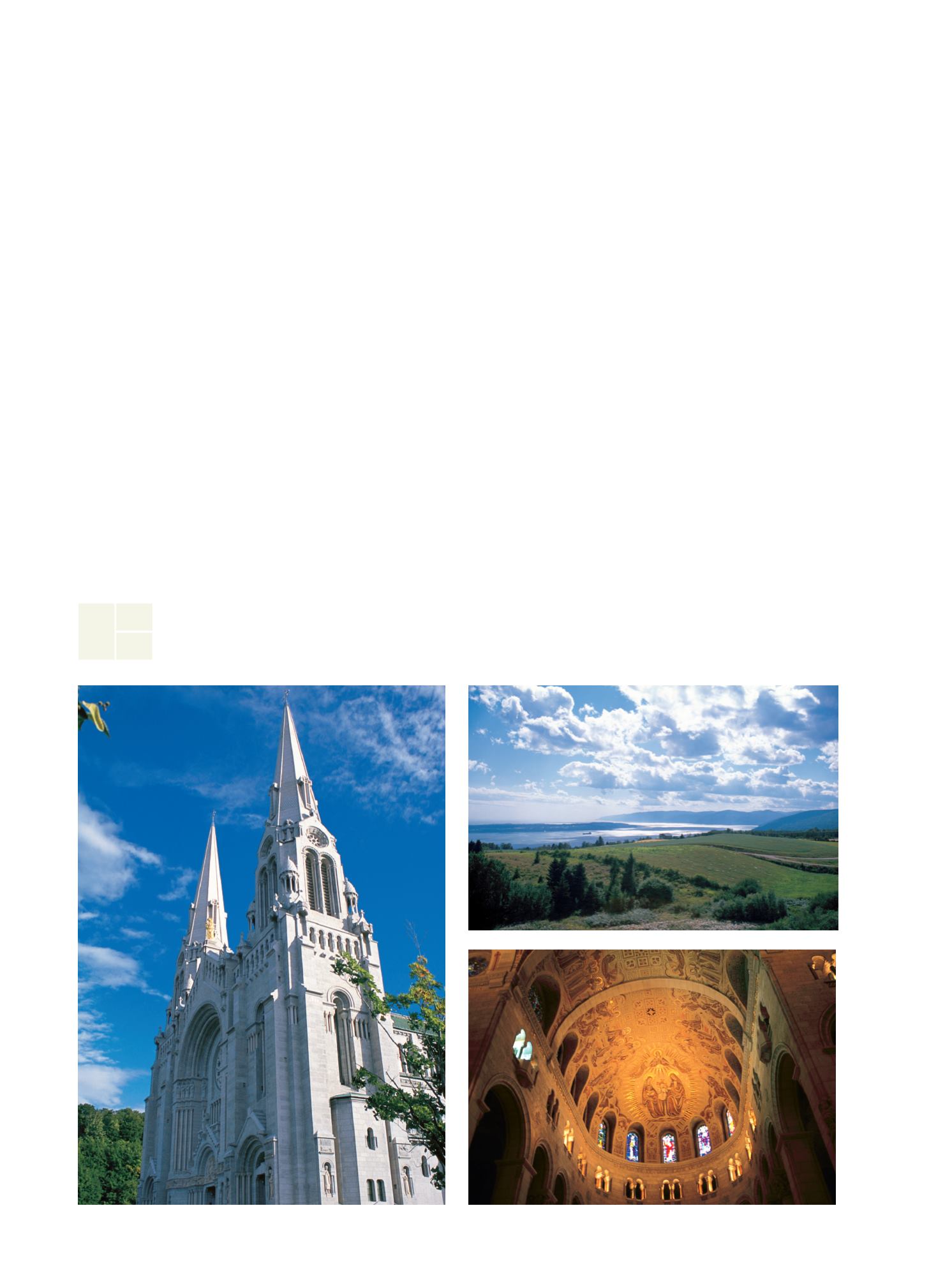
1. Sainte Anne de Beaupré, una de
las grandes iglesias a la orilla del
río Saint Laurent, con su interior
ricamente decorado.
Sainte Anne de Beaupré, one of
the large on the edge of River
Saint Laurent, with its richly
decorated interior.
2. La isla Aux Coudes, uno de los
lugares más encantadores del
gran río.
Aux Coudes Island, one of the
most charming places on the
great river.
2
1
1


