56
·amura·
and listen to the sounds of summer life or the
silence of winter nights, when the snow blankets
the area. It is an entertaining city overflowing
with bars, “boites a Chanson”, traditional French
restaurants, maple syrup, its Inuit museum and
historic sites that preserve the aroma of France.
In 1535 Jacques Cartier stopped in the town of
Stadacomé, which later became Quebec, located at
the foot of a great rock that he christened Cap
Diamant. Due to the boom in the fur trade, in 1608
Samuel de Champlain built homes and, little by lit-
tle, French merchants settled there, creating the
Ville Basse, a trade center, while theVilleHaute, built
on the rock, was where the religious institutions
where located. Disputed by France and England, the
Treaty of Paris of 1763 made Quebec formally
English though the inhabitants remained French.
From Québec to the Island of Orleans
The Island of Orleans (Ile d’Orleans) is located in front
of the city of Quebec and we reached it after a short
sail during which we enjoyed the beautiful view of
the city and the island, a real floating garden where
the apples compete in beauty with the towns
adornedwith flowers of the season. We docked at the
Saint Laurent de L’Île marina and toured the island
and its peaceful towns caressed by the rhythmof the
tides on bicycle. Here, “Il y a desmaisons où les chan-
sons aiment entrer”, (There are houses were songs
like to enter) sang Felix Leclerc and in the terrace of
the Auberge de Chaumonnot we enjoyed its charm
Chanson”, sus restaurantes de tradición francesa, su
miel de maple, su museo de la cultura inuit y sus luga-
res históricos que conservan el aroma de Francia.
En 1535 Jacques Cartier se detuvo en el pueblo
de Stadacomé, que luego se volverá Quebec, al pie
del peñón que bautizó Cap Diamant. Con el auge del
comercio de las pieles, finalmente en 1608 Samuel
de Champlain erigió unas casas y poco a poco los
comerciantes franceses se instalaron, creando la
Ville Basse, centro de comercio, mientras en la Ville
Haute, instalada sobre el peñón, estaban las institu-
ciones religiosas. Centro de disputa entre Francia e
Inglaterra, Quebec se volvió definitivamente inglesa
con el tratado de París en 1763, aunque la población
era francesa.
Desde Quebec hasta la Isla de Orleáns
La isla de Orleáns se encuentra enfrente de la ciudad
de Quebec y la alcanzamos con una corta navega-
ción, disfrutando de la hermosa vista sobre la ciudad
y la isla, un auténtico vergel flotante, donde los man-
zanos compiten en belleza con los pueblos decora-
dos con flores de temporada.
Atracamos en la marina de Saint Laurent de L’Île
para visitar en bicicleta la isla y sus apacibles pueblos
acariciados por el ritmo de las mareas. Aquí, “Il y a des
maisons où les chansons aiment entrer”, cantaba Felix
Leclerc (Hay casas en donde a las canciones les gustan
entrar) y en la terraza del Auberge de Chaumonot dis-
frutamos del hechizo con un Blanc-cassis, mientras
las gaviotas vigilan el pan a la antigua que sale con
compás int •
compass int
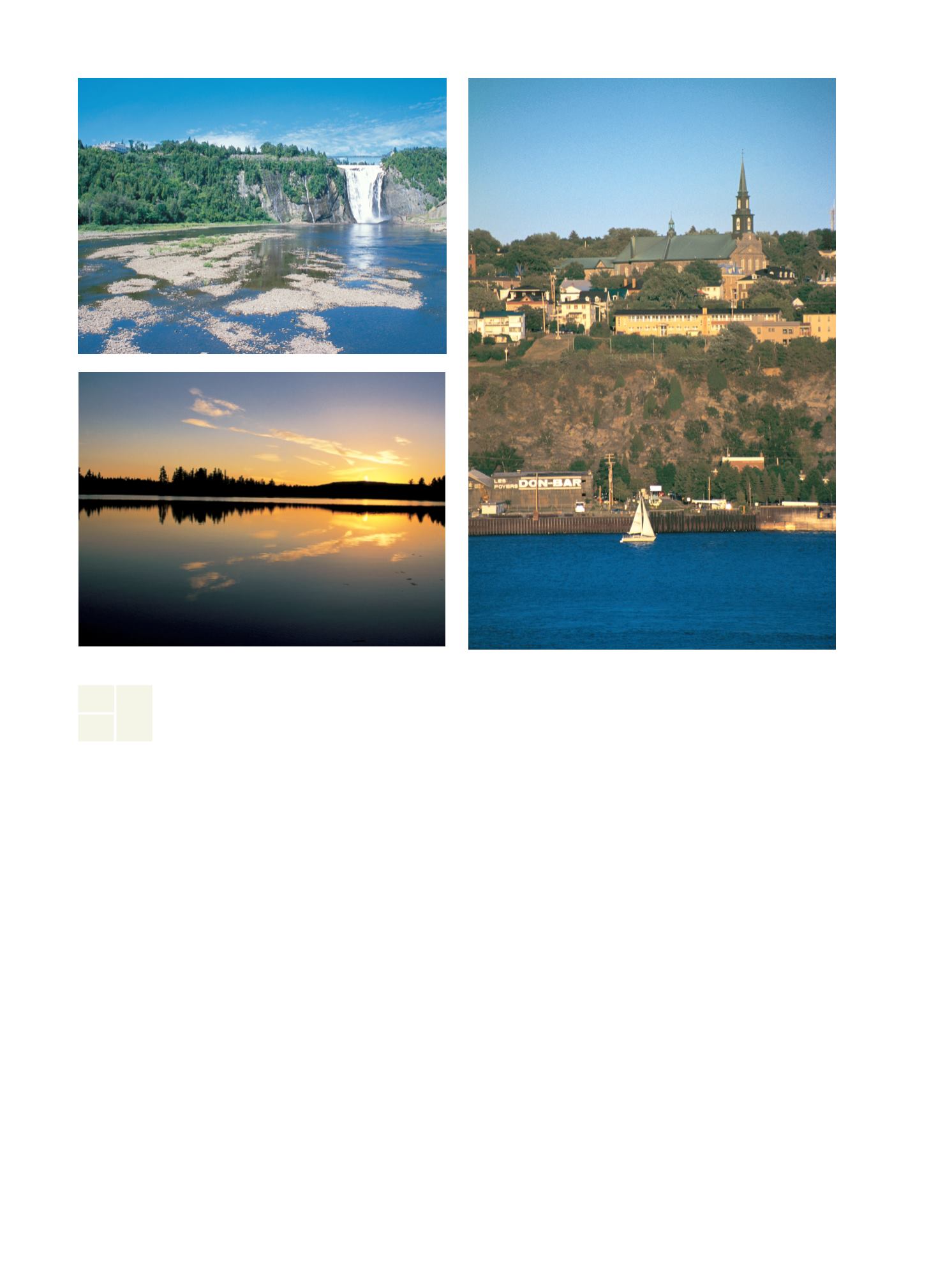
1. La cascada de Montmorency
cae con una impresionante
fuerza a la orilla del Saint Laurent.
The Montmorency waterfalls
descend with impressive force
at the edge of Saint Laurent.
2. Los atardeceres sobre los lagos
son una feria de colores en
Québec.
The sunsets above the lakes are
a festival of colors in Québec.
3. Lewis, enfrente de la ciudad de
Québec, donde el gran río ofrece
una navegación placentera
Lewis, opposite the city of
Québec, where the river offers
pleasant sailingy.
1
2
3


