compás int •
compass int
58
·amura·
with a Blanc-cassiswhile the seagulls keep a look out
for the traditional, fragrant bread that comes out of
the ovens of La boulange in Saint Jean. The past is
present in the ancient naval shipyards that built
goélettes
, boats that were used for trade, and in the
Chalouperie they still construct the small boats from
long ago.
From the Island of Orleans to Baie Saint Paul
To sail on the great river youmust consult a detailed
marine map and know the hours of the tides that
either help or hinder with their strong currents and
leave anchor spots high and dry. We have to follow
the navigation channels where the water is deep
enough and, with the tides, reach the port.
A short navigation, helped by the calm winds
encountered in the middle of the river, while a total
calmis foundon the banks, tookus toBaie Saint Paul,
a charming town with houses whose windows are
adorned with flowers and which is located at the end
of a bay that, at low tide, is emptied of its waters.
Hidden at the bottom of the valley of the Du Gouffre
River, which flows into the Saint Laurent, it was, in
1678, one of the first settlements of the region. It is
an extraordinary, romantic capsule where the
MocroBrasserie of Charlevoix, the producer of
Quebec’s finest beer, is found. It is also a town that
sings in the shade of its bell tower, a place where you
canvisit thegalleriesontheSaint Chapelle street and
the Economusée du fromage to sample the cheese.
From Baie Saint Paul to La Malbaie
Playing with the tides and the wind, we neared the
l’Île au Coudre, a striking island of beautiful mead-
exquisito olor de los hornos de La boulange en Saint
Jean. El pasado se encuentra en los antiguos talleres
navales que construían las
goélettes
, barcos que se
usaban para el comercio y en la Chalouperie todavía se
hacen las pequeñas barcas de antaño.
Desde la Isla de Orleáns hasta Baie Saint Paul
Para navegar en el gran río es necesario consultar un
detallado mapa marítimo y conocer los horarios de
las mareas que ayudan o estorban con su fuerte
corriente y dejan los puntos de anclaje sin agua.
Tenemos que seguir los canales de navegación donde
el agua tiene suficiente profundidad y llegar a puer-
to con las mareas.
Una corta navegación, ayudada por los tranquilos
vientos encontrados en medio del río, mientras una
calma total habita las orillas, nos llevó hasta Baie Saint
Paul, un encantador pueblo adornado de flores en sus
ventanas, en el fondo de una bahía que se vacía de sus
aguas a marea baja. Escondido en el fondo del valle del
río Du Gouffre, que desemboca en el Saint Laurent, fue
uno de los primeros asentamientos de la región en
1678, extraña cápsula romántica donde se fabrican las
mejores cervezas de Quebec en la MicroBrasserie de
Charlevoix. Es un pueblo que canta a la sombra de su
campanario, donde se visitan las galerías de la calle
Saint Jean Baptiste o el Economusée du fromage para
probar los quesos.
Desde Baie Saint Paul hasta La Malbaie
Jugando con las mareas y el viento, nos acercamos a
l’Île au Coudre, una bella isla que recorrimos en bici-
cleta en medio de hermosas praderas, con sus capi-
llas, sus molinos de agua y de viento, recordando que
1. El puerto de la ciudad de Québec
donde nos encontramos con el
Queen Mary II, el trasatlántico
más grande. Visto desde la
colina de la ciudad.
The port of the city of Québec,
where we found the Queen
Mary II, the largest transatlantic
liner. Seen from the city’s hill.
2. La marea descubre las piedras
del Saint Laurent en la isla de
Orleáns.
The tide reveals the stones of
Saint Laurent on the island of
Orleáns.
3. Cada pueblo de la Isla de Orleáns
se adorna con una elegante iglesia.
Each town on the Island of
Orleáns is adorned with an
elegant church.
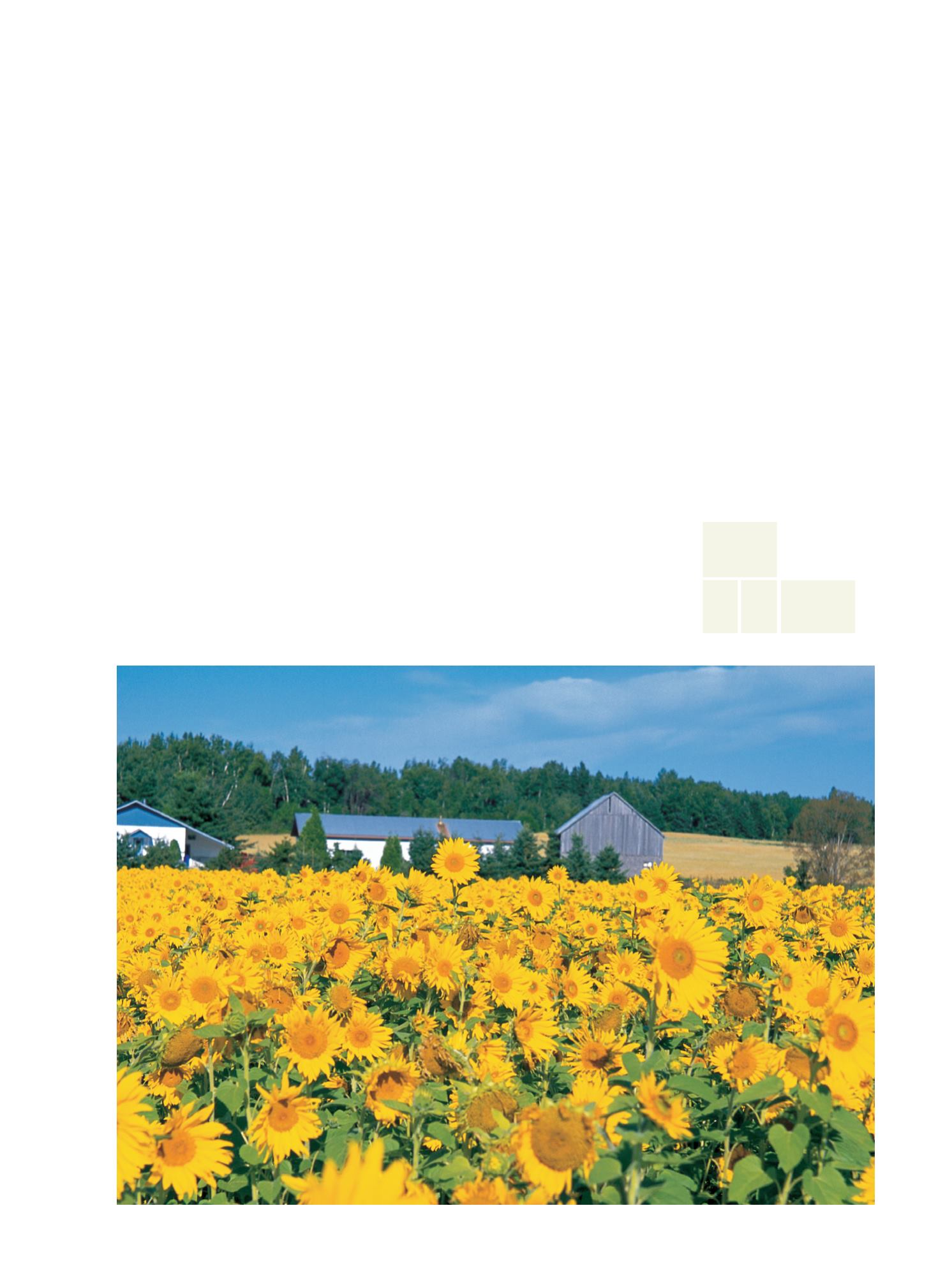
4. Campos de girasoles en las
cercanías del lago Saint Jean,
una feria de colores.
Fields of sunflowers close to
Saint Jean lake, a festival of color.
1
3
4
2


