·amura·
52
los conquistadores •
the conquerors
Today it is impossible not to link, the cave
painting to contemporary art, for example, even
if it is an incredible exercise, so close to one an-
other, first because all art lives in the present,
and second, because thanks to the new technolo-
gies and the contemporary way of presentation
of today’s museums, it appears that the objects
have not gone centuries.
It would seem that the mission of the Sou-
maya Museum is to give mankind the time and
dedication that each work has throughout its his-
tory, to preserve it and share it for all those who
wish to do so may enjoy it. Give yourself the time
to know it and to live it; it gives us the opportu-
nity to open communication channels that allow
us to go directly to the oeuvre itself, without the
constricting frames. A work of art is then a per-
fect psychoanalyst that lets individuals explore
their own transcendence, plus the direct contact
with art encourages us to become more sensitive
and therefore more aware of the needs of others,
more tolerant and respectful of the diversity that
characterizes our civilization.
Hence the importance of a legacy of the size
of the Soumaya Museum.
A legacy leaves us the commitment to be the
future of society, a future with a great past, for
which we are and will always be in debt. In the
words by Umberto Eco, it is not about “being the
contemporary of its own success, but throwing
that bottle into the sea waiting for someone,
undefined and indefinable, able of ever finding
the beauty that the man from the past found in
words or images”.
That is perhaps the greatest legacy that this
museumcould leave us: cast that bottle into the sea
and hope that those of us who have found it, seize
it and pass it on.
“We have to find the way to make that all
fundamental and desirable things, be univer-
sally accessible.”
Carlos SlimHelu
otras maneras de vivir la existencia. Nos hace reflexionar
sobre nuestro origen, nuestras raíces y el rumbo que le
daremos a las nuevas civilizaciones.
Es imposible hoy endía no ligar, por ejemplo, la pintu-
ra rupestre con el arte actual, aunque resulte un ejercicio
increíble, están tan cercanos unodel otro, primeroporque
todo arte vive en el presente, y segundo porque gracias a
las nuevas tecnologías y a la manera de la presentación
contemporáneade losmuseos actuales, parecequeentre
los objetos no han transcurrido siglos de historia.
Pareciera que la misión del Museo Soumaya es la de
darle a la humanidad el tiempo y la dedicación que tiene
cada obra a lo largo de su historia, conservarla y compar-
tirla, para que todos los que lo deseen la puedan disfru-
tar. Hay que darse el tiempo de conocerlo y de vivirlo;
nos da la oportunidad de abrir canales de comunicación
que nos permiten llegar directamente a la obra misma,
sin marcos que la constriñan. Una obra de arte es en-
tonces como un perfecto psicoanalista, que le permite
al individuo explorar su propia trascendencia; además
el contacto directo con el arte nos impulsa a volvernos
más sensibles y por lo tanto, más conscientes de las ne-
cesidades de otros, más tolerantes y respetuosos de la
pluralidad que caracteriza a nuestra civilización.
De ahí la importancia de un legado del tamaño del
Museo Soumaya.
Un legado nos deja el compromiso de ser el futuro de
la sociedad; un futuro con un enorme pasado, respecto al
cual estamos y estaremos siempre en deuda. En palabras
de Umberto Eco, no se trata “de ser el contemporáneo de
su propio éxito, sino de lanzar esa botella al mar espe-
rando que alguien, indefinido e indefinible, sea capaz de
encontrar algún día la belleza que el hombre del pasado
encontró en las palabras o en las imágenes”.
Ése es quizá el mayor legado que pudo dejarnos
este museo: echar esa botella al mar y esperar que
quienes la hemos encontrado, la aprovechemos y la
transmitamos.
“Tenemos que encontrar la manera de hacer que
todas las cosas fundamentales y deseables, sean uni-
versalmente accesibles.”
Ing. Carlos Slim Helú
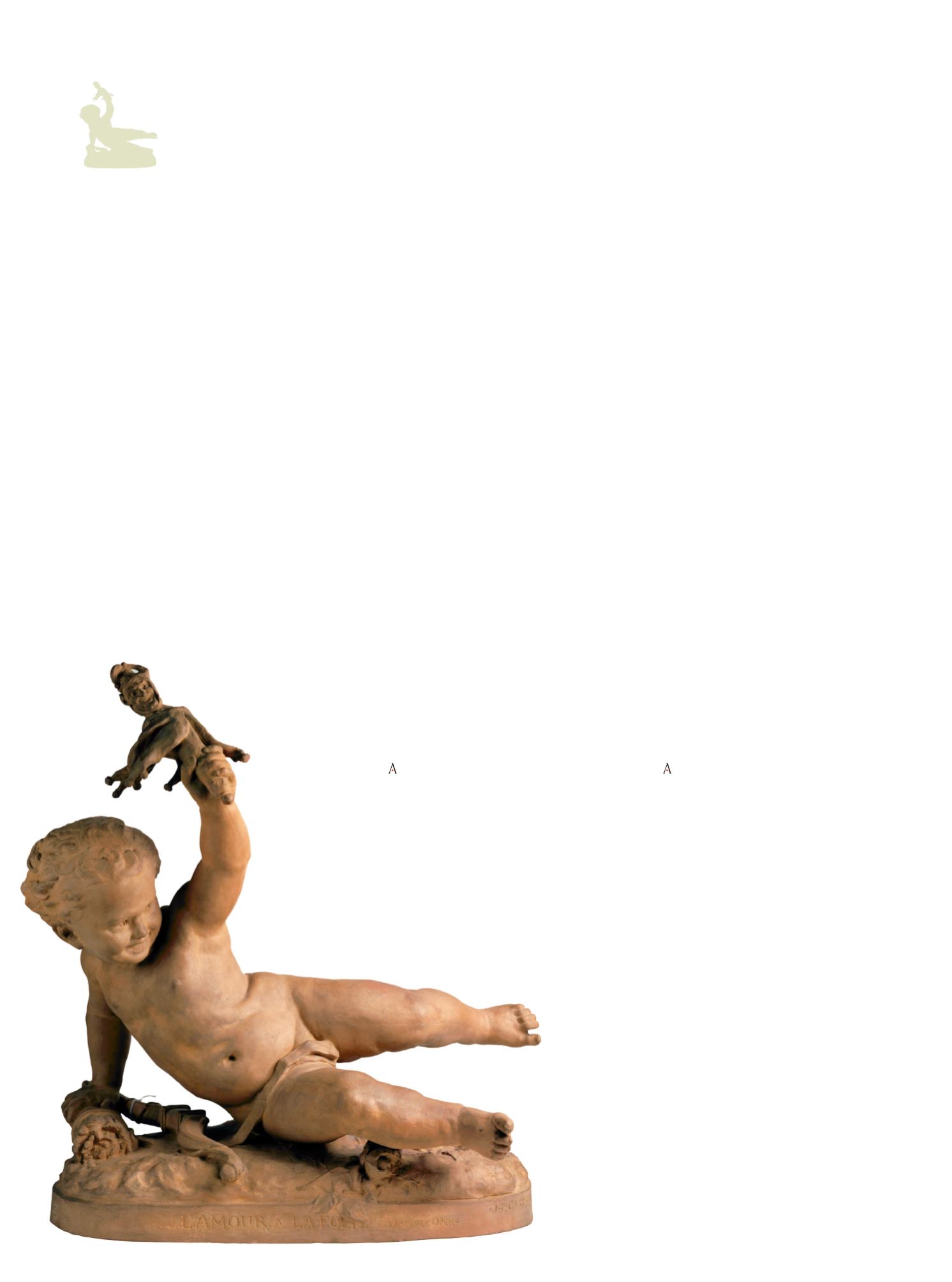
Ésta es una de las primeras maquetas para la fachada de la Ópera de París; aparece aquí Eros,
este niño cuya mirada es francamente maliciosa. El amor que agita el corazón de los hombres,
lo mueve y lo trastoca, el amor que se escapa; una alegoría del poeta inspirado, en la locura.
This is one of the first models for the facade of the Paris Opera, here is Eros, the child whose
eyes are downright malicious. The love that agitates the heart of men, moves and upsets it,
the love that escapes, an allegory of the inspired poet, of madness.
1. Jean-Baptiste
Carpeaux
(Valenciennes,
Francia, 1827–
Courbevoie,
Francia, 1875)
El Amor hasta la
locura
1869
Terracota
70 x 67 x 44 cm
Colección Museo
Soumaya.Funda-
ción Carlos Slim,
A.C. / Ciudad de
México
1


