32
·amura·
I
n the middle of the Pacific there are several archi-
pelagos that form French Polynesia, a number of
islands surrounded by lagoons that explode in
different tones of blue, ring-like atolls that shelter a
world painted in turquoise and black volcanic islands
enveloped by a deep blue sea.
The reefs of this southern paradise shelter a mar-
velous underwater universe inhabited by an immense
variety of multicolored fish and the land is covered in
tropical vegetation and flowers that fill the air with
their exotic perfumes.
Tahiti, in the Archipiélago de la Société (Society
Islands), is where Papeete, the capital, is located. It is
the largest of the 118 islands and atolls that make up
French Polynesia. The islands are of volcanic origin
and, while some are still mountains surrounded by
coral reefs, a few are mere rings of reef and others
never formed at all.
The Polynesian Triangle
In 4000 B.C. there was a great migration from
Southeast Asia to colonize the islands of the Pacific
and it is believed that they reached the Marquesas
archipelago in 200 B.C. From there, they spread to the
other archipelagos.
In the so-called “Polynesian triangle”, limited by
Hawaii to the north, Easter Island to the southeast
and New Zealand to the southwest, people have a
common origin and speak Maohi.
E
n medio del Pacífico surgen varios archipiélagos que
componen la Polinesia francesa, unas islas rodeadas
de lagunas cuyos colores estallan en diferentes to-
nos de azules, unos atolones que parecen anillos y los cua-
les encierran un mundo pintado de turquesa, unas islas
volcánicas negras envueltas en un mar azul profundo.
Paraíso del sur donde sus arrecifes albergan un ma-
ravilloso universo submarino habitado por una inmensa
variedad de peces de colores, y las tierras se cubren de
vegetación tropical con flores que impregnan el aire con
sus perfumes exóticos.
Tahití es la más grande de las 118 islas y atolones
que componen la Polinesia francesa, donde se sitúa Pa-
peete, la capital, en el Archipiélago de la Société (Socie-
dad). Las islas son de origen volcánico, en algunas
subsiste la montaña rodeada por el arrecife de coral, en
otras queda solamente el anillo del arrecife y hay otras
en las que nunca se ha formado.
El Triángulo polinesio
En 4000 a. C. empezó una gran migración desde el sures-
te asiático para colonizar las islas del Pacífico, y se dice
que llegaron a las Marquesas en el 200 a. C. Desde allí se
distribuyeron por los otros archipiélagos. En el llamado
“Triángulo polinesio”, delimitado por Hawai al norte, la Is-
la de Pascua en el sureste y Nueva Zelanda en el suroes-
te, la gente tiene un origen común y hablan en maohi.
Los primeros europeos llegaron con Magallanes,
que descubrió los Tuamotu en 1521 y en 1595 el
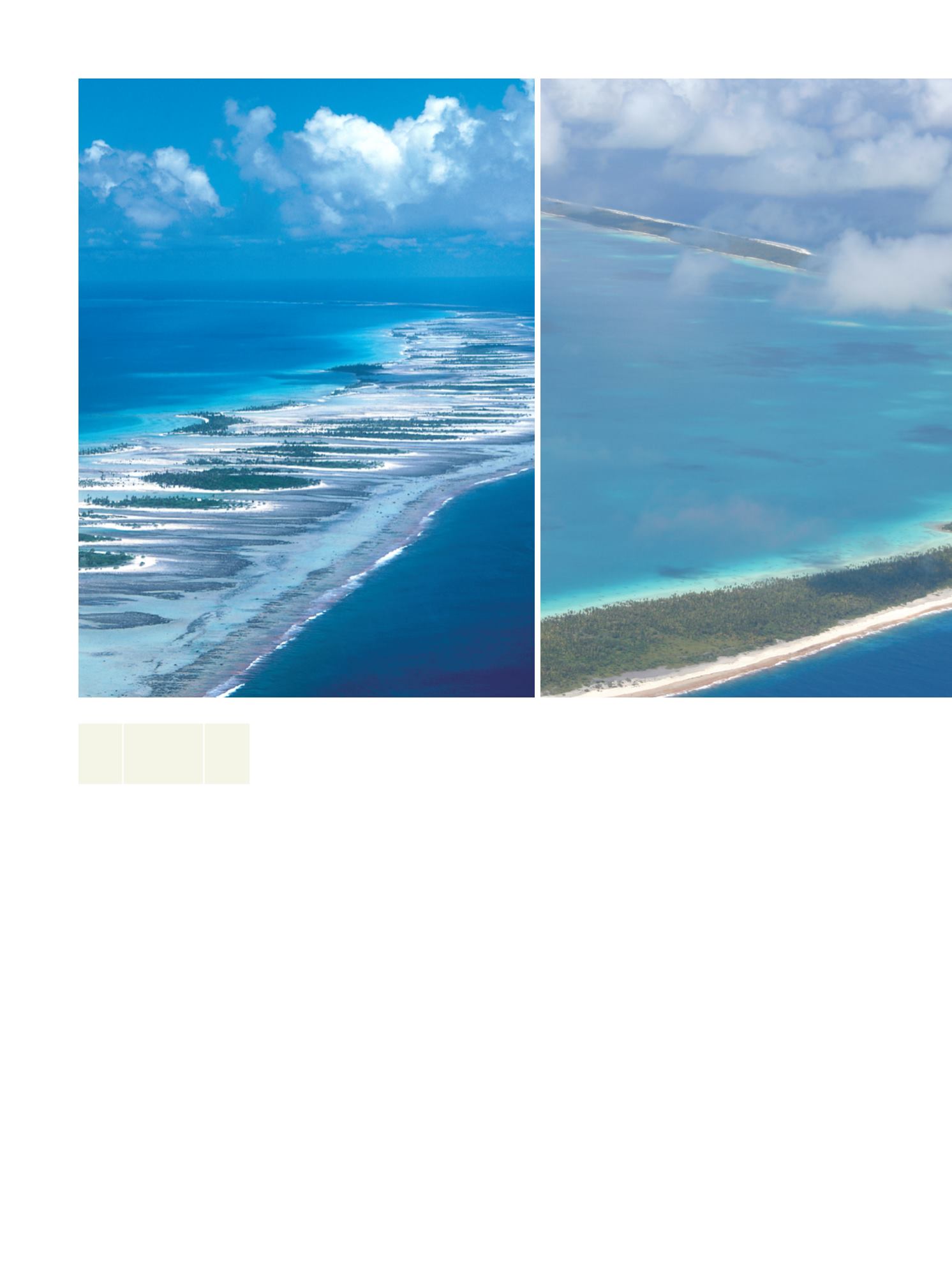
La Isla de Rangiroa es un festival de colores
que estallan sobre la arena blanca y el coral
que forman el atolón
Rangiroa Island is a festival of colors that
burst over the white sand and coral that
form the atoll
compás int •
compass int


