·amura·
122
tips & tops
Texto/
Text
: AMURA • Foto /
Photo
: ilopdie / DAVID GL
Tips & Tops
• Tiibet’s official currency is the Yuan. A Yuan
equals $ 0.20 U.S. and 0153 Euros. In Lhasa. It’s
easy to exchange Euros or dollars into Chinese
currency. Local ATMs may get Chinese money,
and cards are only accepted in some parts of
Lhasa.
• The capital, Lhasa, is the highest in the world. It
is recommended not to exert your efforts in the
first days of your stay. In case of persistent dis-
comfort, you should see a doctor. At this altitude,
the sun also deserves attention. Protection is rec-
ommended. Use sunscreen and sunglasses to fil-
ter ultraviolet rays as well as a hat or cap.
• The climate is semi-arid in most areas. Rain is
more frequent in the southeast, but the drylands
are dominant. The average rainfall is 380 mm
per year. In the highlands and mountains the
temperature is cold and blizzards are frequent
throughout the year. The temperature can drop
significantly at sunset.
• Shops are open daily from 9am to 7pm, and some
until 10pm. Banks are closed on Saturdays and
Sundays. Holidays are, the New Year which lasts
for two days. The NewYear Tibetan lunar calendar
which dates vary based on the lunar cycles and
the Chinese calendar. Labor Day is May 1st. and
the National Day is the 1st of October.
Tips
• La moneda oficial del Tíbet es el Yuan. Un Yuan equi-
vale a 0.20 dólares americanos y a 0.153 Euros. Dentro
de Lhasa no hay dificultad alguna para cambiar Euros o
dólares por moneda china. En los cajeros automáticos
locales es posible obtener dinero chino, y las tarjetas
sólo son aceptadas en algunos lugares de Lhasa.
• La capital, Lhasa, es la más elevada del mundo. Se re-
comienda no hacer esfuerzos durante los primeros
días de estadía. En caso de malestar persistente, se
debe acudir al médico. A esta altura también merece
atención el sol. Se recomienda la protección de crema
y lentes oscuros para filtrar los rayos ultravioleta, así
como de sombrero o gorra.
• El clima es semiárido en la mayor parte del territorio.
Las lluvias son más frecuentes en el sureste, pero do-
minan las zonas secas. El promedio de precipitación
es de 380 mm al año. En las mesetas y las montañas
la temperatura es fría y las ventiscas son frecuentes
durante todo el año. La temperatura suele descender
significativamente al ponerse el sol.
• Los comercios abren diario de 9am a 7pm, y algunos
hasta las 10pm. Los bancos cierran sábados y domin-
gos. Son fechas festivas el Año Nuevo, durante dos
días; el Año Nuevo del calendario lunar tibetano, con
fecha variable con base en los ciclos lunares y el calen-
dario chino; el Día del Trabajo, 1o de mayo; y la Fiesta
Nacional, el 1o de octubre.
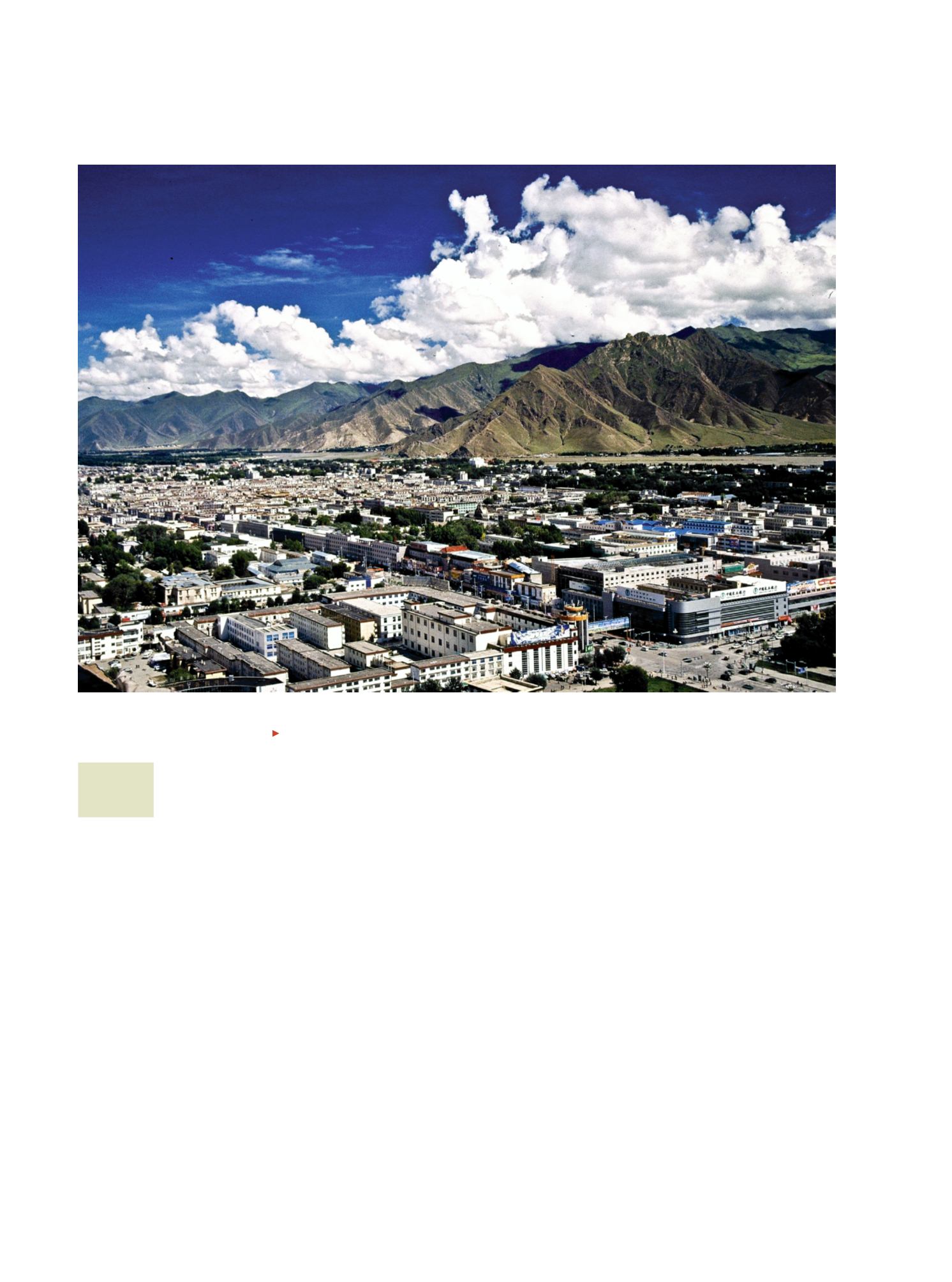
1.PanorámicadeLha-
sa,capitaldelTíbet.
Elaireesmástrans-
parenten lasalturas.
/ Panoramic view of
Lhasa, capital city
of Tibet. Air is more
clear at heights.
1


