117
·amura·
Kokoschka. A la vuelta del siglo, Viena, fue una de
las capitales culturales europeas más importan-
tes, la creciente clase media aspiraba a liberarse
del pasado y a explorar nuevas formas de expre-
sión en la arquitectura, las artes, la literatura y la
música. La Secesión vienesa, fundada y liderada
por Gustav Klimt en 1897, fue un grupo progresivo
de artistas cuyo trabajo abarcaba indistintamente
los aspectos arquitectónicos, artísticos y artesa-
nales. El espíritu de la época, se veía animado por
la búsqueda de un arte total que cortara los lazos
con el pasado y estableciera el modernismo en
Austria. Esta joven generación -que adoptó el esti-
lo internacional
art nouveau
- perseguía el renaci-
miento de las artes aplicadas convocando a un
grupo de arquitectos, artistas, diseñadores, arte-
sanos, grabadores; algunos Naturalistas otros
Simbolistas. Joseph Maria Olbrich, diseñó el icóni-
co edificio que ocupaba la Secesión como lugar
permanente para sus exposiciones. A propósito de
una exposición dedicada a Ludwig Van Beethoven,
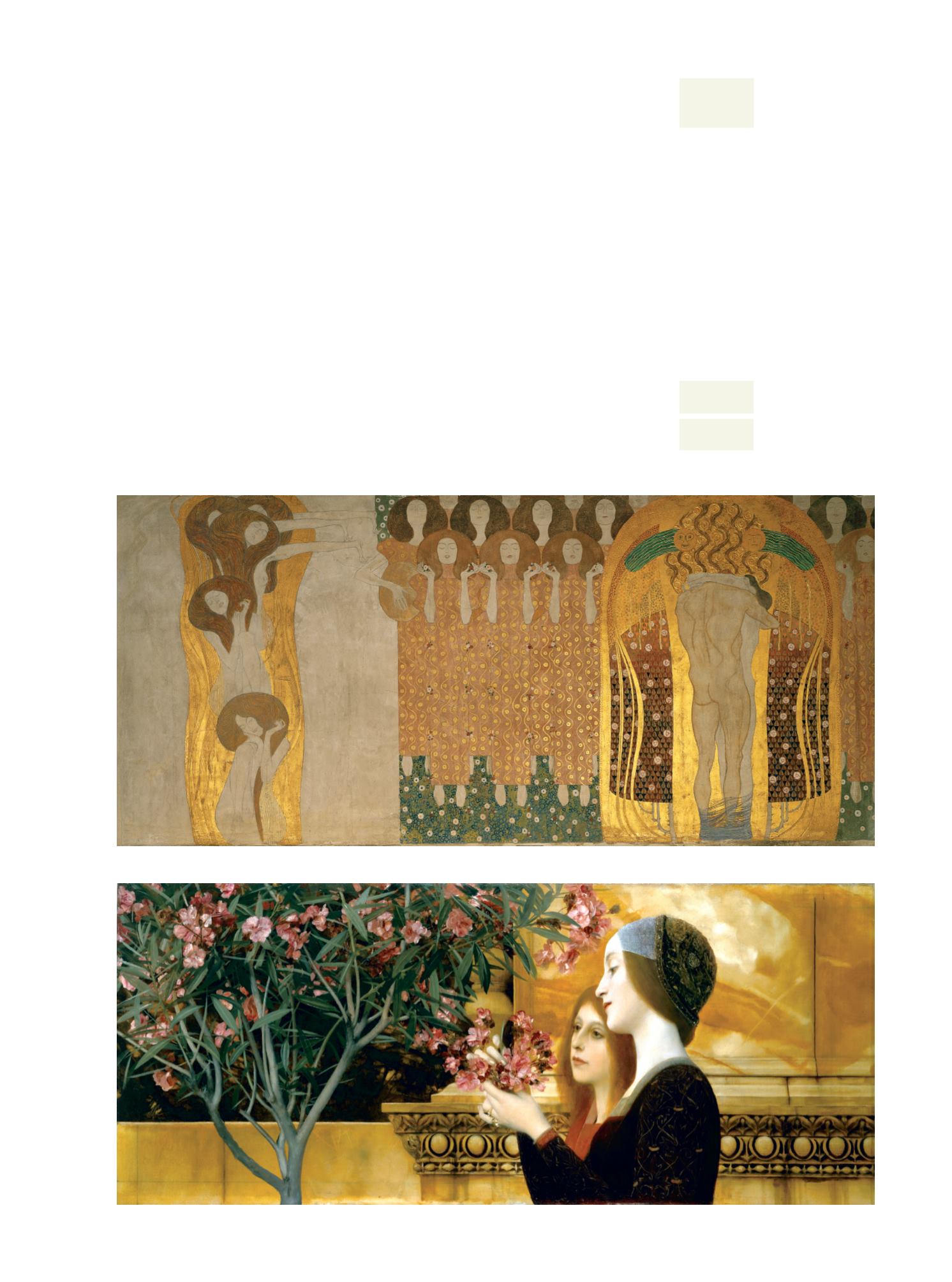
Gustav Klimt pinta el
Friso de Beethoven
en 1902.
Una copia en tamaño original se presenta en la
and of course, the art of Egon Shiele and Oskar
Kokoschka. Around the century, Vienna,wasoneof
themost important European cultural capitals, the
increasing middle class aspired to get rid of the
past and to explore new ways of expression in the
architecture, the arts, the literature and the music.
The Viennese Secession, founded and leaded by
Gustav Klimt in 1897, was a progressive group of
artists whose work covered indistinctly the archi-
tectural, artistic and craftwork aspects. The spirit
of the time seemed motivated by the search of a
total art which cut off the ties with the past and
establish the modernism in Austria. This young
generation -that adopted the international style
art nouveau
- pursued the revival of the arts
applied calling a group of architects, artists, desig-
ners, craftsmen, engravers; some Naturalists other
Symbolists. JosephMaria Olbrich designed the ico-
nic building that occupied the Secession as a per-
manent place for their exhibits. On purpose of an
exhibition dedicated a Ludwig Van Beethoven,
GustavKlimt paints the
Friskof Beethoven
in1902.
A copy in original size is presented in the exhibi-
1.
The Beethoven Frieze
(detalle /
detail
)
1901-2 (copia /
copy
1984)
Belvedere, Vienna
2.
Two Girls with an Oleander
c.1890-2
Wadsworth AtheneumMuseumof Art,
Hartford, CT. The Douglas Tracy Smith and
Dorothy Potter Smith Fund and The Ella
Gallup Sumner and Mary Catlin Sumner
Collection Fund.
The Beethoven Frieze (detalle /
detail
)
1901-2 (copia /
copy
1984)
Belvedere, Vienna
los conquistadores •
the conquerors
1
2


